Bee Symbolism Myth Meaning & Symbolism
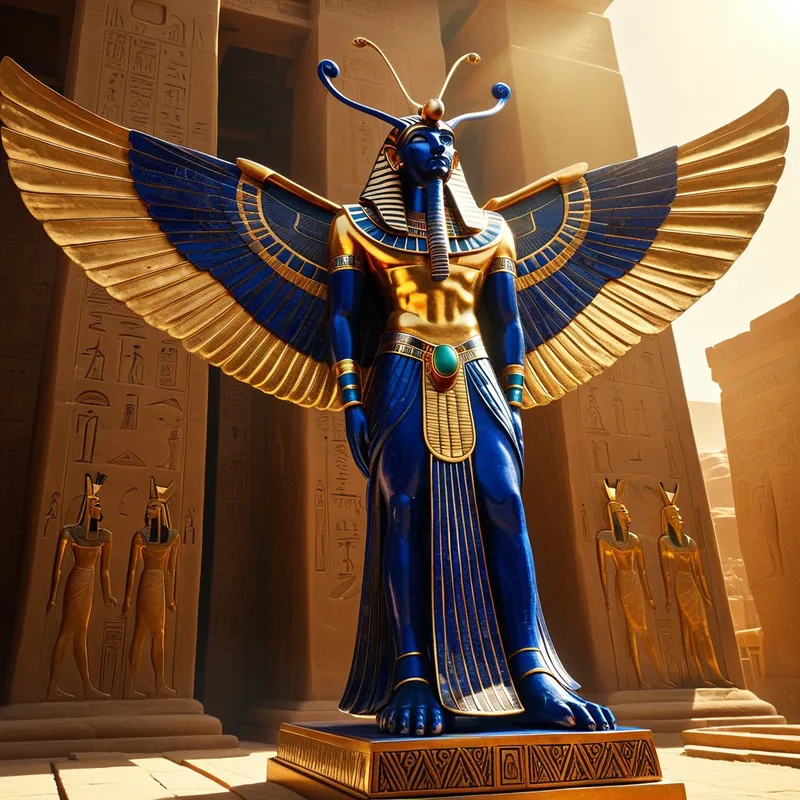
The bee, born from the tears of the sun god Ra, becomes the sacred emblem of the pharaoh, symbolizing the sweet order forged from divine chaos.
The Tale of Bee Symbolism
In the time before time, when the world was a dark, formless ocean of Nun, the first light was a cry of pain. The great sun, Ra, had labored to bring forth the cosmos from his own being. He spoke the words of creation, and the first land, the Benben stone, rose from the waters. He fashioned gods and goddesses, the sky and the earth. But in that moment of supreme effort, as he surveyed the raw, teeming potential of his new world, a profound weariness seized him. It was not the fatigue of the body, but of the soul—a loneliness at the pinnacle of existence.
From his solitary eye, a single tear gathered. It was not a tear of sorrow, but of overwhelming creative tension, the pressure of holding all possibility within one being. This tear, heavy with the essence of life and light, detached and fell. It did not fall into the waters of Nun, but hung in the air between the sun and the newborn earth, a perfect, glistening sphere of liquid gold.
And then, it broke.
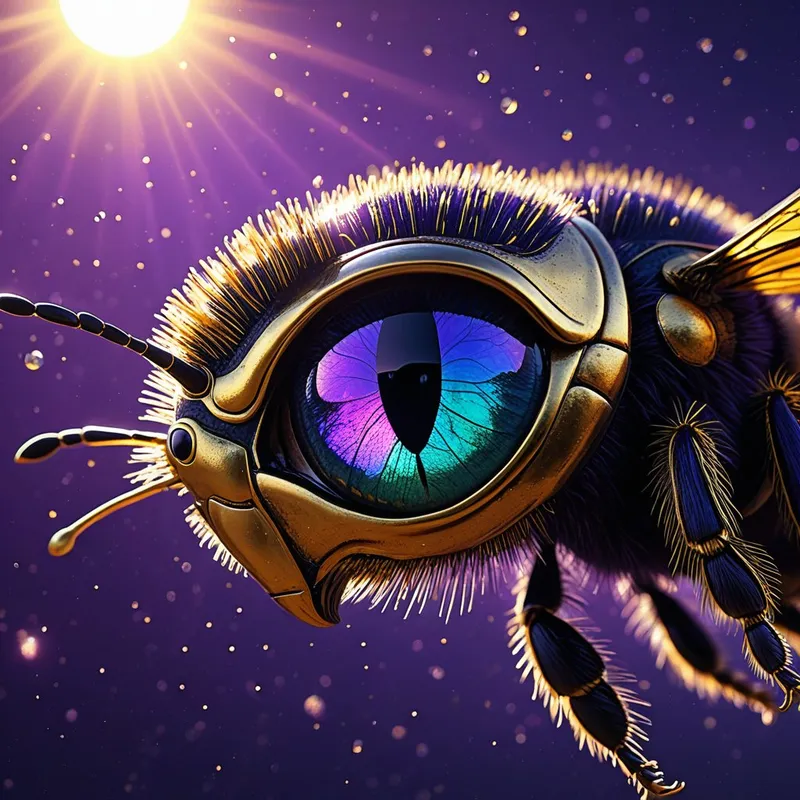
Not with a splash, but with a hum—a low, resonant vibration that was the first music of the ordered world. From the shattered droplet emerged a cloud of living light: creatures of gleaming gold and obsidian, their wings thin sheets of beaten sunlight, their bodies armored and precise. They were the bees. They did not fly aimlessly, but with immediate, fierce purpose. Their humming was a song of industry, a divine algorithm. They descended upon the wild, untamed flowers that had sprung from Ra’s earlier words, and they began their work.
They gathered the scattered essence of life, the chaotic sweetness, and in the hidden darkness of their hive—a structure of perfect, hexagonal geometry—they transformed it. They forged the first honey: solid, stable, golden, and sweet. It was the first act of alchemy, turning the fleeting nectar of wild creation into a lasting, nourishing substance. Ra saw this, and his weariness lifted. His tear, his moment of divine vulnerability, had not been a sign of weakness, but the seed of a new principle: the principle of sacred, organized industry. He saw in the bee a perfect servant and a perfect symbol. He decreed that henceforth, the bee would be the emblem of the Pharaoh. For the Pharaoh’s duty was the same: to gather the scattered people, the chaotic forces of the Two Lands, and through the divine law of Maat, transform them into a stable, enduring, and prosperous kingdom—a hive of civilization in the wilderness of the world.
Cultural Origins & Context
The sacred status of the bee in ancient Egypt is not rooted in a single, canonical narrative like the Osiris cycle, but is woven into the very fabric of their cosmology and kingship. The earliest and most potent reference comes from the royal titulary. One of the pharaoh’s titles was nswt-bjt, literally “He of the Sedge and the Bee.” The sedge plant represented Upper Egypt, and the bee represented Lower Egypt. Thus, the bee was not merely an insect; it was a foundational geopolitical symbol of the unified nation itself.
This symbolism is archaeologically ancient. A gold pectoral from the tomb of the Middle Kingdom pharaoh Senusret I bears a beautiful cloisonné bee. In temple reliefs and texts, bees are associated with Ra and with Neith, the warrior-creator goddess of Sais, who was sometimes called “the honey-maker.” The bee’s mythic origin story as the tears of Ra is recorded in later periods, synthesizing these older strands of thought. It was likely part of the esoteric knowledge preserved and transmitted by the priesthood, used to explain and sanctify the nature of pharaonic rule. The myth served a vital societal function: it provided a divine, natural model for the centralization of power, the organization of labor, and the transformation of natural bounty (the Nile’s fertility) into cultural wealth (granaries, monuments, a stable society). It told the people that their king’s authority was as natural, industrious, and sweetly productive as the bee’s.
Symbolic Architecture
The bee is a symbol of profound paradox, embodying a union of opposites that lies at the heart of creation and governance.
The bee is born from a moment of divine fragmentation—a tear—to become the ultimate architect of cohesion. Its work begins in chaos and ends in golden, geometric order.
Psychologically, the bee represents the organizing principle of consciousness. The tear of Ra is the raw, overwhelming emotion or creative impulse that feels like a breakdown. The bee is the psychic function that arrives to gather these disparate, potent feelings and thoughts, and through diligent, often unconscious work (the hive is hidden), transforms them into something structured, nourishing, and preservable—honey, or in the human mind, insight, art, or a coherent sense of self.
The hive symbolizes the complex, autonomous psyche. Its perfect hexagons speak to innate, natural laws of efficiency and community. The Pharaoh, as the “Bee King,” is thus not a tyrant, but the conscious ego that identifies with and serves this greater psychic order (Maat). The sting represents the necessary, defensive aggression required to protect this hard-won order from dissolution back into chaos. It is the power of boundaries, of saying “no” to what would destroy the hive.
The Dreamer’s Resonance
When the bee enters the modern dreamscape, it signals a profound somatic and psychological process: the call to constructive organization from within emotional flux. It is not a call to mere busywork, but to sacred industry.
Dreaming of a single, persistent bee may indicate a specific, potent insight or creative impulse (“the tear”) trying to get your attention, buzzing at the window of your consciousness. A swarm can feel overwhelming, representing anxiety, buzzing thoughts, or a feeling that one’s emotional life is chaotic and out of control. Yet, the swarm in myth is not destructive; it is generative. This dream asks: What raw, sweet potential is swirling within you that needs to be gathered?
Dreaming of a hive, especially if one is inside it, points directly to the dreamer’s inner world. Is the hive thriving, full of golden light and hum? Or is it dark, abandoned, or under attack? This is a snapshot of the psyche’s current capacity for self-organization. The somatic sensation of the hum is key—it is a vibration felt in the bones, a sign of a deep, resonant process at work below the level of everyday thought. To dream of making or tasting honey is a powerful sign of psychic integration succeeding; the dreamer is beginning to enjoy the nourishing, sweet results of their inner work.
Alchemical Translation
The myth of the bee models the alchemical process of individuation—the journey toward psychic wholeness—with stunning clarity. The prima materia, the base substance, is the tear of Ra: our own moments of overwhelming emotion, vulnerability, or creative desperation. This is the nigredo, the blackening, the chaotic starting point.
The alchemical work is not to dismiss the tear, but to honor it as the divine seed. The bee is the Mercurial spirit, the active agent of transformation that we must ally with within ourselves.
The bee’s gathering of nectar is the albedo, the whitening, the careful collection and observation of our disparate experiences, memories, and talents. The flight from flower to flower is the conscious effort to connect and integrate different parts of our life. The return to the hive—the hidden, unconscious process—is where the true transmutation occurs. In the darkness of the hive (the unconscious), through patient, instinctual work, the nectar of experience is broken down and reconstituted.
The final production of honey is the rubedo, the reddening, the creation of the Philosopher’s Stone. In psychological terms, this is the achieved golden mean, the stable, enduring, and nourishing core of the personality. It is the wisdom (Maat) we distill from a lifetime of experience. It is sweet, it preserves, and it heals. For the modern individual, the bee myth teaches that our moments of greatest vulnerability are not failures, but the very source of our most potent creative and organizing energy. Our task is to become both the tearful sun and the diligent bee—to allow the feeling, and then to engage in the sacred, structuring work of making a soul from it. We are called to build our hive, to become the sovereign ruler of our own inner kingdom, transforming the chaos of being into a life of resonant, golden order.
Associated Symbols
Explore related symbols from the CaleaDream lexicon: