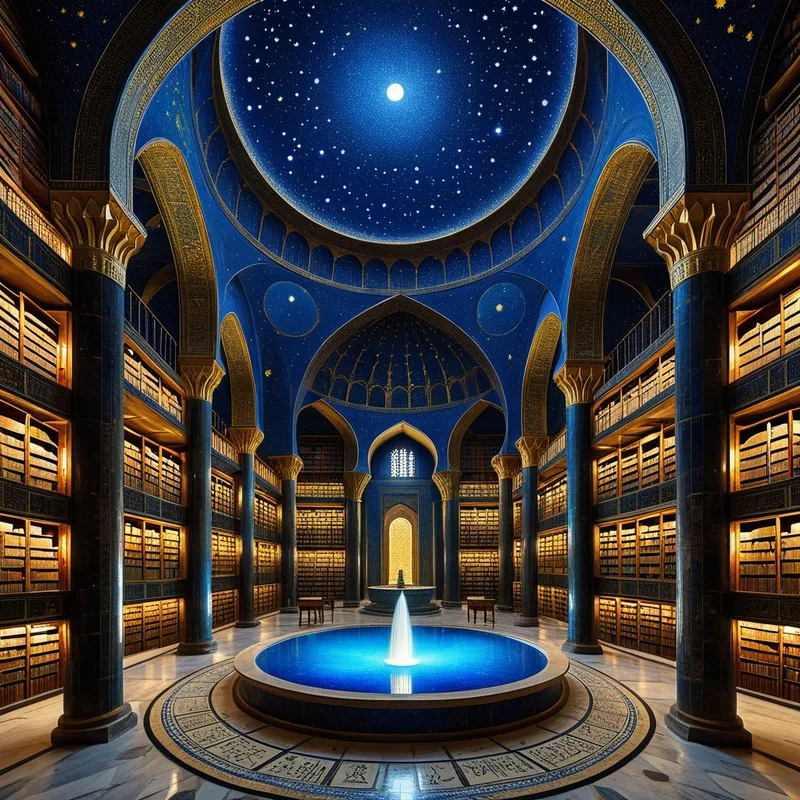
Bayt al-Hikma Myth Meaning & Symbolism
A mythic vision of a luminous library where all knowledge converges, guarded by celestial intellects, calling the seeker to a profound inner synthesis.
The Tale of Bayt al-Hikma
Listen, and let the veils of time grow thin. There is a tale whispered not in the wind, but in the turning of pages and the quiet hum of a mind at the edge of understanding. It speaks of a place that is not merely a place, but a state of being—Bayt al-Hikma.
In the heart of the City of Peace, under a dome that seemed to capture the very vault of heaven, it stood. Its doors were not of common wood, but of intention, carved with the arabesques of possibility. To enter, one did not simply walk; one had to shed the dust of the road, the noise of certainty, the armor of a singular truth. The air inside was cool and carried the scent of aged paper, ink, and something else—the ozone scent of a thought just born.
Its guardians were not soldiers with blades, but al-hukama with eyes that held the patience of stars. They moved through the canyon-like aisles, their robes whispering against floors of polished stone that reflected the light from a thousand lamps. These lamps did not burn oil, but the concentrated attention of centuries. Here, a man from al-Rum argued geometry with a scholar from Faris, their voices weaving a new proof in the air. There, a physician from al-Hind traced the lines of a body on a parchment, while another deciphered the motions of the planets from a zij.
The great conflict here was not of clashing armies, but of clashing worlds—the world of al-din and the world of al-aql. The rising action was the silent, heroic labor of translation: the careful, reverent movement of wisdom from the tongue of Aflatun to the tongue of the Qur'an, from the logic of Aristu to the jurisprudence of the Sharia. It was the sound of a quill scratching, bridging a chasm a thousand years wide.
And the resolution? It was never final, never a closed book. It was the moment a student, overwhelmed by the symphony of contradicting truths, suddenly saw not contradiction, but a pattern vaster and more beautiful. It was the spark of a new question, a new synthesis that would itself become a book on these endless shelves. The House did not give answers; it gave a more profound capacity for wonder. To leave was to carry not a scroll, but a new lens through which to see all of creation, a inner Bayt al-Hikma now echoing within one's own soul.
Cultural Origins & Context
The myth of Bayt al-Hikma is rooted in the historical golden age of the Abbasid Caliphate, particularly in 8th-9th century Baghdad. While a physical institution—a grand library and translation bureau—did exist, its mythic stature grew from its societal function. It was not merely a repository, but a bold intellectual project: to gather all the world's knowledge, from the Greeks, Persians, Indians, and others, translate it into Arabic, and critically engage with it.
This myth was passed down by historians like al-Mas'udi, poets, and the scholars themselves, who became legendary figures. Its societal function was multifaceted: it was a symbol of imperial prestige, a theological tool to demonstrate that all truth is God's truth (Allah's truth), and a powerful narrative of Islamic civilization as a synthesizing, civilizing force. It modeled a form of cosmopolitan piety where the pursuit of knowledge (talab al-'ilm) was itself a sacred path.
Symbolic Architecture
Psychologically, Bayt al-Hikma represents the Self—the total, organized psyche that houses all our potential knowledge and experience. It is the inner sanctum where disparate parts of ourselves can be gathered, translated, and integrated.
The House of Wisdom is not built of stone, but of attention. Its foundation is the courage to host contradictions; its dome is the expanded consciousness that can hold them.
The towering shelves symbolize the collective unconscious, the inherited and accumulated wisdom of humanity and our own personal history. The translators, the al-hukama, represent the ego in its highest role: not as a ruler, but as a humble, diligent mediator between the unknown (foreign texts) and the known (our conscious understanding). The act of translation is the core symbolic action of consciousness itself—making the unconscious conscious. The conflict between faith and reason mirrors the internal tension between our intuitive, symbolic mind and our rational, analytical mind. The myth proposes that enlightenment is not the victory of one over the other, but their sacred marriage within the architecture of the soul.
The Dreamer's Resonance
When this myth stirs in modern dreams, it often manifests as dreams of vast, labyrinthine libraries, archives, or data centers. The dreamer may be searching for a specific, elusive book or file, or they may be tasked with organizing a chaotic, overwhelming collection of information.
Somatically, this can correlate with a feeling of mental "fullness" or congestion—a sense that one has ingested too many ideas, philosophies, or life experiences without digesting them. The psychological process is one of cognitive and emotional integration. The dream is signaling that the psyche is attempting its own "translation project." It is trying to find the common language between a professional identity and a personal passion, between a childhood belief and an adult insight, between trauma and resilience. The anxiety in the dream is the fear of this synthesis failing, of being lost forever in the stacks of one's own complexity. The profound calm that can sometimes arise is the feeling of the "guardian" archetype within—the part of us that can patiently tend to this inner library.
Alchemical Translation
The alchemical process mirrored in this myth is sublimatio—the elevation of base material into a higher, more refined state. Here, the "base material" is the raw, fragmented, and often conflicting data of our lives: our memories, cultural conditioning, passions, and traumas. The "vessel" is the disciplined, seeking mind—the Bayt al-Hikma itself.
Individuation is the lifelong translation of the soul's foreign texts. Each integrated complex becomes a illuminated manuscript in your inner House.
The first stage is gathering (collection). We must consciously call in all parts of ourselves, especially those we have exiled or ignored. The second is translation (interpretation). This is the hard work of therapy, reflection, and art—finding the personal meaning in our inherited and experienced "scripts." The final stage is synthesis (creation). This is not merely understanding, but the creation of a new, living philosophy from the synthesized material. The "philosopher's stone" produced is not a single answer, but a resilient, adaptive consciousness—a mind that can dwell comfortably in complexity, that can host doubt and faith simultaneously, and that generates not dogma, but ever-deeper, more compassionate questions. One becomes, in essence, a living Bayt al-Hikma, a beacon where the light of diverse truths converges into a singular, radiant wisdom.
Associated Symbols
Explore related symbols from the CaleaDream lexicon: