Baptismal Waters Myth Meaning & Symbolism
A ritual of submersion and emergence, where water becomes the threshold between an old self and a new, divinely touched life.
The Tale of Baptismal Waters
Listen. Before the word, there was the water. Not the tame, piped water of a city, but the wild water—the churning deep of Tehom, the lifeblood of the great river, the patient, salt-stung sea. It was into such a river, the Jordan, flowing brown and insistent through a sun-baked land, that the people came. They came burdened, their spirits parched as the desert stones.
And there was a voice in the wilderness, a man clothed in camel’s hair, his skin like cracked leather, his eyes holding the fire of a long-awaited storm. John. He stood where the river shallowed, calling not to the righteous, but to the weary, the guilty, the seekers. “Repent!” his voice echoed, a stone dropped into the still pool of their souls. “For the kingdom of heaven is at hand.”
They came, one by one and in crowds, confessing the secrets they carried. He took them, his strong hands firm on their backs. No gentle sprinkling, this. This was a drowning. He lowered them, the cool river closing over their heads, swallowing their cries, their past, their very breath. For a heartbeat, they were gone, claimed by the element from which all life first crawled. Then, bursting forth, gasping, water streaming from hair and beard and robe, they emerged. Not simply wet, but changed. The old life was left in the river’s flow, carried downstream to the Dead Sea. They climbed the bank newborn, shivering with a strange, clean hope.
Then came one who needed no repentance. Yeshua from Nazareth, with no burden to confess. Yet he waded into the same water, standing among the tax collectors and soldiers. John protested, but the man from Nazareth insisted. “Let it be so now; it is proper for us to do this to fulfill all righteousness.”
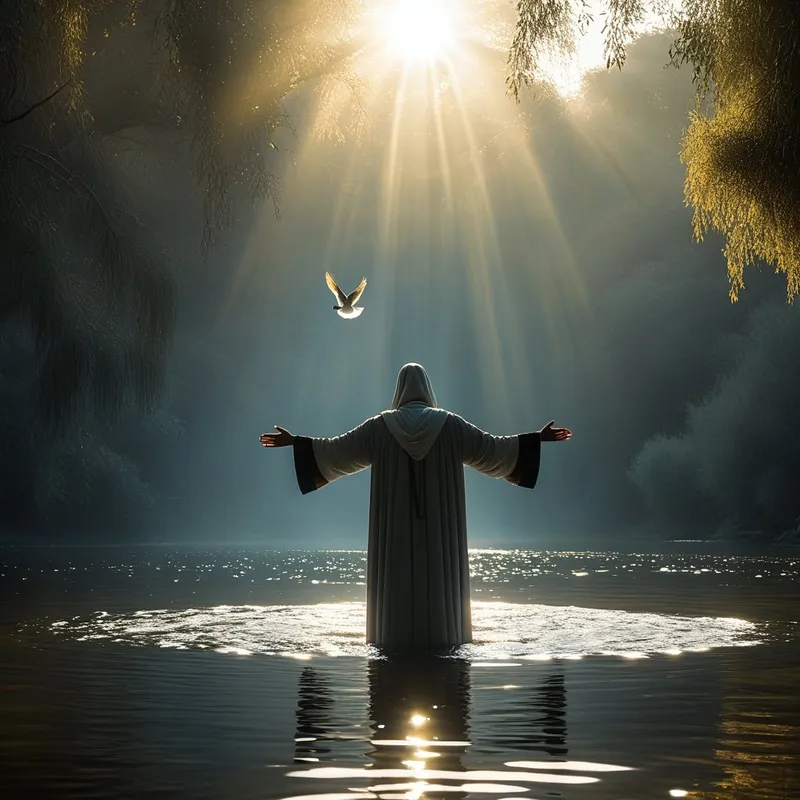
As the water enveloped him, as he rose, the heavens themselves tore open. A shaft of light, pure and tangible, fell upon him. And a shape descended—not an eagle of war, but a dove, the spirit of creation itself, alighting with impossible gentleness. Then the voice, not from the wilderness but from the very fabric of the sky, a sound felt in the bones: “This is my Son, whom I love; with him I am well pleased.” The water had been made holy not by the ritual, but by the one who submitted to it. The threshold was now forever open.
Cultural Origins & Context
The ritual of baptism did not spring, fully formed, from the Baptist’s ministry. Its roots sink deep into the soil of Jewish purification rites—the mikveh—and stretch back to the narrative waters of the Great Flood and the parting of the Red Sea. It was an act of boundary-crossing. For the early followers of The Way, baptism became the definitive initiation. It marked the severing point from one’s old social and religious identity and the incorporation into a new, often persecuted, community of believers.
This myth was passed down not as a mere historical footnote, but as the foundational story of every convert. It was told at vigil services in the dead of night, whispered in catacombs, proclaimed at riversides. Its societal function was radical: it declared that identity was not fixed by birth, status, or past action. It could be dissolved in water and reconstituted by spirit. It was the great equalizer, the psychic reset button for an empire groaning under the weight of fate and hierarchy.
Symbolic Architecture
At its core, the myth presents water in its ultimate ambivalence: it is both tomb and womb.
To be baptized is to consent to a symbolic death, so that a more authentic life may be born.
The submersion is the dissolution of the ego’s rigid structures—the persona we present, the sins we cling to, the history that defines us. It is a return to the undifferentiated, primal state. The emergence is not a return to the old bank, but an arrival on a new shore. The dove, symbol of the Spirit, represents the new principle of organization—not law, but grace; not fear, but belovedness. The voice from heaven affirms an identity not earned, but bestowed: “You are my child.” This is the archetypal pattern of the Innocent, not as naiveté, but as the hard-won state of being grounded in a fundamental, unshakable worth.
The river itself is the limen, the transformative space where one thing becomes another. It is neither the wilderness of lack nor the promised land of fulfillment, but the flowing, dynamic process between them.
The Dreamer's Resonance
When this myth stirs in the modern dreamer, it often manifests as dreams of overwhelming water: being caught in a cleansing rain, swimming through submerged hallways, or watching a tidal wave approach with both terror and awe. The somatic sensation is key—the weightlessness of suspension, the panic of breath held, the gasp of breaking the surface.
Psychologically, this signals a profound process of psychic digestion. The ego is being asked to let go of an outworn attitude, a toxic self-image, or a burdensome chapter of life. The dream water is the unconscious itself, rising to dissolve the dams we have built. To dream of emerging cleansed suggests the ego is successfully navigating this dissolution, ready to integrate a new quality of being. To dream of drowning points to the fear of ego-death, the terror that if we let go of our familiar brokenness, nothing will remain. The dream is an invitation to trust the process, to find the Baptist figure within—that fierce, ascetic part of our psyche that calls us to honesty and prepares the way for transformation.
Alchemical Translation
In the alchemy of the soul, baptism is the operation of solutio—dissolution. The fixed, leaden elements of the personality (our complexes, our pride, our trauma-encrusted narratives) are plunged into the aqua permanens, the eternal water of the unconscious.
The goal is not to escape the water, but to be fundamentally altered by it, to have the water and the spirit marry within the depths of the self.
The modern individual’s journey of individuation mirrors this myth precisely. We must first acknowledge the “wilderness” of our inner lack of integration (repentance). We must then willingly submit our conscious identity to be broken down by the truths we have avoided (the submersion). This is a terrifying, passive act—it is being done to us by a power greater than our will. The triumph is not in the struggling, but in the surrendering.
The emergence is the birth of the Self, the experience of being grounded in something transcendent and intimately personal. The voice that says “You are my beloved” is the voice of the Self speaking to the ego, bestowing a dignity that does not depend on achievement. The dove’s descent signifies the influx of a new, guiding energy—intuition, compassion, creativity—that now animates the reborn personality. The baptized one walks onto the bank not perfect, but oriented. The old life flows away behind them, and the path ahead, though unknown, is walked in the resonance of that divine affirmation. The waters have done their work; the soul has crossed its Jordan.
Associated Symbols
Explore related symbols from the CaleaDream lexicon: