Baptismal Fonts Myth Meaning & Symbolism
A sacred vessel of water where the old self is ritually drowned, and a new, spirit-born self emerges from the depths, cleansed and claimed.
The Tale of Baptismal Fonts
Listen, and hear the tale not of a hero, but of a threshold. It begins not with a cry of birth, but with a held breath at the edge of a pool.
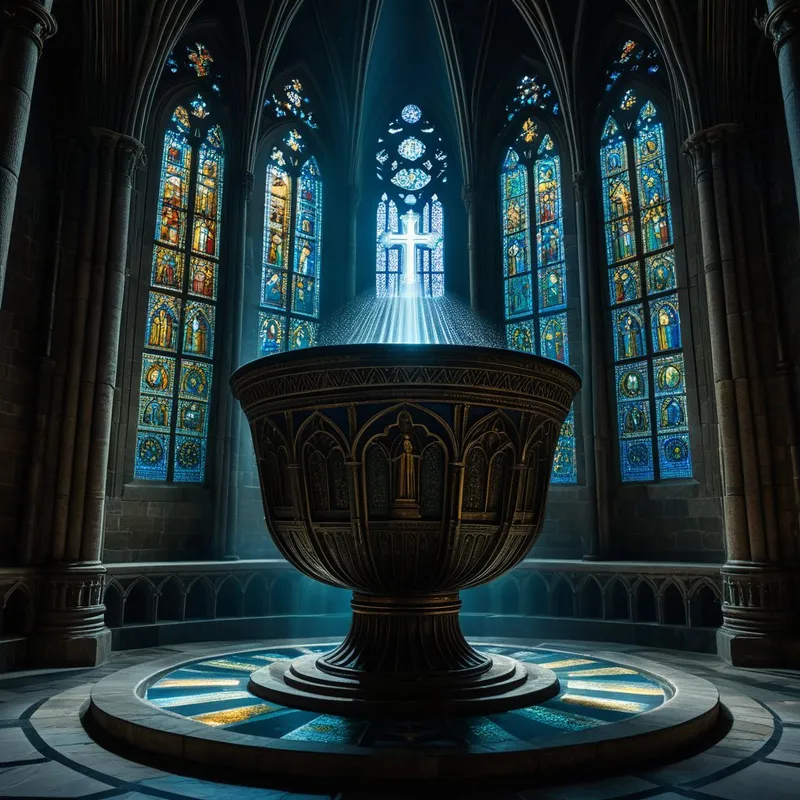
In the hushed belly of a great stone beast—a cathedral—where light falls in colored shafts like spears from heaven, there stands a vessel. It is not gold, nor jeweled for kings, but often of simple, cold stone, worn smooth by centuries of trembling hands. This is the Baptismal Font. Its water is not drawn from a common well; it is a captured piece of the primordial deep, blessed and charged, a still ocean in a cup.
To this font comes the seeker, the one who walks in the old skin. They are clothed in the world, dust on their feet, the weight of a name and a story upon their shoulders. The air is thick with incense and the silent songs of the ages. A figure stands beside the font, a guide, a voice for the Holy Spirit. The question hangs in the air, ancient and terrible in its simplicity: Do you renounce? The old ghosts—the shadow-selves of pride, of fear, of isolation—are named and cast away into the echoing silence.
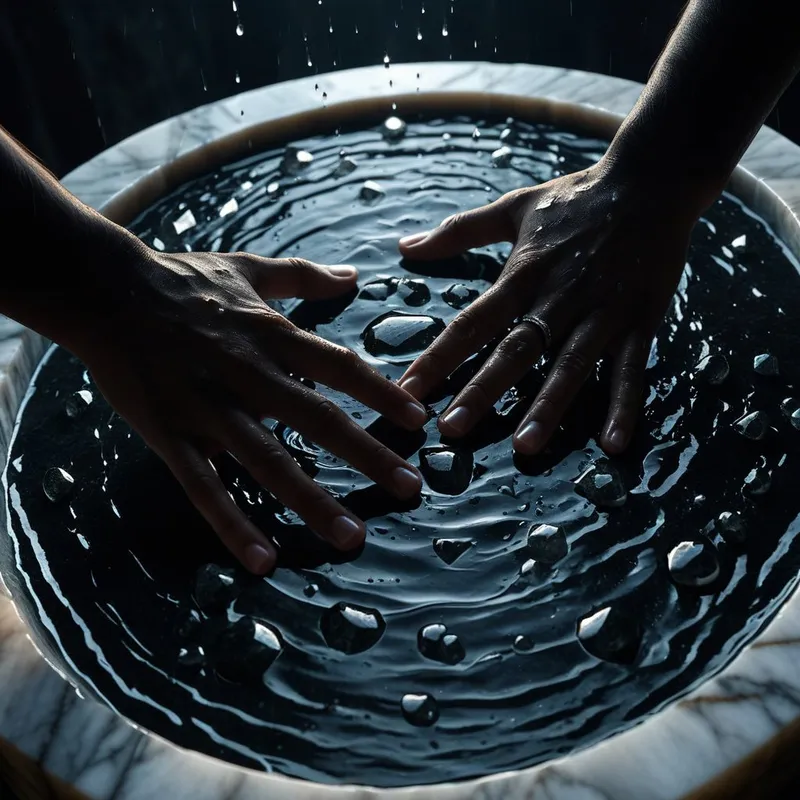
Then, the moment of drowning. Hands support, but the will must yield. The seeker is bent back, a living arch over the stone rim. The world—the vaulted ceiling, the watching faces—tilts and vanishes. There is only the cold embrace, the shocking invasion of water in nose and mouth, the silencing of all sound but the roar of one's own blood. For a heartbeat that stretches into eternity, they are a corpse in the tomb of water, the old Adam fully extinguished.
And then, the rising. Breaking the surface is not a return, but an arrival. They are hauled from the liquid grave, gasping not for old air, but for a new kind of breath. The water streams from them like a shed cocoon. They are anointed with oil, sweet and thick, a seal upon a new creation. A white garment, blinding in its purity, is wrapped around them—a skin of light. They are given a new name, spoken softly into the steam of their rebirth. They are no longer of the world they left at the font's edge. They have passed through the water, and the water has passed through them.
Cultural Origins & Context
This ritual drama finds its roots not in a single story, but in a confluence of powerful streams. It echoes the Jewish mikveh, a practice of ritual immersion for purification. It draws its primal power from the archetype of the flood, where a world is washed clean to begin anew, and the crossing of the Red Sea, where a people pass through walls of water from slavery into covenant.
In the early centuries of the Christian movement, baptism was often a stark, adult affair. It frequently occurred in natural bodies of water—rivers, springs, or specially built pools (piscinae). The catechumenate was a long preparation, a stripping away of pagan identity. Baptism, especially the practiced immersion, was a public and radical act of treason against the old gods and the Roman state, marking one’s citizenship in a new, heavenly kingdom. The font, therefore, was not just a piece of furniture; it was the womb and tomb of the Church, the literal point of entry. Its placement in the narthex, separate from the main nave, physically enacted this passage from the profane world into the sacred community.
Symbolic Architecture
The myth of the font is a masterclass in symbolic density. It is a psychodrama of the soul, mapping a profound internal process onto physical elements.
The font is the crucible where the lead of the conditioned self is dissolved, so the gold of the essential self may be revealed.
The Water is the primary symbol of the unconscious itself—chaotic, life-giving, and death-dealing. It represents the formless potential from which all life emerges and to which all structure returns. Immersion is a voluntary regression into this primordial state, a surrender of ego-control to the deeper, shaping currents of the psyche (the Spirit).
The Drowning is the symbolic death of the persona and the conscious ego's tyranny. It is the end of "I am what I have achieved, what I own, what others think of me." This death is not annihilation, but a necessary dissolution, like a seed breaking open in the dark earth.
The White Garment (alb) symbolizes the new, uncontaminated identity that coalesces from the waters. It is the "true self" unburdened by the projections and traumas of the past, a self defined not by history, but by essence and relationship to the divine.
The Dreamer's Resonance
When the baptismal font appears in modern dreams, it rarely comes with church trappings. It may manifest as a sudden pool in a forest, an overflowing bathtub, or a mysterious well in one's backyard. The dreamer is called to its edge.
To dream of hesitating at the font's rim speaks to a profound psychological readiness for change coupled with a terror of ego-death. The dreamer knows a old way of being must end, but fears the unknown self on the other side of the plunge. To dream of being forcibly held under may point to a feeling of being overwhelmed by unconscious material—a depression, a grief, a rising tide of ignored emotions that threatens to engulf the conscious mind. Conversely, to dream of rising from the water, gasping and renewed, often follows or heralds a major life transition that has been successfully integrated: a career change, the end of a relationship, a recovery. The somatic feeling is one of shocking cold followed by invigorating clarity, a literal breath of new life.

Alchemical Translation
The myth of the font is a perfect map for the Jungian process of individuation. It models the alchemical nigredo, the blackening, which is not a moral failing but the necessary confrontation with one's shadow—the "renunciation" of the false selves we cling to.
The ritual is an externalized prayer for an internal revolution: that the conscious mind might consent to its own temporary undoing for the sake of a greater wholeness.
The immersion is the albedo, the washing clean. In the psyche, this is the painful but illuminating work of analysis, of seeing one's patterns, complexes, and history with clear-eyed honesty, allowing the purifying waters of awareness to flow through them. The rising and anointing correspond to citrinitas and rubedo, the integration and embodiment of this new understanding. The "new name" is the discovery of one's unique vocation or purpose, the essence that was always there, buried under the accretions of a life lived by others' scripts.
For the modern individual, the font is not made of stone but of intention. It is the therapeutic hour, the meditation cushion, the journal page, the courageous conversation—any vessel that holds the space for us to willingly submerge our old narratives. We are both the neophyte and the priest. We must ask ourselves the renunciatory questions, and we must have the faith to lean back into the chilling, liberating waters of our own truth. To be baptized, in this deepest sense, is to consent to the perpetual cycle of death and rebirth that is not a one-time event, but the very rhythm of an authentic life.
Associated Symbols
Explore related symbols from the CaleaDream lexicon: