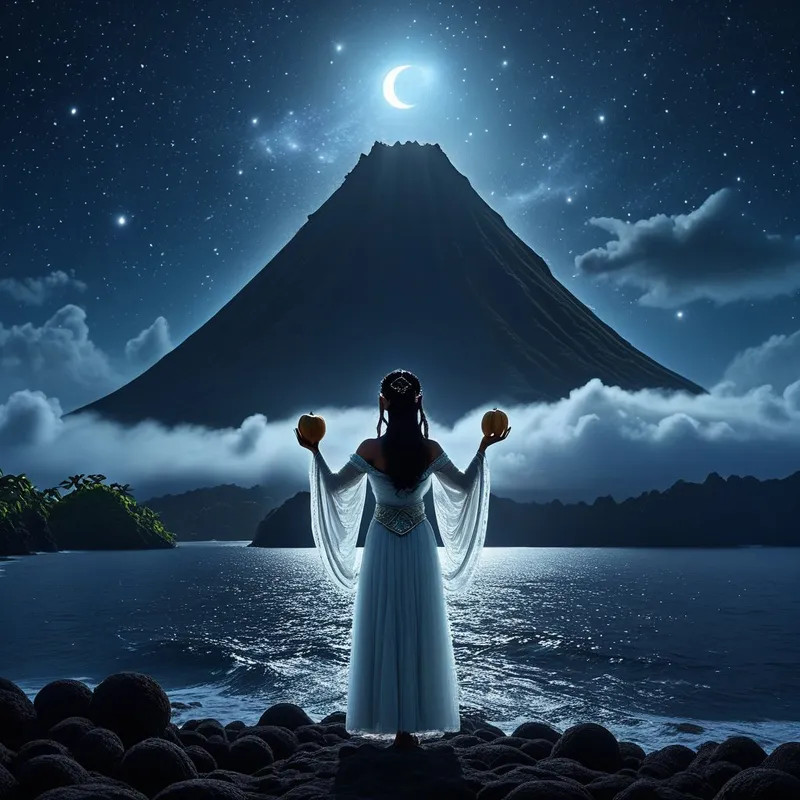
Banda Islands Myth Meaning & Symbolism
A myth of a celestial princess who stole the secret of nutmeg, was cast from the heavens, and whose body became the fabled Spice Islands.
The Tale of Banda Islands
Listen, and let the salt air fill your lungs. Let the memory of a scent—sweet, woody, intoxicating—guide you back to a time before maps, when the world was held in the stories of sailors and the dreams of gods.
In the high heavens of Kayangan, there lived a princess of unparalleled grace, Nyai Roro Kidul’s younger kin. Her name is lost to the waves, but her nature was that of restless wind. The court of the gods was a place of perfect, eternal order, but her eyes were ever drawn downward, to the swirling blues and greens of the mortal world, to the raw, chaotic beauty of its volcanoes and seas. Yet, even that earthly splendor paled before one treasure kept locked in the highest vault of the sky: the Tree of Pala.
This was no ordinary tree. Its bark shimmered like forged iron, its leaves whispered secrets of eternity, and from its boughs hung fruits like captured suns. When they split, they revealed a crimson lace—the mace—wrapped around a dark, hard seed. This was the nutmeg. Its fragrance was the very scent of paradise; to taste it was to know a joy so profound it bordered on pain. It was forbidden to all but the supreme deity.
The princess’s curiosity became a gnawing hunger. While the gods slumbered in their contentment, she slipped into the vault. The air was thick with the perfume of a thousand seasons. With a touch that trembled not from fear but from terrible longing, she plucked a single, perfect fruit. At that moment, the harmony of the cosmos shivered. The theft was discovered not by sight, but by a sudden, glaring absence in the celestial song.
The wrath was immediate and absolute. There was no trial. The decree was exile—a fall from grace literal and devastating. Cast out from Kayangan, she plummeted through the void, the stolen fruit clutched to her breast. She fell for nine days and nights, through layers of cloud and memory, until the ocean rose to meet her. The impact did not kill her, for she was still divine. It shattered her.
Her body, broken by the fall and the weight of her transgression, fragmented upon the volcanic peaks rising from the deep Laut Banda. Her spirit dissolved into the soil, the rain, the very air. And from the places where her flesh and blood met the earth, something miraculous occurred. Where her tears salted the ground, the sea remained fertile. Where her bones became stone, volcanoes stood sentinel. And from the heart still cradling the stolen fruit, a new kind of life erupted. Saplings of the celestial Pala tree pushed through the volcanic ash, taking root. They were not quite as radiant as their heavenly parent, but they bore the same sacred fruit. The princess was gone. In her place were ten small islands, lush and fierce, forever perfumed with the scent of her desire and her crime. The Banda Islands were born.

Cultural Origins & Context
This myth finds its breath in the oral traditions of the Orang Banda and the seafaring communities of the wider Maluku archipelago. It is not a myth preserved in formal epics like the Mahabharata, but one carried on the trade winds, told by fishermen navigating by the stars and elders explaining why their home was both a paradise and a prize. Its primary function was etiological—to explain the profound, almost uncanny origin of the islands’ unique bounty. In a world where spices were literal currency of kings, the story provided a sacred origin for nutmeg, elevating it from mere commodity to a substance of cosmic significance.
The tale also served as a deep cultural mirror. For centuries, the Bandas existed in a tense, powerful symbiosis with the outside world. They were remote, difficult to access, and protected by treacherous seas—much like a guarded celestial treasure. The myth encoded a local understanding of their place in the world: they were literally fragments of the divine, and their precious resource was born from a transformative act of rebellion and sacrifice. It was a narrative of identity that asserted their centrality in the cosmic order, long before European cartographers placed them at the center of the spice trade.
Symbolic Architecture
At its core, this is a myth of metamorphosis through transgression. The celestial princess is not a passive victim but an active, desiring entity. Her “sin” is the archetypal reaching for forbidden knowledge, the Promethean impulse that disrupts static perfection for the sake of something new.
The most profound creations are often born from a sacred disobedience, a breaking of the old harmony to seed a new, more complex world.
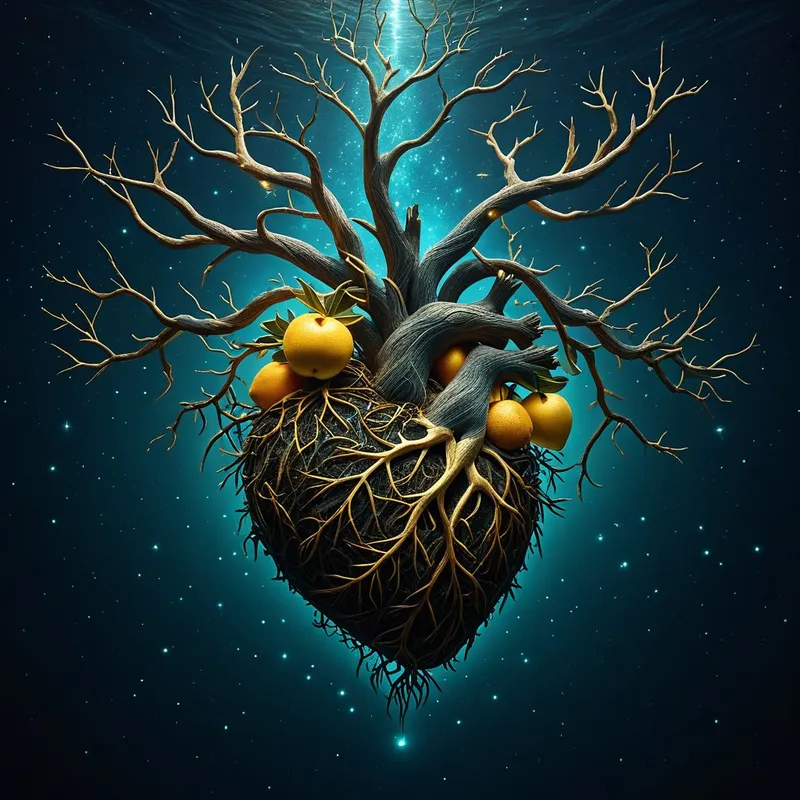
The nutmeg itself is the ultimate symbol of this paradox. It is a seed of desire (the princess’s longing), a fruit of crime (the theft), and a gift of immense value (the islands’ legacy). It represents the concentrated essence—an idea, a talent, a longing—so potent it cannot remain contained in its original, “heavenly” state. It must fall, be shattered, and be reconstituted in the earthly realm to realize its full potential.
The princess’s fragmentation is not a punishment in the purely moral sense, but the necessary alchemical process. Her unified, celestial self cannot contain the consequence of her act. She must become the landscape itself; her individual consciousness dissolves to become the generative principle of an entire ecosystem. The personal becomes the geological. This mirrors the psychological process where a singular, ego-driven desire, when acted upon, can dismantle the old personality and give birth to a new, more expansive identity rooted in the “soil” of lived reality.

The Dreamer's Resonance
To dream in the pattern of the Banda myth is to be in the throes of a profound psychic descent. You may dream of falling not into terror, but into a strange, fertile darkness. You may dream of holding a secret object—a glowing stone, a peculiar fruit, a forbidden book—that feels simultaneously like a treasure and a terrible burden. The somatic sensation is often one of weight: the gravity of a choice, the density of a potential that is too great for your current form to hold.
This dream state signifies the unconscious mobilization of a transformative process. The “stolen nutmeg” is that nascent part of the self—a creative impulse, a repressed truth, a radical insight—that you have “taken” from the sterile “heaven” of your accustomed identity or societal expectations. The dream acknowledges the theft, the rupture from previous innocence. The subsequent fall and shattering represent the ego’s dissolution as it attempts to integrate this powerful new content. It is a crisis of identity, where the dreamer feels they are coming apart. Yet, within the dream, there is also the hint of a new landscape forming from the pieces. This is the psyche’s assurance: the breakdown is prelude to a breakthrough. You are not being destroyed; you are being geographically re-drawn.
Alchemical Translation
The alchemical journey mirrored here is the nigredo, the blackening, followed by the albedo. The pristine, white celestial sphere (the princess in Kayangan) is plunged into the blackness of the fall and the volcanic earth (nigredo). This is the necessary descent into the underworld of the psyche, where cherished illusions and old structures are shattered.
Individuation demands a fall from grace. The ego must be exiled from its familiar paradise to encounter the raw, volcanic material of the Self.
The resolution is not a return to heaven, but a transmutation into a new mode of being. The princess does not get forgiven and recalled. She becomes the Banda Islands. This is the albedo: the emergence of a new, enduring form from the blackened matter. The psychic “nutmeg”—that stolen potential—is no longer a hidden, personal secret. It has been planted, through the act of sacrifice (of the old self), and has become the defining feature of a new inner landscape. The process teaches that our greatest gifts are often inseparable from our deepest transgressions against internal or external conformity. The goal is not to avoid the fall, but to understand that our fragmentation upon the rocks of reality is the very process by which we become fertile ground, capable of bearing fruit that nourishes the wider world.
The modern individual engaged in this alchemy is the one who dares to “steal” their own authentic desire from the “gods” of parental expectation, social convention, or their own rigid perfectionism. They accept the ensuing crisis—the feeling of being broken apart, exiled from former certainties. And if they can endure the dissolution, they find that their essence reforms not as a solitary figure, but as a rich, complex, and generative inner world. They become the islands, and their once-forbidden truth becomes the spice that gives flavor to their existence.
Associated Symbols
Explore related symbols from the CaleaDream lexicon: