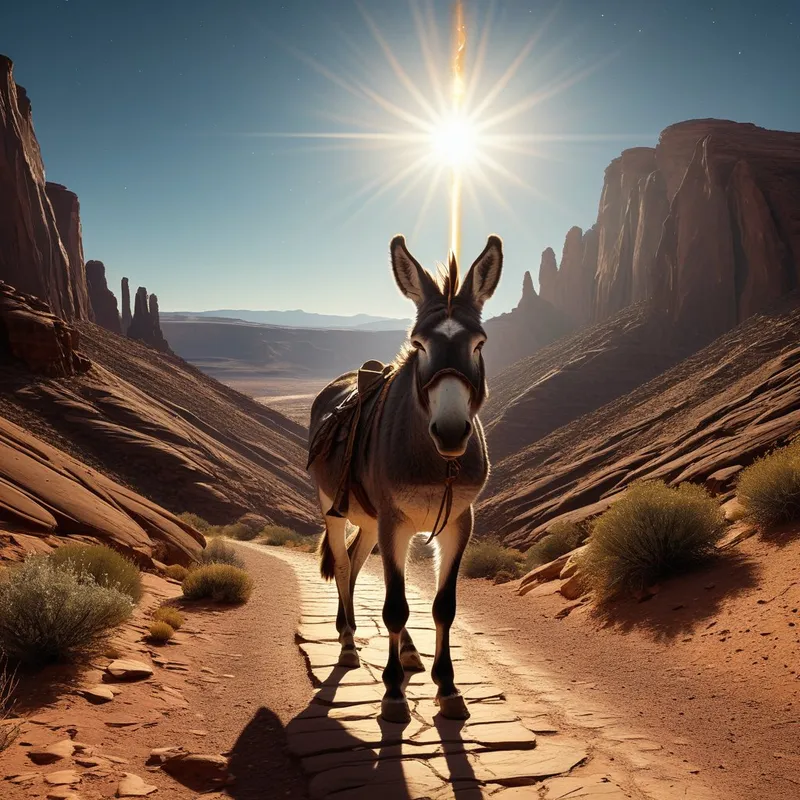
Balaam's Donkey Myth Meaning & Symbolism
A prophet, blinded by ambition, is chastised by his own donkey who sees the angel he cannot, revealing that true vision is not a privilege of title.
The Tale of Balaam's Donkey
The air over Moab was thick with the scent of fear and gold. King Balak, his heart a clenched fist, looked out from the high places and saw a people encamped like a locust swarm on the plains—the Israelites. Their god was a rumor of thunder and parted seas, and Balak knew his armies were but chaff before such a wind. But he knew of a man, a seer from the east, whose words held the power to bless and to blight. His name was Balaam, son of Beor, a man who walked the knife-edge between worlds, who spoke with the YHWH of the Israelites yet lived among the hills of Pethor.
Messengers came, their pouches heavy with the fees of divination. "Curse this people for me," Balak's plea echoed. "For I know that whomever you bless is blessed, and whomever you curse is cursed." Balaam consulted the night and the silence, and the voice of God came to him: "You shall not go with them. You shall not curse the people, for they are blessed."
But Balak was a king, and kings do not hear 'no.' A second, more noble embassy arrived, promising honor and whatever Balaam asked. The seer's heart, that delicate instrument, began to vibrate with a new note—ambition, draped in the robes of piety. "Though Balak were to give me his house full of silver and gold, I could not go beyond the command of the Lord my God," he declared, even as he saddled his donkey. "But stay here tonight, that I may know what more the Lord will say to me." God, seeing the turn of the heart, said, "Rise, go with them; but only the word that I speak to you, that you shall do."
So Balaam rose in the morning, saddled his donkey, and went with the princes of Moab. But the anger of the Lord was kindled because he went. And the donkey saw what the prophet could not.
On the narrow path between the vineyards, with a wall on this side and a wall on that side, the angel of the Lord stood, a drawn sword in his hand, a being of pure, terrifying purpose. The donkey saw the divine fury and turned aside into the field. Balaam, his inner sight clouded by the future weight of Balak's gold, saw only rebellion. He struck the donkey to turn her back onto the path.
Further they went, into a narrow pass where there was no room to turn, right or left. Again the angel stood. The donkey, pressed against a wall, crushed Balaam's foot. In his rage, he struck her again.
A third time, on a place so narrow there was no room to move at all, the angel stood. The donkey, seeing no escape, simply lay down under Balaam. The prophet's fury was white-hot. He took his staff and beat the beast a third time.
Then the Lord opened the mouth of the donkey, and she said to Balaam, "What have I done to you, that you have struck me these three times?"
Balaam, in his rage, argued with the animal. "Because you have made a fool of me! I wish I had a sword in my hand, for then I would kill you."
The donkey replied with the weary logic of centuries of service: "Am I not your donkey, which you have ridden all your life to this day? Have I been in the habit of treating you this way?"
And he said, "No."
Then the Lord opened Balaam's eyes, and he saw the angel of the Lord standing in the way, his sword drawn. He bowed his head and fell on his face. The angel said, "Why have you struck your donkey these three times? Behold, I have come out as an adversary because your way is perverse before me. The donkey saw me and turned aside before me these three times. If she had not turned aside, surely just now I would have killed you and let her live."
The sword was not for Israel. It was for the prophet. The curse he was hired to speak was destined to become a blessing, and the blessing he secretly coveted for himself was his own curse. On the high places, overlooking the camp of the blessed, Balaam would open his mouth, but the words that came forth were not his own. They were poems of starry destiny and lion-like strength, blessings that fell from his lips like stones, to the dismay of the king who paid for them. The one who set out to curse saw, too late, that he was merely an instrument. The true seer had been the beast of burden all along.
Cultural Origins & Context
This narrative is embedded within the Pentateuch, specifically the Book of Numbers (Chapters 22-24). It functions as a pivotal folktale within a larger geopolitical drama. Scholarly consensus places its composition in the late monarchic or post-exilic periods of ancient Israel, though its oral roots are likely far older. The story serves a profound sociological purpose: to assert the absolute sovereignty of Israel's God over all powers, even the renowned pagan diviners of the surrounding nations.
Balaam is not an Israelite; he is a seer from Mesopotamia, a figure of genuine international repute. By making this famous pagan prophet a mouthpiece for YHWH's blessings, the Israelite storytellers accomplished two things. First, they demonstrated that their God's will cannot be bought, subverted, or manipulated by any human craft, even the esteemed craft of divination. Second, it provided a potent, memorable satire on royal power: a desperate king is thwarted not by armies, but by a donkey and the immutable words of a God he does not understand. The tale was a tool of identity reinforcement, telling a people often under threat that their destiny was protected by a power that turned the wisdom of the world into foolishness.
Symbolic Architecture
The myth is a perfect allegory for the psychology of perception and the hierarchies of consciousness. Balaam represents the directed, intellectual, goal-oriented ego. He has a title (seer), a skill (blessing/cursing), and a destination (honor and reward). His vision is narrowly focused on the horizon of his ambition.
The donkey symbolizes the embodied, instinctual, somatic self—the often-ignored foundation upon which the ego rides. She is in direct contact with the ground of being, the immediate present. Her three actions—turning aside, pressing close, lying down—are not rebellions but brilliant, life-preserving adaptations to a reality the ego refuses to see.
The angel with the drawn sword is the objective, autonomous truth of the Self—the psychic totality that demands alignment. It is not a moral punishment, but a structural reality. To proceed on a path contrary to one's deeper nature is to walk into a sword.
The "opening of the eyes" is not the granting of new sight, but the removal of the inner blockage that prevented Balaam from seeing what was always there. The climax is a devastating inversion: the one called to see (the seer) is blind; the one considered a dumb beast is the true perceiver. The voice of the donkey is the voice of the repressed instinct, the body's wisdom, finally given speech after being beaten into silence.
The Dreamer's Resonance
When this myth stirs in the modern unconscious, it often manifests in dreams of frustrating obstruction. You dream of a car that won't start, a path that endlessly twists back on itself, or a trusted animal that suddenly refuses to obey. The somatic feeling is one of furious impotence—you are being thwarted by the very vehicle of your life.
Psychologically, this indicates a profound conflict between the conscious direction of the dreamer's life and the instinctual wisdom of the psyche. The "Balaam complex" is active: the dreamer is, perhaps for noble or ambitious reasons, forcing a path that is fundamentally opposed to their deeper integrity. The "donkey"—the body, the intuition, the simple need for rest or a different way—is trying to save them. The beating in the dream is the ego's continued repression and devaluation of this inner guidance. The dream is a final warning before a psychic crisis—the "angel's sword"—manifests as burnout, illness, or a catastrophic life error. The dream asks: What part of yourself are you riding toward disaster? What simple, animal truth are you beating into silence?

Alchemical Translation
The alchemical process modeled here is the mortificatio and illuminatio of the ego. Balaam's journey is the flawed opus. He begins with a base motive (gold) disguised as a spiritual quest (seeking God's will). The three beatings are the necessary, repeated failures of the ego's project. Each time the donkey resists, it is the prima materia—the raw, despised substance of one's own nature—refusing to be transmuted into the ego's gold.
The true alchemical fire is the angel's sword, the confronting truth that stops the entire false process. The crushing of Balaam's foot against the wall is the nigredo, the darkening, where the ego is literally pinned by the consequences of its own direction. The donkey speaking is the vox Dei, the voice of the divine, emerging from the most lowly and rejected part of the self.
Individuation is not about the sage bestowing wisdom from on high. It is the humiliating, glorious moment when the beast of burden you have taken for granted becomes your teacher, and you must bow before the truth it has seen all along.
The final blessings Balaam speaks are not his own. They represent the lapis philosophorum, the philosopher's stone. The product of this painful transmutation is authentic expression—words that are in harmony with the objective Self. The ego (Balaam) is not destroyed, but its function is corrected. It becomes a vessel, not a director. It speaks the poetry of the totality, not the propaganda of its own ambition. The individual is freed from the curse of self-will and aligned with a blessing that was destined for them all along, if only they had the eyes of a donkey to see it.
Associated Symbols
Explore related symbols from the CaleaDream lexicon: