
Baihu Myth Meaning & Symbolism
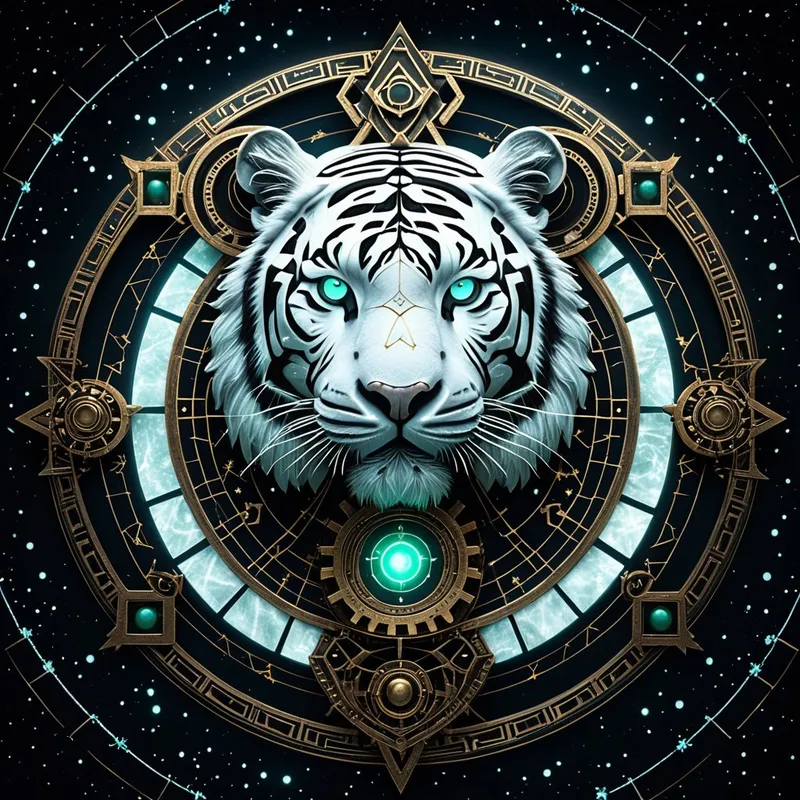
The White Tiger, a celestial guardian of the West, embodies the season of autumn, righteous power, and the disciplined, protective force within the cosmic and human order.
The Tale of Baihu
Before the first emperor drew breath, before the Middle Kingdom had a name, the heavens were a vast, untamed wilderness. In the chaos of the primordial dark, the stars themselves were beasts, roaming the celestial plains. From the crucible of this cosmic forge, four sovereigns were given form, tasked with bringing the cardinal winds to heel and anchoring the world in harmony. And in the West, where the sun dies each day in a blaze of crimson and gold, the sovereign of Metal and Autumn took its shape.
It did not emerge with a roar, but with a silence so profound it stilled the very winds. Where it placed its paw, the mountains hardened into white jade and veins of silver. Its breath was not fire, but the first chill that whispers through the ripe grain, the herald of harvest and decay. They named it Baihu, the White Tiger of the West.
Its domain was the season of letting go. While the Azure Dragon of the East brought the surge of spring, Baihu presided over the necessary fall. It was the warden of boundaries, the enforcer of cosmic law. Its gaze, like polished bronze, saw not the lush potential of life, but the essential structure beneath—the skeleton of the tree once its leaves have fallen, the righteous path when emotion clouds judgment. It patrolled the border between the known world and the vast unknown, its white form a spectral warning and a steadfast promise: what is ripe must be gathered; what is corrupt must be cut away.
Legends say that in the age of the Yellow Emperor, when demons of chaos slithered from the western wastes, it was the spectral shadow of Baihu that fell upon them. Not with wild savagery, but with a terrifying, precise grace. Each movement was a verdict, each strike an execution of celestial mandate. The demons did not flee from fear, but from the unbearable clarity of its presence, which dissolved their formless malice into nothingness. With order restored, Baihu would return to its peak, its form dissolving into the autumn mists, leaving behind only the scent of frost and a profound, echoing peace—the peace of a debt paid, a balance restored, a boundary firmly held.
Cultural Origins & Context
Baihu is not a myth born from a single story, but a constellation of meaning woven into the very fabric of ancient Chinese cosmology. Its origins lie in the system of the Si Xiang (Four Symbols), which itself evolved from earlier astrological observations of the twenty-eight lunar mansions. By the Warring States period, the correlation between the White Tiger, the west, the autumn season, the metal element, and the color white was firmly established in philosophical and proto-scientific thought.
This was not merely folklore for the masses; it was a fundamental operating system for the universe, used by emperors, generals, and diviners. The tiger was a potent military symbol, its image emblazoned on shields and commander's flags to invoke Baihu's attributes of courage, authority, and strategic prowess. Its domain over autumn linked it to harvest, but also to the executions that were traditionally carried out in that season—the "autumn killings" that purified the state. Thus, the myth was passed down not just by storytellers, but through ritual, astronomy, statecraft, and the art of war, functioning as a constant reminder of the necessary, often severe, principles of order, justice, and cyclical change that underpin both heaven and human society.
Symbolic Architecture
Psychologically, Baihu represents the archetypal principle of structure, discrimination, and righteous force. It is not the creative impulse, but the critical faculty that gives form to creation. It is the part of the psyche that establishes boundaries, makes difficult decisions, and enforces inner law.
The White Tiger does not create the world; it defends the sanctity of the form that creation has taken. It is the integrity of the vessel.
Its association with Metal symbolizes the psyche's capacity for discernment—to cut away the superfluous, to refine the ore of experience into the steel of character. Its season, Autumn, speaks to the essential psychological process of letting go. This is not a passive loss, but an active, often painful, harvest: gathering the fruits of our experiences and consciously releasing what no longer serves growth, making space for the necessary winter of introspection. Baihu is the courage to face this interior autumn, to judge our own actions with clarity, and to protect the nascent, vulnerable self from both internal chaos and external predation.
The Dreamer's Resonance
When Baihu pads into the modern dreamscape, it often appears during life phases requiring decisive action, boundary-setting, or moral courage. The dreamer may not see a literal tiger, but will feel its signature: a chilling clarity, a sense of being watched or judged by an impeccable authority, or the stark beauty of a barren, frost-laden landscape.
Somnially, it manifests as dreams of being a guardian or sentinel, of wielding a sharp, clean instrument (a sword, a scalpel, a key), or of confronting a looming, shadowy disorder that requires firm, disciplined action to dispel. There is often a somatic component—a feeling of tension in the spine, a sharp intake of breath, or a cool, metallic taste. These dreams signal that the psyche is mobilizing its discriminative power. The dreamer is undergoing a process of internal "autumn," where immature impulses, outdated identities, or moral compromises are being identified and prepared for release. The presence of the Tiger can feel severe, but its purpose is protective; it arises to defend the dreamer's core integrity from being overgrown by chaos or eroded by passivity.

Alchemical Translation
The journey of Baihu models the alchemical stage of separatio and the forging of the conscious ego's rightful authority. In the process of individuation, we must move beyond the blooming, undifferentiated chaos of the unconscious (the East's Dragon) and develop a capacity for discernment and conscious choice.
To integrate the White Tiger is to become the sovereign of your own inner west—to accept the mantle of responsibility for your judgments, your boundaries, and the necessary endings you must enact.
This is the "warrior" path, not of outward aggression, but of inner discipline. It involves confronting the shadowy "demons" of our own avoidance, cowardice, or moral ambiguity with unwavering clarity. We learn to "harvest" our experiences, taking full responsibility for our actions and their consequences. The triumph is not conquest, but the establishment of a firm, resilient structure within the psyche—a citadel of the self, guarded by the calm, fearsome certainty of one's own hard-won integrity. In doing so, we do not become harsh or unfeeling; rather, we create a protected inner space where the more vulnerable aspects of the soul (the Innocent, the Lover) can safely exist. We transmute raw instinct into disciplined power, and chaotic experience into the refined metal of conscious character.
Associated Symbols
Explore related symbols from the CaleaDream lexicon: