Ba Gua Myth Meaning & Symbolism
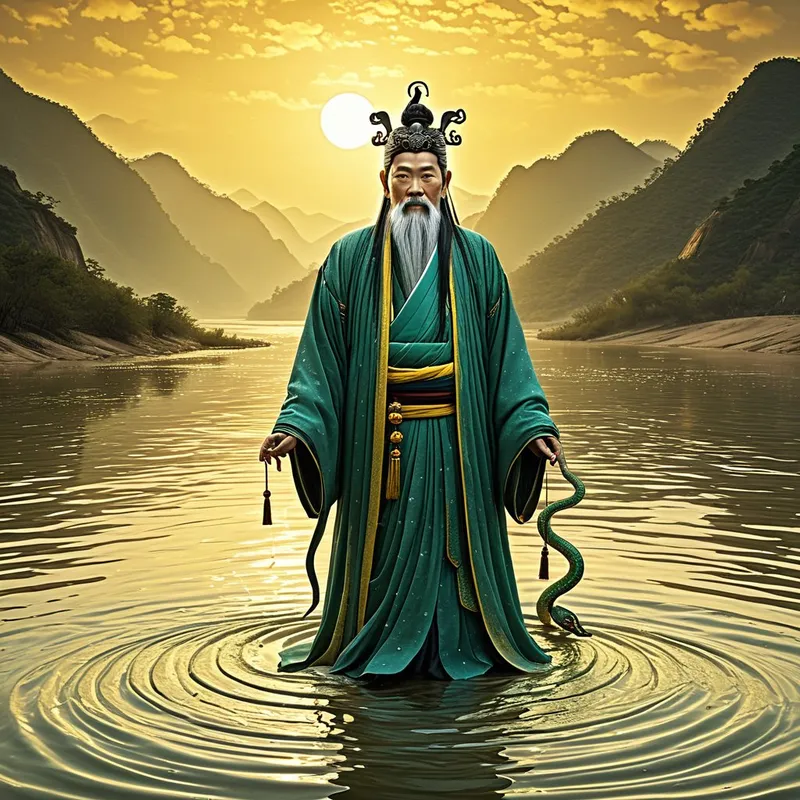
The myth of Fu Xi receiving the eight trigrams from the He Tu, revealing the fundamental patterns of heaven, earth, and the human soul.
The Tale of Ba Gua
Before there were words to bind the world, there was only the great, formless churning of the Hundun. Heaven and Earth were not yet parted. In that timeless dawn, a figure emerged from the silt of the mighty Yellow River. He was Fu Xi, the serpent-bodied sage-king, his eyes holding the deep, patient stillness of the ancient waters. He walked among the people, who lived in fear and confusion, their lives ruled by the caprice of floods and wild beasts. They had no order, no pattern to understand the chaos of existence.
One day, as Fu Xi meditated by the river’s edge, a great rumbling stirred the deep. The waters, usually a muddy brown, began to swirl with a light that was not of the sun. From the heart of the current rose a magnificent creature—a dragon-horse, its scales like polished jade, its mane flowing like liquid mist. Upon its back was no rider, but a pattern: a sacred diagram of swirling dots, dark and light, arranged in a perfect, terrifying symmetry. This was the He Tu.
As Fu Xi gazed upon it, the world fell silent. The chirping of birds, the rush of the river, the wind in the reeds—all faded into a profound hum. The dots on the chart began to move, to dance, to connect. They spoke a language older than sound, revealing the fundamental rhythms of reality: the firmness of the mountain, the penetration of the wind, the clinging nature of fire, the receptivity of the earth. From this divine blueprint, Fu Xi perceived the eight archetypal forces.
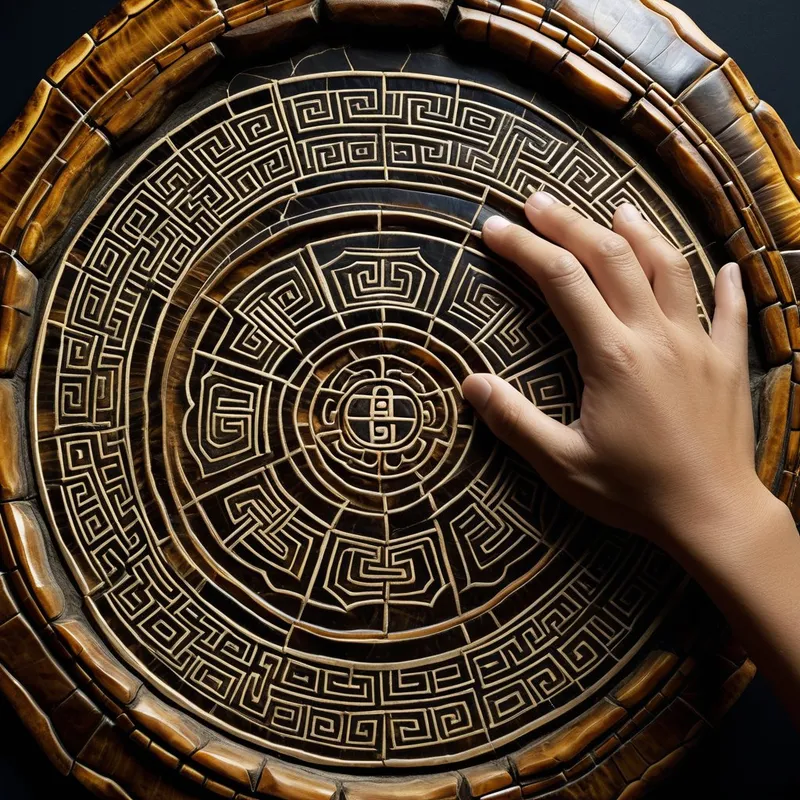
His hand, guided by a vision beyond sight, reached for a tortoise shell that lay upon the bank. With a sharp stone, he began to carve. A single, unbroken line for the creative power of Qian. A broken line for the receptive depth of Kun. He carved six more: for the arousing shock of thunder, the gentle persistence of wind, the radiant clarity of fire, the perilous abyss of water, the stilling mountain, and the joyful lake.
With the eighth and final trigram complete, a sigh seemed to pass through all of creation. The eight symbols formed a circle, a perfect wheel of becoming. The people gathered, and for the first time, they saw not chaos, but a map. They could now foresee the seasons, understand the movements of animals, and find harmony within their own hearts. Order was born from the waters of the unknown, and the soul of the world had been given its first and most enduring grammar.
Cultural Origins & Context
The myth of the Ba Gua’s revelation is not a folktale for entertainment, but a foundational narrative of Chinese cosmological thought, primarily preserved in the appendices of the I Ching. It belongs to the stratum of myths concerning the San Huang, the Three Sovereigns, of whom Fu Xi is the first. This places the myth in a prehistoric, legendary time before recorded history, a time of origins when the boundaries between the human, the natural, and the divine were permeable.
The story was transmitted orally by shamans, ritualists, and later, by Confucian and Daoist scholars who saw in it the origin of all civilized knowledge—from writing and marriage rituals to statecraft and divination. Its societal function was profound: it provided a sacred mandate for the social and cosmic order. The emperor, as the Son of Heaven, was seen as the living mediator of this Ba Gua principle, responsible for maintaining the harmony between the celestial patterns revealed to Fu Xi and the earthly realm. It transformed a worldview from one of fearful submission to unpredictable spirits into one of participatory alignment with a knowable, patterned universe.
Symbolic Architecture
At its core, the Ba Gua is a symbolic architecture of the psyche and the cosmos. It is not a static diagram but a dynamic field of relationships. The two fundamental lines—the unbroken (yang) and the broken (yin)—are the binary code of reality. From their combination arise the eight trigrams, which are not gods, but archetypal principles: the fundamental attitudes or energies that shape events, personalities, and moments in time.
The Ba Gua is the mind of the universe made visible, a grammar for the dialogue between the unseen potential of Heaven and the manifest form of Earth.
Fu Xi represents the awakened human consciousness, the Sheng Ren. His serpentine lower body connects him to the chthonic, instinctual wisdom of the earth and the unconscious, while his human upper body signifies the capacity for rational observation and symbolic creation. The dragon-horse and the He Tu symbolize a revelation from the depths of the collective unconscious—the unus mundus or unified field—where all patterns exist in potential. The act of carving the trigrams is the critical moment of translation, where intuitive, non-linear knowing is crystallized into a structured, communicable system. This is the birth of culture itself: the imposition of meaningful order onto the raw data of experience.
The Dreamer's Resonance
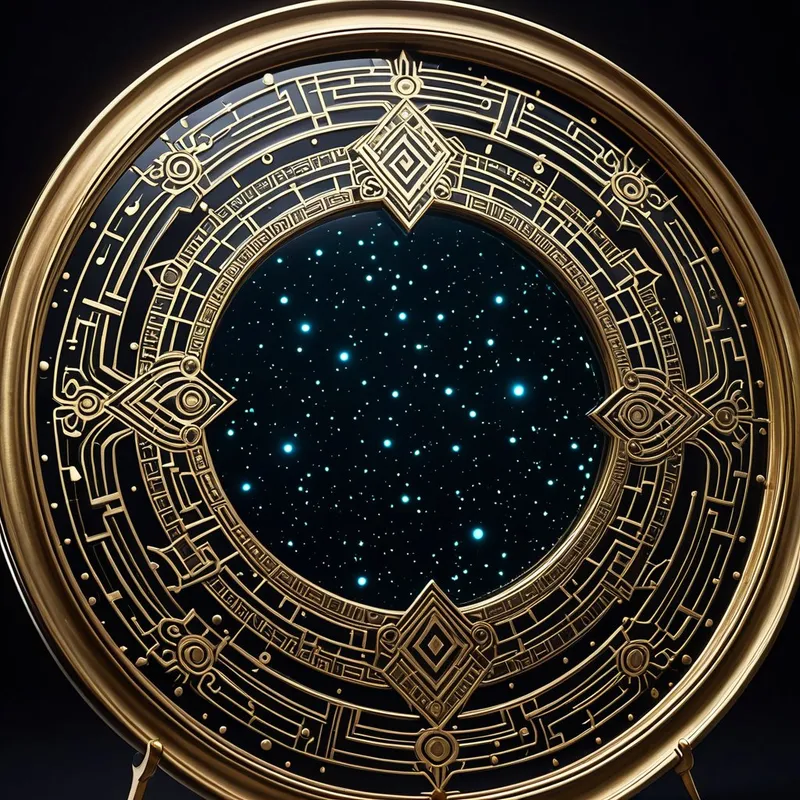
When the pattern of the Ba Gua appears in a modern dream, it rarely manifests as a literal diagram. Instead, one may dream of a complex, eight-sided room; a circular intersection with paths leading in precise, contrasting directions; or a mandala whose sections shift between states of solidity and fluidity, light and dark. Such dreams often arise during periods of profound life transition or intellectual/spiritual confusion, when the dreamer’s old map of the world has shattered.
The somatic sensation is one of being at a still center within a whirlwind of possibilities. Psychologically, this dream signals the psyche’s attempt to re-orient. It is the Self, the total personality, providing a template for reorganization. The dreamer is not being given an answer, but a framework. The conflict in the dream is the tension between clinging to one broken trigram (a single, rigid perspective) and the daunting, yet liberating, task of holding the entire rotating wheel. The process is one of moving from a fragmented, chaotic self-concept toward a more integrated understanding where opposites—strength and yielding, action and rest—are seen as necessary, complementary parts of a whole system.
Alchemical Translation
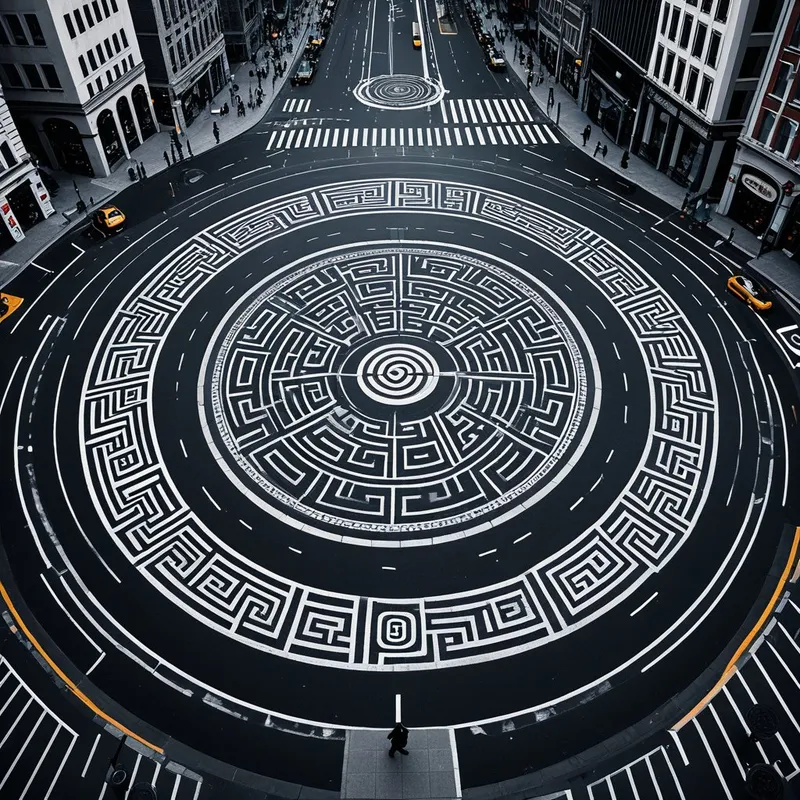
The myth of the Ba Gua models the alchemical process of psychic transmutation, or individuation, with elegant precision. The initial state is the Hundun of the unexamined life—a confusion of impulses, complexes, and contradictory drives. The “dragon-horse” rising from the river is the eruption of content from the unconscious, often disruptive and numinous, which demands attention (the nigredo or blackening phase of confusion).
Fu Xi’s contemplation and translation of the He Tu represent the albedo or whitening phase: the conscious mind applying itself to understand the symbolic language of the unconscious. This is the hard work of analysis, meditation, and active imagination—carving the rough stone of experience into discernible forms.
Individuation is not becoming perfect, but becoming whole; it is the conscious rotation of the inner Ba Gua, acknowledging each trigram of our being without letting any one rule the entire wheel.
The final creation of the circular arrangement of the eight trigrams symbolizes the rubedo or reddening: the achievement of a new, more complex psychic order. This is the birth of the “transcendent function,” a new attitude that can hold tension between opposites. The modern individual’s “triumph” is not conquering chaos, but learning its inherent order. It is realizing that one’s moods, talents, flaws, and relationships are not random, but part of a dynamic, intelligible system. To engage in this alchemy is to become, like Fu Xi, a sage in one’s own right—a humble cartographer of the soul’s endless, patterned becoming.
Associated Symbols
Explore related symbols from the CaleaDream lexicon: