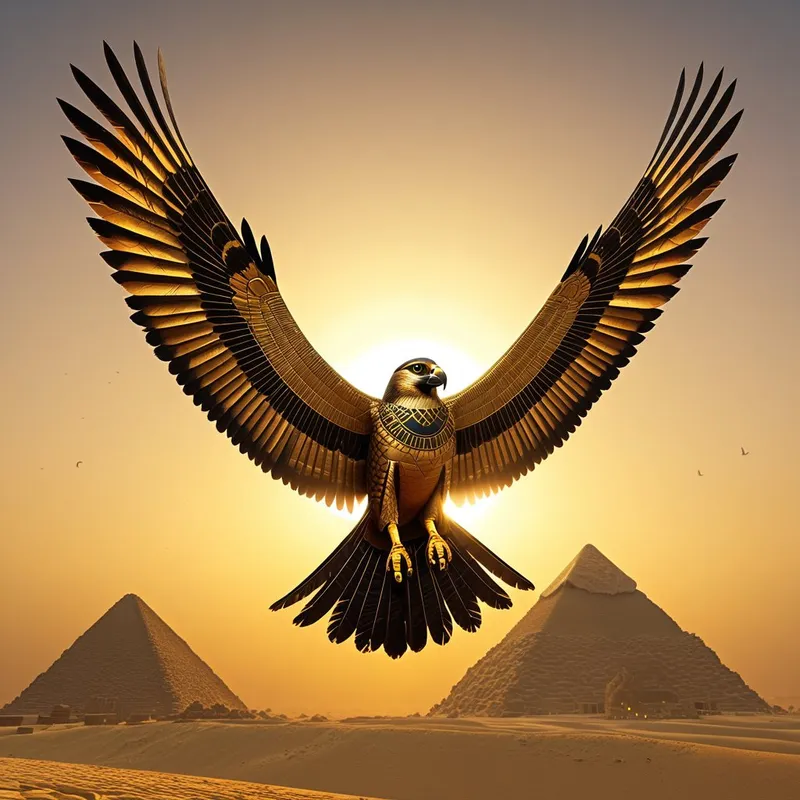
Ba Bird Myth Meaning & Symbolism
The Ba Bird is the Egyptian soul-part that flies from the tomb at death, seeking reunion with the eternal, embodying the psyche's longing for wholeness.
The Tale of the Ba Bird
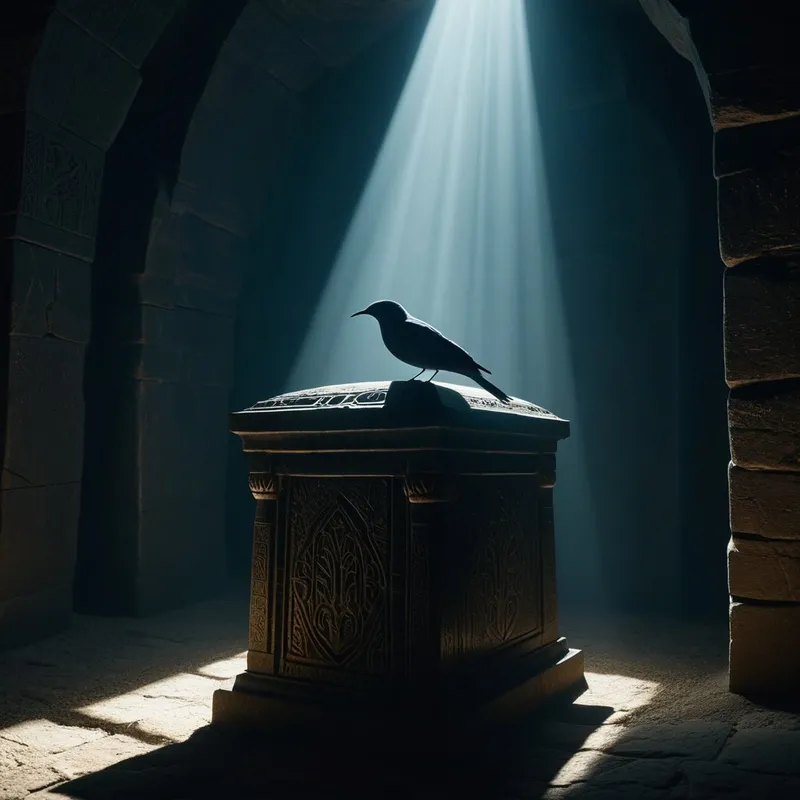
Listen, and hear the whisper of the reeds along the Nile. Feel the dry, eternal heat of the sun, Ra, upon your skin. In the silence of the royal tomb, deep within the stone heart of the earth, a stillness holds its breath. Here lies the Khat, the vessel that once walked in daylight, now swathed in linen, anointed with oils, surrounded by spells written in a language of power.
But this is not an end. It is a hinge between worlds.
As the last chant of the Sem priests fades, a new sound begins—a rustling not of wind, but of potential. From the still mouth of the sleeper, a shimmer gathers. It is not breath, but essence. It coalesces, takes form: the head of the departed, wise and familiar, now borne upon the graceful, powerful body of a bird. This is the Ba.
With a beat of wings that makes no sound in our air but echoes in the Duat, the Ba bursts forth. It passes through stone as if through mist, rising from the deep, dark tomb into the shocking brilliance of the day. It soars over the green ribbon of the Nile, over the fields where the Ka might still dwell. It flies towards the sun, not in escape, but in longing.
Its journey is perilous. It must navigate the hidden waterways of the night, evade the jaws of Ammit, and remember the true names of the gates it passes. It seeks the Akh, its glorious, starry state. But most of all, it seeks return. For the Ba is not meant to wander forever. As the sun sets, painting the sky with the blood of Apep, the Ba bird turns its path homeward. It descends, a streak of twilight, back to the silent tomb, back to the resting Khat. In that nightly reunion, in the mysterious embrace of the self with its own memory and form, is the promise: "You shall not perish. You shall endure."
Cultural Origins & Context
The concept of the Ba is not a single myth from a singular text, but a profound theological idea woven into the very fabric of ancient Egyptian civilization for over three millennia. It emerges from the Pyramid Texts, the oldest religious writings in the world, inscribed within royal tombs of the Old Kingdom. It is elaborated in the Coffin Texts and finds its most famous expression in the Book of the Dead.
This was not a public myth for the marketplace, but a sacred reality for the tomb and the afterlife. It was knowledge held by scribes and priests, enacted in the most intimate ritual space: the burial chamber. The Ba’s societal function was existential; it provided a complete map of the soul’s journey beyond death. It democratized immortality—originally a pharaoh’s privilege, but eventually a hope for all who could afford the spells. The Ba affirmed a cosmos where death was a transition, not an annihilation, and where the individual’s unique personality (the Ba) had a divine, mobile, and eternal aspect.
Symbolic Architecture
The Ba is one of the most sophisticated psychological concepts from the ancient world. It is not merely "the soul" in a vague sense, but a specific soul-part representing everything that makes a person distinct: their personality, character, memory, and will—their "effective manifestation." The human head signifies this enduring individuality, while the bird body, often a falcon or swallow, symbolizes mobility, freedom, and the capacity to traverse realms.
The Ba is the paradox of the self: the part that must leave to become itself, yet must return to remember what it is.
Its eternal cycle—flying forth by day to navigate the cosmic realms and returning to the tomb at night—models a fundamental psychic truth. It represents the necessary rhythm between differentiation and integration, between exploring the vastness of the world (or the psyche) and returning to the grounded reality of the body and one’s history (the Khat). The Ba cannot achieve its final, blessed state as an Akh without both movements: the courageous journey and the faithful return. It is the soul as a process, not a static object.
The Dreamer's Resonance
When the Ba Bird alights in a modern dream, it signals a profound somatic and psychological process underway. It is the dream of the soul feeling its own contours. To dream of a human-headed bird, especially one that is leaving or returning, often accompanies a life phase where one’s essential identity feels both liberated and untethered.
You may dream of your own face on a bird as you look in a mirror, or watch such a creature fly from your chest as you sleep. This is the psyche illustrating the "leaving" phase: perhaps after a major life change (a move, career shift, loss), where a core part of you is exploring new psychic territory, feeling free but also potentially disconnected from your roots, your body, or your past. The somatic sensation might be one of lightness bordering on dissociation, or exhilarating freedom.
Conversely, dreaming of such a bird flying into a window, a familiar room, or towards your sleeping dream-body speaks of the "return." This is the phase of integration, where insights gained, identities forged in the world, are being brought back home to the core self. It can feel like a deep, settling peace, a reconciliation. The dream is a testament to the psyche’s innate, ancient wisdom: it knows it must both wander and come home to be whole.

Alchemical Translation
The myth of the Ba Bird is a precise alchemical manual for individuation—the Jungian process of becoming the integrated, authentic Self. The tomb is not merely a grave; it is the prima materia, the unconscious, undifferentiated state of the psyche. The sealed sarcophagus is the ego’s rigid identification with a single, mortal form.
The rising of the Ba is the first, crucial operation of separatio. It is the moment of awakening where a part of the psyche realizes it is more than its historical conditioning, its social roles, its physical limitations. It takes flight—this is the exploration of the unconscious, the engagement with archetypes, the daring venture into new thoughts and feelings. This is the Explorer archetype in its purest form.
Individuation is not a linear flight to the sun, but the sacred, cyclical pilgrimage between the known earth and the boundless sky.
Yet, the alchemy is incomplete without the conjunctio, the sacred marriage. The Ba’s return to the tomb is this essential step. It is the bringing of the gold discovered in the heavens back to the lead of the earthly self. The modern individual must learn this Ba-rhythm: to venture into the world of ideas, relationships, and ambitions, but then to consciously return those experiences to the hearth of the soul, to digest them, to let them transform the very structure of the personal self. The ultimate goal is not to escape the "tomb" of your personal history, but to transfigure it. The reunited Ba and Khat, through this nightly alchemy, aim to become the Akh—the luminous, effective, and eternal Self. To live this myth is to understand that wholeness is found in the faithful dialogue between the wanderer and the home it never truly leaves.
Associated Symbols
Explore related symbols from the CaleaDream lexicon: