Ba and Ka Myth Meaning & Symbolism
The ancient Egyptian myth of the Ba and Ka reveals the soul's dual nature: the eternal essence and the dynamic personality, forever seeking reunion.
The Tale of Ba and Ka
In the time when the sun was a young god and the Nile’s black earth first breathed life, the mystery of a person was not one, but two. It was whispered in the reeds, carved in the silent stone of the inner sanctum, that to be human was to be a house divided, a sacred tension yearning for its own resolution.
Consider the noble Scribe Nakht. In life, he was a man of two lands: his body, Khat, walked the sun-baked earth, his hand moving with the fluid grace of the river, inscribing the sacred words. But within him dwelled his Ka. This was his sustaining spirit, his divine double, a silent companion born with him at the first breath. It was the image of his perfect self, the blueprint of his vitality, fed by the scent of incense and the essence of offerings. It resided in his statues and his name, a ghostly anchor in the world of form.
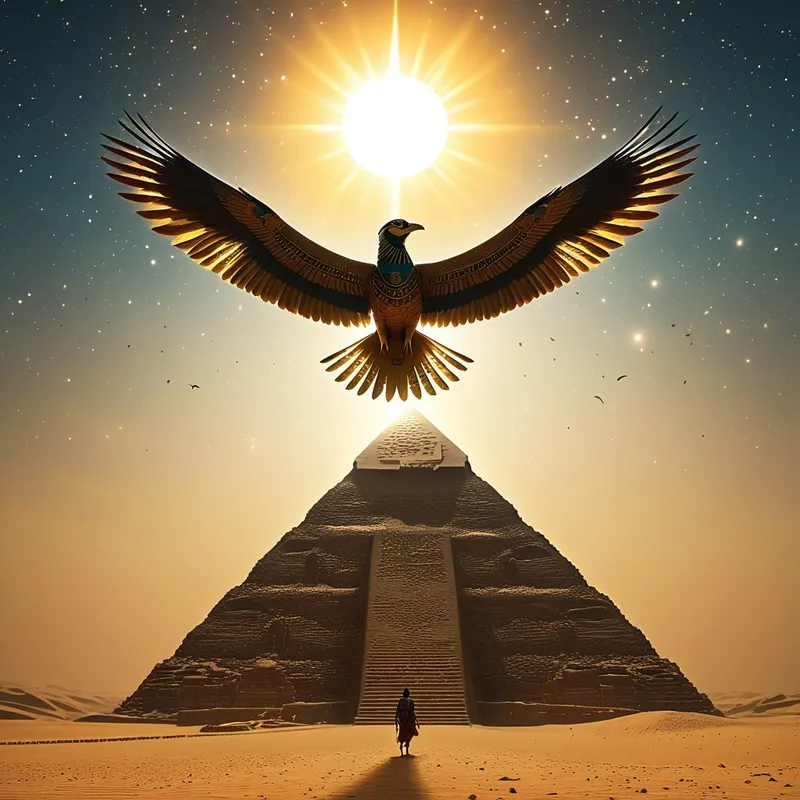
Then came the day the sun set for the final time on Nakht’s eyes. His Khat was prepared with salt and linen, becoming an eternal vessel. But his journey had just begun. From his stilled body arose his Ba. Imagine a bird of light, with the face of Nakht and the wings of a falcon, bursting forth in a shimmer of desperate freedom. The Ba was all that made Nakht, Nakht: his memories of his wife’s laughter, the weight of the papyrus scroll, his secret fears, his proudest moments—his very personality, now unmoored.
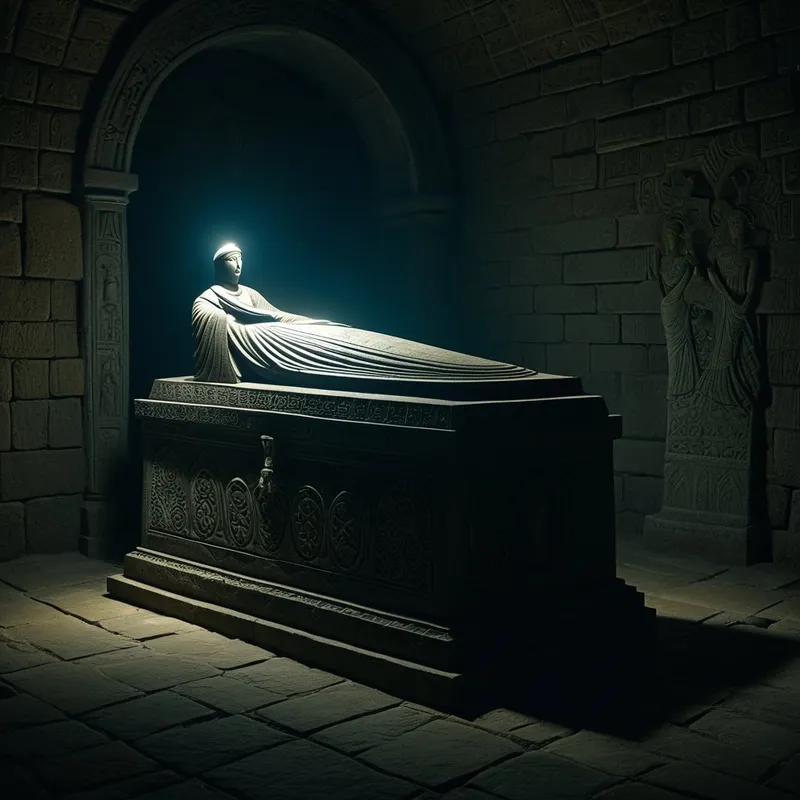
The Ba let out a silent cry that echoed in the Duat. It longed not for the endless stars, but for home. It beat its luminous wings against the oppressive darkness of the tomb, a cage of stone and silence. It was free, yet utterly lost, a spark separated from its flame. For the Ba knew, in its deepest essence, that it was only half a soul. Its other half, its silent twin, the Ka, remained behind, bound to the mummified body and the statue in the dark, cool serdab.
The great conflict was not against monsters, but against dissolution. The Ba risked fading into the void, a forgotten whisper, while the Ka risked withering into nothingness, starved of the identity that gave it purpose. Their separation was a living death for both.
The resolution was a reunion whispered by the gods. Guided by spells from the Book of the Dead, the Ba learned to navigate the Duat. It found the strength to return, not as a visitor, but as a missing piece returning to its whole. On a night when the moon mirrored the solar barque, the Ba descended. It hovered before the serene statue of Nakht, before his silent, linen-wrapped form. There was no dramatic clash, only a profound recognition. The dynamic, remembering Ba saw its static, sustaining Ka. Slowly, inevitably, like two drops of mercury, they flowed together.
In that fusion—the Ba-Ka united—was born the Akh, the shining, effective spirit. Nakht was no longer scribe or spirit, memory or form. He was complete. He had become an enduring star, his essence and his experience forged into a single, eternal light. The house was no longer divided; it had become a temple.
Cultural Origins & Context
This was not a single story told around a fire, but a theological framework woven into the very fabric of ancient Egyptian civilization for over three millennia. The concepts of Ka and Ba evolved from the Old Kingdom pyramid texts, reserved for the pharaoh, to become democratized in the Middle and New Kingdoms, accessible to any who could afford the funerary rites.
The myth was passed down through the immutable medium of tomb walls, coffin inscriptions, and papyri like the Book of the Dead. It was enacted by priests in ritual and validated daily by the practice of leaving offerings at tomb chapels—food, drink, incense—to “feed the Ka.” Its societal function was paramount: it provided a complete map of the human soul and a practical technology for eternal life. It answered the terrifying question of what happens after death not with a vague promise, but with a precise, actionable process of reintegration. It made death a transition to a new state of being, contingent on the reconciliation of one’s own inner duality.
Symbolic Architecture
At its heart, the myth of Ba and Ka is a profound map of the psyche’s fundamental structure. It describes not what we have, but what we are.
The Ka is the potential of the seed, the Ba is the story of the tree. One cannot exist meaningfully without the other.
The Ka symbolizes our essential, foundational self. It is the life force given at birth, our innate potential, our genetic and spiritual blueprint. Psychologically, it correlates to what we might call the Self in its pure, unmanifest form—our core vitality and the unconscious ground of our being. It is static, not in a dead way, but in the way a magnetic field is static: a constant, structuring presence.
The Ba, in contrast, is our manifested, experiential self. It is the accumulation of our lifetime: our personality, memories, desires, failures, and triumphs—everything that makes us uniquely individual. It is dynamic, mobile, and conscious. It is the ego-personality in dialogue with the world.
The tomb, then, is not just a grave, but the psyche itself—the confined, often dark, personal unconscious where these two aspects are initially held apart after a trauma (death, in the myth; psychological crisis, in life). Their reunion into the Akh represents the ultimate goal: the integration of the unconscious foundation (Ka) with the conscious personality (Ba) to create a fully realized, effective, and transcendent individual.
The Dreamer's Resonance
When this ancient pattern stirs in the modern dreamer, it speaks of a profound inner schism seeking healing. You do not dream of a literal bird-headed spirit, but of its psychological equivalents.
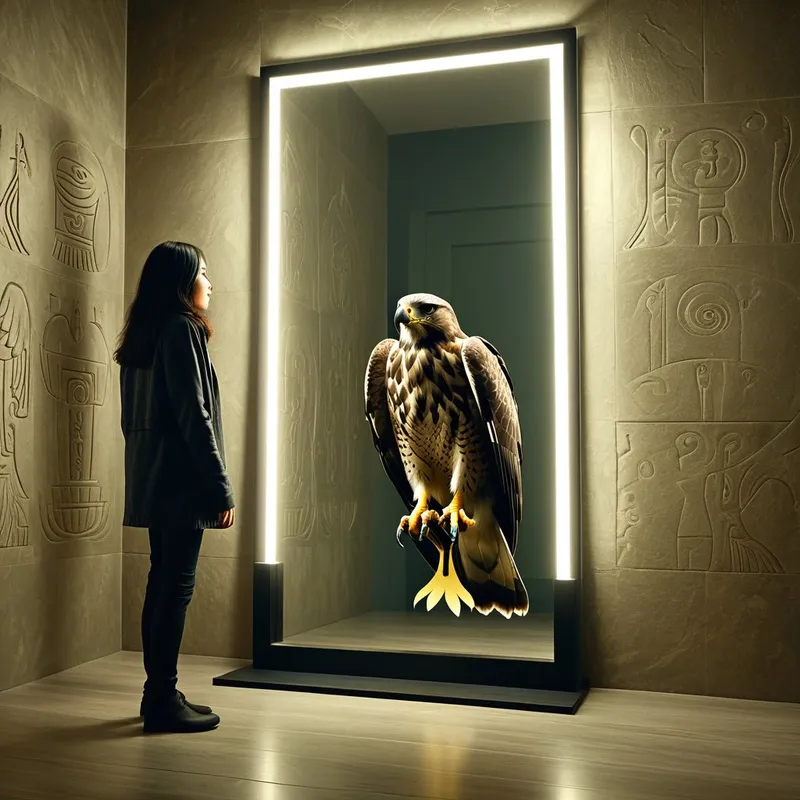
Dreaming of a familiar house where one room is permanently locked, or a mirror that shows a distorted or different version of yourself, echoes the Ka-Ba separation. It is the feeling that a vital part of you is walled off, inaccessible. Dreams of frantic searching—for a lost object that is “you,” for a twin sibling you never knew, for your own name—mirror the Ba’s desperate flight. The somatic experience is often one of anxiety, restlessness, or a hollow feeling in the chest, a sense of being “ungrounded” or not fully inhabiting your own life.
Conversely, dreams of profound, peaceful reunions—meeting a luminous double and merging with it, finding the key to the locked room to discover it is a sanctuary, or simply feeling a sudden, overwhelming sense of “coming home” to yourself—signal the movement toward integration. This is the psyche working to heal the split between who you feel you are (Ba) and who you are meant to be at your core (Ka).
Alchemical Translation
The myth of Ba and Ka is a precise alchemical manual for the process of individuation—the modern journey toward psychic wholeness. The Duat is the nigredo, the dark night of the soul, where our conscious identity (Ba) feels lost and disconnected from its source. The mummified body is the fixatio, the necessary containment and preservation of our raw material (the physical and instinctual self) so it does not decay into chaos.
Individuation is not about becoming perfect, but about becoming whole. It is the Ba, with all its scars, returning to bless the Ka with the gift of a life actually lived.
The journey involves the conscious Ba (our aware ego) descending into the tomb of the unconscious to seek its Ka. This is shadow work, delving into forgotten memories, inherited patterns, and unlived potentials. We “feed the Ka” not with literal bread, but with attention, acknowledgment, and the energy of our conscious life.
The reunion is the coniunctio oppositorum, the sacred marriage of opposites. It is the moment when your lived experience (your successes, your grief, your unique story) is finally reconciled with your innate, essential nature. The outcome is the creation of your own Akh—not an afterlife spirit, but a fully realized, effective, and authentic Self. You become a coherent force in the world, no longer torn between the person you present and the person you sense you are meant to be. The eternal struggle between being and essence finds, however temporarily, its peaceful, shining resolution.
Associated Symbols
Explore related symbols from the CaleaDream lexicon: