Axioms of Nyaya Myth Meaning & Symbolism
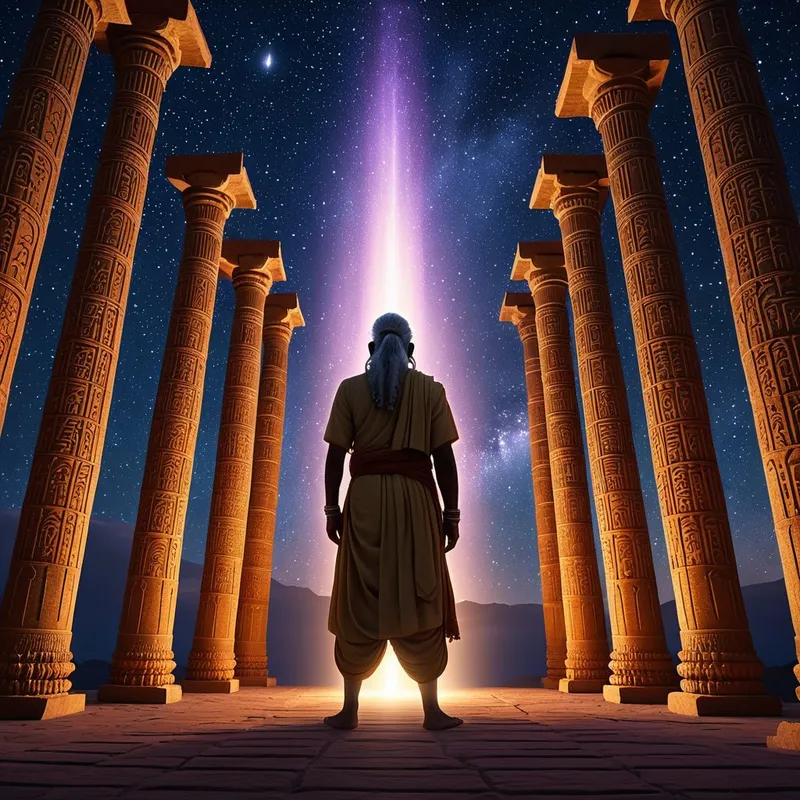
The myth of the sixteen Axioms of Nyaya, the unshakable pillars of logic, forged to guide humanity from the chaos of illusion into the clarity of truth.
The Tale of Axioms of Nyaya
Listen, then, to the tale not of gods who thunder or demons who roar, but of a silence so profound it birthed a structure for the cosmos of the mind. In the age when the world was young and thought was a wild, untamed river, humanity wandered in a fog of doubt. Every perception was a mirage, every argument a tangled thicket, every truth a fleeting shadow. The great seers, the Rishis, saw this suffering of the intellect—a chaos more terrifying than any battlefield, for it turned brother against brother, soul against itself, in a war with no weapons and no end.
From the still center of this cacophony, a presence emerged. It was not born of passion or power, but of necessity. It was Nyaya—not a god with a flaming chariot, but a principle made manifest, a deity whose form was clarity itself. His eyes were not of fire, but of penetrating discernment; his voice was not a shout, but the resonant click of a puzzle falling into place. He stood upon the plains of human confusion and saw that to navigate the world, one needed a map. Not a map of lands, but a map of thought itself.
And so, from the substance of pure awareness, he forged them. Not with hammer and anvil, but with the relentless pressure of inquiry. One by one, they descended from the realm of ideal form into the world of debate and discovery: the Sixteen Axioms. They were pillars of luminous certainty in the shifting sands of opinion. The first four laid the very ground upon which truth could stand: Pramāṇa (the sources of knowing), Prameya (the knowable), Saṃśaya (the spur to inquiry), and Prayojana (the aim). Then came the tools to build: Dṛṣṭānta (the illustrative instance), the unshakable Siddhānta, the bones of Avayava, and the probing test of Tarka.
The final pillars were the guardians against folly: Nirṇaya, the fierce debate of Vāda, the mere caviling of Jalpa, and the destructive Vitaṇḍā. Last stood the pitfalls themselves—Hetvābhāsa, Chala, Jāti, and the final, tragic Nigrahasthāna. As the last axiom settled into the fabric of reality, a great sigh seemed to pass through the world. The fog did not vanish, but a path was now visible through it. The wild river of thought had banks. The war of words had rules. Humanity was given not answers, but the means to find them.

Cultural Origins & Context
This "myth" of the Axioms finds its home not in the grand epics of the Mahābhārata or Rāmāyaṇa, but in the rigorous, scholastic traditions of Nyāya and its sister school, Vaiśeṣika. Attributed to the sage Akṣapāda Gautama in his Nyāya Sūtras (circa 2nd century CE), the sixteen categories (padārthas) were systematized as the very architecture of rational inquiry. They were passed down not by bards around a fire, but by teachers (gurus) in the gurukulas and debating halls (parishads) of ancient India.
Its societal function was profoundly civilizational. In a culture that valued spiritual liberation (moksha) above all, Nyaya provided the intellectual toolkit to clear the underbrush of false belief, faulty perception, and deceptive rhetoric that stood between the seeker and ultimate truth. It was the necessary precursor to deeper philosophical and spiritual realization, ensuring that the journey toward the infinite was built on the solid ground of valid knowledge. It was the myth of the mind's own awakening, a narrative that equipped an entire civilization to argue, to prove, and to discern with breathtaking sophistication.
Symbolic Architecture
The myth of the Axioms is a profound map of consciousness erecting its own scaffolding. It symbolizes the human psyche's innate drive to impose order on the chaos of raw experience. The sixteen pillars are not cold rules, but archetypal structures of meaning-making.
The first axiom, Pramāṇa, is the declaration that knowing is possible—a radical act of faith in a universe that can be comprehended.
The initial four axioms represent the foundational questions of any conscious being: How do I know? (Pramāṇa). What can be known? (Prameya). What triggers my search? (Saṃśaya). Why am I searching? (Prayojana). The subsequent axioms symbolize the dynamic process of thought itself—moving from example to structure, from testing to conclusion. The final set, from Jalpa to Nigrahasthāna, are the shadow aspects of reason: the ego's attachment to being right, the deceit of cleverness, the futility of false equivalence. They are the necessary demons of the intellectual path, whose recognition is essential for true clarity. Psychologically, the entire system represents the ego's development of a coherent, reality-testing function—a "logical principle" within the psyche that can mediate between inner impulses and outer reality.
The Dreamer's Resonance
When this myth stirs in the modern unconscious, it rarely appears as Sanskrit text. Instead, one dreams of frantic sorting—of endless data streams, of trying to assemble a shattered vase whose pieces keep changing shape, or of being lost in a building with constantly shifting, illogical floorplans. These are dreams of Saṃśaya, of paralyzing doubt.
The somatic sensation is often one of mental congestion, a tightness in the forehead or a restless, scattered energy. The psyche is signaling that it is drowning in unprocessed information, conflicting values, or deceptive narratives (both internal and external). The dream of finding a single, clear instruction manual, a master key, or a stable platform amidst swirling waters is the dream of Siddhānta—the yearning for an established tenet, a core truth upon which to stand. This myth activates when the individual is at a cognitive crossroads, where intuition alone is insufficient, and a clear, disciplined process of discernment is required to navigate a life dilemma.
Alchemical Translation
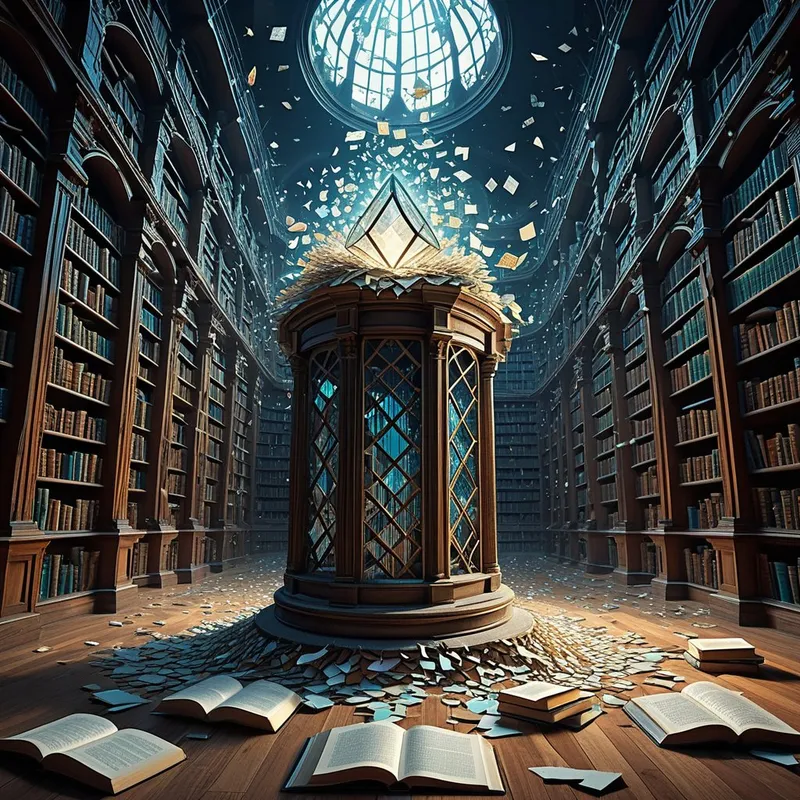
The alchemical journey modeled by the Axioms of Nyaya is the transmutation of the prima materia of confused experience into the gold of conscious understanding. It is the individuation path of the Sage.
The process begins in the nigredo, the black chaos of undifferentiated perception and opinion (Saṃśaya). The first alchemical fire is applied through Pramāṇa—the seeker must choose their instruments of knowing (perception, inference, testimony). This is the separatio, distinguishing reliable data from psychic noise. The construction of the syllogism (Avayava) is the coagulatio, giving solid, articulate form to nascent insights.
The final stage is not the possession of truth, but the attainment of a mind structured like a diamond—clear, precise, and capable of cutting through illusion.
The crucible is debate and self-inquiry (Vāda, Tarka), where the dross of personal bias (Chala, Jāti) is burned away. The climax is not a dramatic victory, but the quiet arrival at Nirṇaya—a settled conclusion born of rigorous process. For the modern individual, this translates to the daily practice of questioning one's assumptions, tracing the logic of emotional reactions, and building a personal philosophy not on borrowed beliefs, but on examined experience. The triumph is a psyche that can hold complexity without collapsing into confusion, a self that is not a slave to passing thoughts or persuasive falsehoods, but a sovereign architect of its own reality.
Associated Symbols
Explore related symbols from the CaleaDream lexicon: