Avalon Myth Meaning & Symbolism
A mystical island of healing and transition, where the wounded king Arthur is taken, representing the soul's journey to the otherworld for restoration.
The Tale of Avalon
Listen. The air grows thick with the salt of the western sea and the sweet, decaying scent of apples. The world you know is ending. The great battle is done. The field of Camlann is a mud-churned graveyard, and the Pendragon, the once and future king, lies broken. His life bleeds into the soil of a realm he could not save.
A hush falls, deeper than grief. From the clinging mists that forever guard the shores of the setting sun, a shape emerges. It is a barge, black as a raven’s wing and silent as a shadow. No oar dips into the water; it is drawn by a will older than kingdoms. Within it, three figures of sorrow: the steadfast Sir Bedivere, the enchantress Morgan le Fay, and between them, the king. Arthur’s armor is rent, his famous sword Excalibur is gone, returned to the lake from whence it came. Only his breath, shallow and pained, stirs the air.
The barge slides westward, leaving the world of men behind. The mists part not as a curtain, but as a memory yielding to a deeper truth. And there it is—Ynys Afallon, the Isle of Apples. Not an island of rock and sand, but of perpetual twilight, where the trees are heavy with fruit that gleams like captured moonlight. The air is warm and still, smelling of damp earth and blossom.
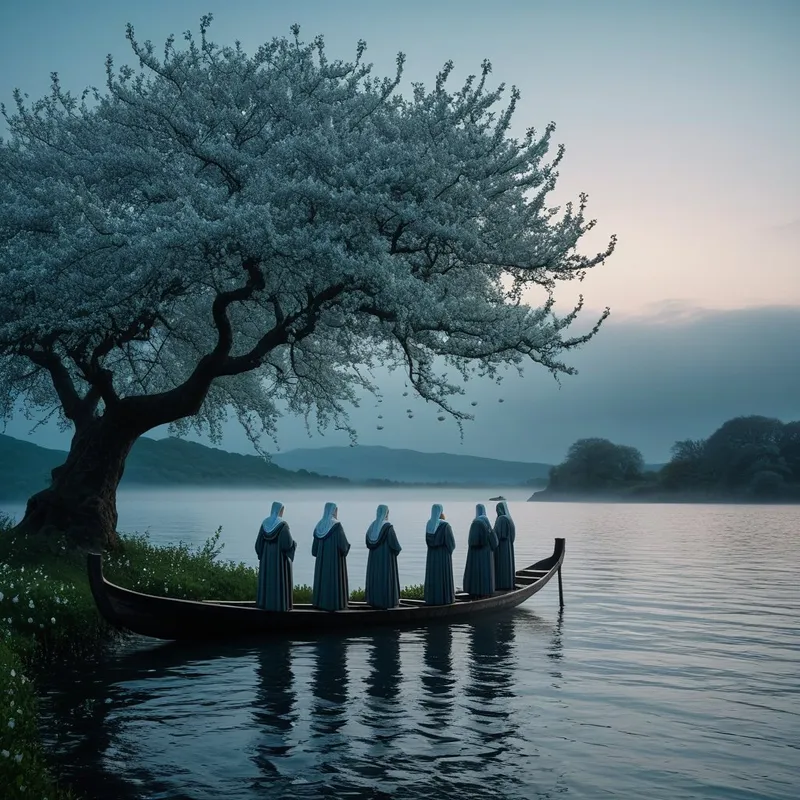
On the shore, nine figures wait. They are the Sisters of Avalon, clad in robes the colour of mist and ash. Their leader is Morgan, now in her other aspect: not a schemer of courts, but a ban-druí, a woman of deep craft. Their faces are serene, timeless. They do not speak as the barge grounds itself on the pearlescent shore. With hands that know the secrets of herb and bone, of spirit and flesh, they lift the king. Their touch is cool, their movements a silent ritual older than Christendom.
They carry him not to a hall, but to a green mound, a sídhe that hums with a low, terrestrial song. Within, in a chamber lit by a single, unwavering flame, they lay him on a bed of carved stone. Morgan places her hands upon his wound. She sings in a language of bees and flowing water. The other sisters join, their voices weaving a net of sound around the broken king. Here, in this place between the worlds, the final battle is not undone, but its venom is drawn out. The king does not wake. He enters a sleep that is not death—a suspension, a deep, healing caul of time. He is taken into the isle, into the apple-scented dark, to be made whole by a magic the world has forgotten. The barge remains, empty, on the shore, a silent promise to a world waiting for its return.
Cultural Origins & Context
The roots of Avalon sink deep into the pre-Christian soil of the Celtic otherworld. While its most famous incarnation is in the later medieval Arthurian cycles of Geoffrey of Monmouth and Sir Thomas Malory, its essence is pure Celtic cosmology. The Celts envisioned not a linear afterlife of heaven or hell, but a parallel realm, the Tír na nÓg or Annwn, often located over the western sea or within hollow hills. These were places of eternal feasting, beauty, and healing, accessible only at liminal points—dusk, dawn, mist, or via a guide.
Avalon, or Ynys Afallon (Isle of Apples), is a direct descendant of this tradition. The apple, with its five-petaled blossom (a pentagram) and seeds of life within, was a powerful symbol of immortality, magic, and the otherworld in Celtic lore. The isle was ruled by powerful female figures, the nine sisters, echoing the Celtic veneration of triple goddesses and female sovereignty. This myth was not a fixed scripture but a living tradition, told by bards and fili around fires. Its function was to map the psyche’s journey beyond catastrophe, to provide a narrative container for the hope of restoration after profound cultural and personal trauma—like the trauma of the Saxon invasions which shadow the Arthurian mythos.
Symbolic Architecture
Avalon is not merely a location; it is a state of being. It represents the temenos, the sacred, bounded precinct where radical healing can occur. It is the inner sanctuary we must retreat to when the ego’s kingdom—our ambitions, our persona, our worldly self—has been shattered on the fields of our personal Camlanns.
The wounded king must leave his kingdom to find his wholeness. The conscious ego must submit to the unconscious to be remade.
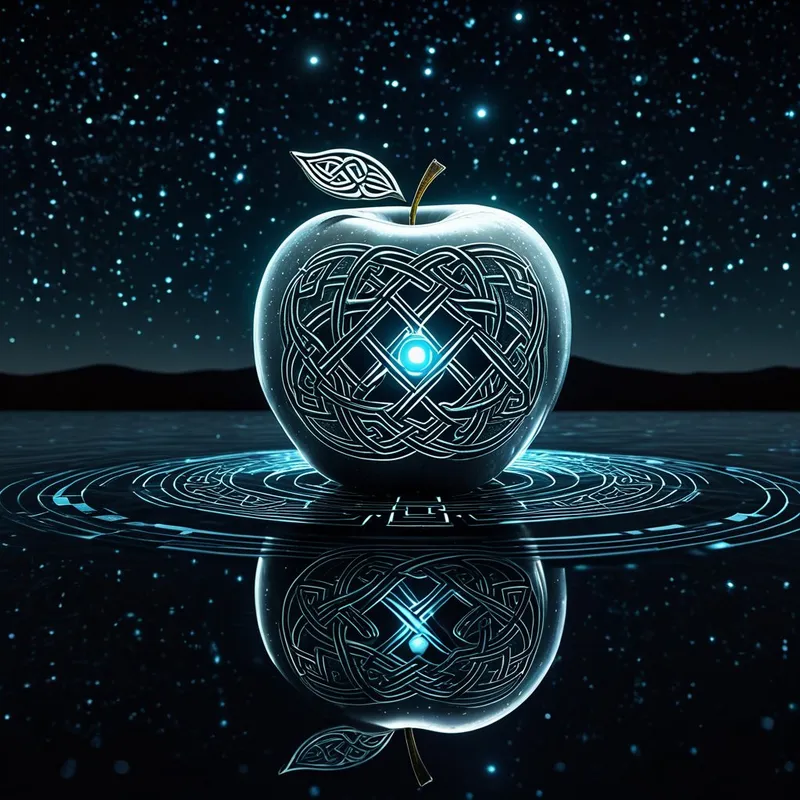
The Wounded King (Arthur) symbolizes a dominant, but now broken, conscious attitude. The Mist is the necessary veil of the unconscious, obscuring the logical path, requiring surrender. The Barge is the vehicle of transition, the liminal state of neither-here-nor-there that carries us into deep process. The Nine Sisters, led by Morgan, embody the transformative, nurturing, and often feared aspects of the anima and the deep feminine wisdom of the psyche. They are the archetypal healers who operate by laws beyond reason. Finally, the Apple is the symbol of the pneuma, the spirit-body, offering not mere cure, but transmutation into a more essential state.
The Dreamer's Resonance
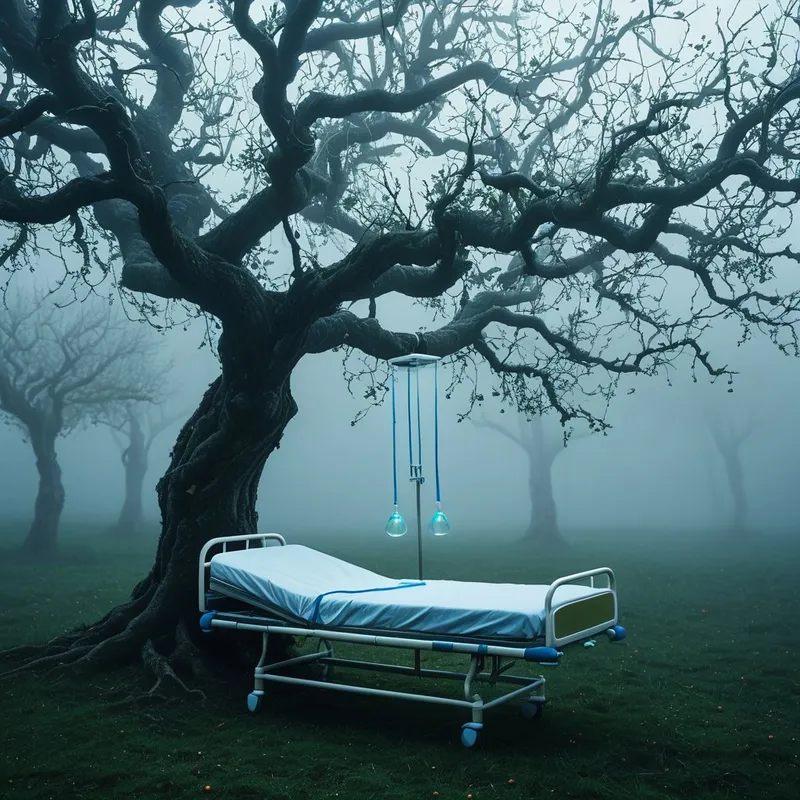
When Avalon appears in modern dreams, it rarely comes as a named island. It manifests as a profound somatic and psychological signal of necessary retreat and deep-cell-level healing. The dreamer may find themselves in a secluded, impossibly beautiful sanatorium; a quiet, fog-bound garden; or being led by a calm, authoritative feminine figure away from a scene of wreckage.
The body in the dream often feels heavy, exhausted, or carrying a vague, unlocalized wound. This is the psyche signaling that the adaptive, striving consciousness is burnt out. The Avalon dream is an intervention from the Self, ordering a cease-fire. The emotional tone is one of profound relief mixed with sorrow—the sorrow of relinquishing a fought-for identity, the relief of finally being taken into care. It is the dream that comes after burnout, a severe illness, a divorce, or any catastrophic failure. It says the battle is over, and a deeper, slower, more organic process must now begin.
Alchemical Translation
The journey to Avalon is a perfect map of the alchemical nigredo and the Jungian process of individuation. Camlann is the mortificatio—the necessary death of the old, heroic ego-complex that has become rigid and untenable. The king’s wound is the crack through which the light—or the deep, dark waters—of the unconscious can enter.
The sword is returned to the water, the tool of conscious will surrendered to the source of life. Only then can the barge appear.
The voyage across the misty waters is the descent into the unconscious (nekyia), a passive, patient allowing. Avalon itself is the vas hermeticum, the sealed vessel where the work of transformation occurs. Here, the masculine principle of conscious rulership (Arthur) is tended to by the feminine principle of instinctual wisdom and nature (Morgan and the Sisters). This is the sacred coniunctio, not in a romantic sense, but as a reintegration of severed psychic opposites.
For the modern individual, the myth instructs: when your world falls apart, you must, in some symbolic or literal way, “go to Avalon.” This means creating a temenos—through therapy, solitude, art, or nature—where you are not a king, a CEO, or a hero, but simply a being in need of mending. It is the courage to be passive, to be healed by forces you do not control, to sleep the long sleep of incubation. From this, one does not return as the same king to the same kingdom. One returns, if at all, with a different kind of sovereignty—one rooted not in the sword, but in the apple; not in rule, but in wholeness. This is the promise of the isle in the mists: that within the deepest wound lies the gateway to the restorative otherworld.
Associated Symbols
Explore related symbols from the CaleaDream lexicon: