Attis and the Pine Tree Myth Meaning & Symbolism
A youth devoted to the goddess Cybele castrates himself in a divine frenzy, dying beneath a pine tree, which becomes his eternal, sacred vessel.
The Tale of Attis and the Pine Tree
Hear now a tale not of Olympus, but of the deep, drum-throbbing earth. It begins in the wild highlands of Phrygia, where the mountains themselves breathe with the presence of [the Great Mother](/myths/the-great-mother “Myth from Jungian culture.”/). Her name is [Cybele](/myths/cybele “Myth from Greek culture.”/), she who wears a crown of towers, she whose chariot is drawn by lions, she in whom all life is conceived and to whom all life returns.
From this primal womb of rock and root was born a youth of impossible beauty. His name was Attis. His form was as slender and graceful as a sapling, his eyes held the light of a spring morning, and his destiny was woven tight to the goddess’s heart. Cybele loved him, chose him as her sacred consort, her priest-king. She set upon him a vow: eternal devotion, a heart and body belonging solely to her divine essence.
For a time, [the world](/myths/the-world “Myth from Tarot culture.”/) was in harmony. Attis served in the goddess’s wild rites, the air fragrant with pine resin and the rhythmic, hypnotic beat of the tympanum. But the mortal world has its own snares. Whether by fate’s cruel twist or a nymph’s enchantment—some whisper of a princess of Pessinus—Attis’s heart wavered. The pure, fierce love for the goddess was clouded by a earthly passion. He turned his gaze from the mountain to the city, contemplating a mortal marriage.
[The earth](/myths/the-earth “Myth from Hindu culture.”/) shuddered. Cybele’s love, vast as the cosmos, could become a fury just as immense. Her presence erupted into the grove where Attis stood with his companions. It was not anger they felt, but an overwhelming, terrifying ecstasy. The very pulse of the goddess entered them, a divine madness (mania) that shook the soul loose from reason. The sweet flute music turned shrill, the drumbeats became the pounding of their own hearts pushed to the brink.
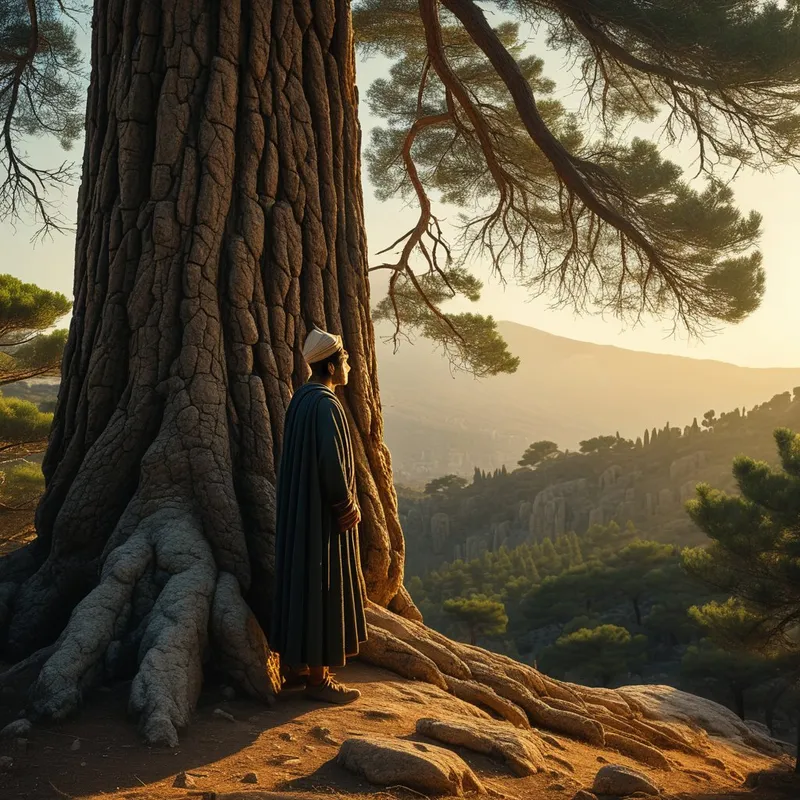
In this storm of sacred frenzy, under the indifferent gaze of a tall pine tree, Attis’s mortal doubt was burned away in a flash of transcendent, terrible clarity. To atone, to return wholly to the goddess, to sever the tie to the fleeting mortal world that had tempted him—he took a sharp stone. With a cry that was both agony and ecstatic release, he performed the ultimate act of devotion: he castrated himself.
His lifeblood soaked into the roots of the pine. He fell, dying, as his companions danced on in their own mad, self-wounding devotion. Where his blood met the earth, violets sprang forth, a tender, purple lament. But the tale does not end in silence. Cybele, her point made in the most devastating way, was filled not with vengeance, but with infinite, grieving love. She would not let her beloved be consumed by mere [death](/myths/death “Myth from Tarot culture.”/). She begged Zeus for a boon: that Attis’s body would never decay.
Zeus granted it. The pine tree under which Attis fell became more than a tree. It became his eternal vessel. His spirit was transmuted, forever bound to the evergreen that neither dies in winter nor sheds its needle-leaves. From that day, the pine tree was sacred. Each spring, a pine would be cut, wrapped in linen like a corpse, adorned with violets, and carried in procession by wailing devotees, to be buried and then reborn—a testament that from utter sacrifice, a strange, vegetal eternity is born.
Cultural Origins & Context
While this myth reached its most elaborate form in the later Roman world, its heart beats from Anatolia. The story of Attis is fundamentally Phrygian, a central narrative of the ecstatic, mystery-driven cult of the Great Mother Cybele, which was imported into Greece around the 6th [century](/myths/century “Myth from Biblical culture.”/) BCE and later to Rome. This was not the mythology of the Homeric bard, but of the initiate. It was passed down not in epic verse for aristocratic banquets, but in the secret rites (mysteries) and public festivals like the Hilaria.
Its societal function was multifaceted. For the state, it sanctified the power of the earth and the cycles of agriculture—the death and rebirth mirrored in the seasonal round. For the individual, particularly the Galli, it provided a divine archetype for their own extreme devotion, transforming a shocking act into a sacred imitation (mimesis). The myth explained the ritual: the cutting of the pine, the days of mourning, the wild celebration of rebirth. It was a story that made sense of a religion that stood deliberately outside Greek norms of moderation, embracing frenzy, gender fluidity, and a direct, visceral connection to the raw power of creation and destruction.
Symbolic Architecture
The myth is a dense [forest](/symbols/forest “Symbol: The forest symbolizes a complex domain of the unconscious mind, representing both mystery and potential for personal growth.”/) of symbols, each a [doorway](/symbols/doorway “Symbol: A doorway signifies transition, opportunities for new beginnings, and the choice to walk through into the unknown.”/) to a psychological [truth](/symbols/truth “Symbol: Truth represents authenticity, honesty, and the quest for knowledge beyond mere appearances.”/). Attis represents the youthful, burgeoning [spirit](/symbols/spirit “Symbol: Spirit symbolizes the essence of life, vitality, and the spiritual journey of the individual.”/) of [life](/symbols/life “Symbol: The symbol of ‘Life’ represents a journey of growth, interconnectedness, and existential meaning, encompassing both the joys and challenges that define human experience.”/) and [consciousness](/symbols/consciousness “Symbol: Consciousness represents the state of awareness and perception, encompassing thoughts, feelings, and experiences.”/), beautiful but unrooted, caught between divine calling and earthly attachment. His castration is the ultimate symbolic act—not of [punishment](/symbols/punishment “Symbol: A dream symbol representing consequences for actions, often tied to guilt, societal rules, or internal moral conflicts.”/), but of radical, voluntary surrender.
To sacrifice the very seat of generative power is to offer up one’s future, one’s potential for creating a separate, mortal lineage, to the source itself.
The pine [tree](/symbols/tree “Symbol: In dreams, the tree often symbolizes growth, stability, and the interconnectedness of life.”/) is the [axis](/symbols/axis “Symbol: A central line or principle around which things revolve, representing stability, orientation, and the fundamental structure of reality or consciousness.”/) of the [drama](/symbols/drama “Symbol: Drama signifies narratives, emotional expression, and the exploration of human experiences.”/). It is [the witness](/symbols/the-witness “Symbol: A figure observing events without direct participation, representing conscience, memory, or societal judgment.”/), the [altar](/symbols/altar “Symbol: An altar represents a sacred space for rituals, offering, and connection to the divine, embodying spirituality and devotion.”/), and finally the transformed [body](/symbols/body “Symbol: The body in dreams often symbolizes the dreamer’s self-identity, personal health, and the relationship they have with their physical existence.”/). Evergreen, it symbolizes immortality and [resilience](/symbols/resilience “Symbol: The capacity to recover quickly from difficulties, adapt to change, and maintain strength through adversity.”/); its resin is preservative and fragrant, akin to embalming spices. It becomes the [axis](/symbols/axis “Symbol: A central line or principle around which things revolve, representing stability, orientation, and the fundamental structure of reality or consciousness.”/) mundi for Attis’s cult, the place where [heaven](/symbols/heaven “Symbol: A symbolic journey toward ultimate fulfillment, spiritual transcendence, or connection with the divine, often representing life’s highest aspirations.”/) and [earth](/symbols/earth “Symbol: The symbol of Earth often represents grounding, stability, and the physical realm, embodying a connection to nature and the innate support it provides.”/) meet in his transfigured state. The violets born from his [blood](/symbols/blood “Symbol: Blood often symbolizes life force, vitality, and deep emotional connections, but it can also evoke themes of sacrifice, trauma, and mortality.”/) are the poignant [beauty](/symbols/beauty “Symbol: This symbol embodies aesthetics, harmony, and the appreciation of life’s finer qualities.”/) that springs from profound suffering, a fleeting, tender counterpoint to the pine’s eternal rigidity.
Cybele embodies the archetypal Great [Mother](/symbols/mother “Symbol: The symbol of ‘Mother’ represents nurturing, protection, and the foundational aspect of one’s emotional being, often associated with comfort and unconditional love.”/) in her full duality: the nourishing, all-encompassing [source](/symbols/source “Symbol: The origin point of something, often representing beginnings, nourishment, or the fundamental cause behind phenomena.”/) and the devouring, demanding force that will reclaim what belongs to her. The conflict is not between good and evil, but between two [kinds](/symbols/kinds “Symbol: The symbol ‘Kinds’ refers to the classification or categorization of things, emphasizing distinctions and the nature of variety within life.”/) of love—the possessive, total love of the archetypal Mother and the differentiating, individualizing love of the mortal world.
The Dreamer’s Resonance
When this myth stirs in the modern unconscious, it rarely appears as a literal narrative. Instead, one might dream of being trapped in, or becoming, a tree—a feeling of glorious but static permanence, of being a monument rather than a person. There may be dreams of profound, self-inflicted wounds that feel simultaneously like catastrophe and liberation. There could be visions of an overwhelming feminine presence (not necessarily a person) that demands absolute loyalty, threatening annihilation if one seeks independence.
Somatically, this can relate to processes of major life transition where an old identity must be “cut away” to serve a deeper, more authentic calling. It speaks to the psychological crisis of the “mother complex,” where the task is not to blame the internalized mother, but to perform the painful, Attis-like act of self-limitation—sacrificing the comfortable, dependent patterns (the “earthly marriage”) to commit to one’s own inner authority and spiritual development. The dreamer is going through a rite of passage where a part of the [psyche](/myths/psyche “Myth from Greek culture.”/) must die so that the essential core can find a new, more eternal form of expression.

Alchemical Translation
In the alchemy of the soul, the myth of Attis maps the brutal, necessary stage of [nigredo](/myths/nigredo “Myth from Alchemical culture.”/). This is the dark night, the moment of utter dissolution where [the ego](/myths/the-ego “Myth from Jungian culture.”/), faced with the overwhelming power of [the Self](/myths/the-self “Myth from Jungian culture.”/) (Cybele), must surrender its most prized possessions: its autonomy, its generative plans, its claim to a separate destiny.
The pine tree is the Lapis in this drama—not a glittering stone, but a living, enduring organism born from the putrefaction of the old man.
The process is one of psychic transmutation through radical sacrifice. The ego’s desire to “marry” the world, to project its fertility outward in conventional ways, is cut off. This is not annihilation, but a redirection of energy. The libido that once flowed outward is forced inward, downward, into the roots of being. There, fertilized by its own sacrifice, it gives birth not to children, but to a new structural principle: the enduring, resilient Pine-Self.
For the modern individual navigating individuation, Attis’s path is a warning and a guide. It warns of the catastrophic potential of ignoring a deep, archetypal calling. But it guides by showing that the ensuing crisis, if fully embraced in its horrific totality, contains its own resolution. The goal is not to become a sterile monument, but to achieve the pine’s quality: to be grounded, resilient, alive in all seasons, and serving as a sacred axis for one’s own life—a consciousness that has died to its petty, mortal ambitions and been reborn into a service that is both eternal and uniquely one’s own. The violets at the base remind us that from this severe process, a unexpected and tender beauty forever blooms.
Associated Symbols
Explore related symbols from the CaleaDream lexicon: