
Asvattha Myth Meaning & Symbolism
The Asvattha tree, rooted in heaven and branching to earth, symbolizes the inverted nature of reality and the soul's journey from the eternal to the temporal.
The Tale of Asvattha
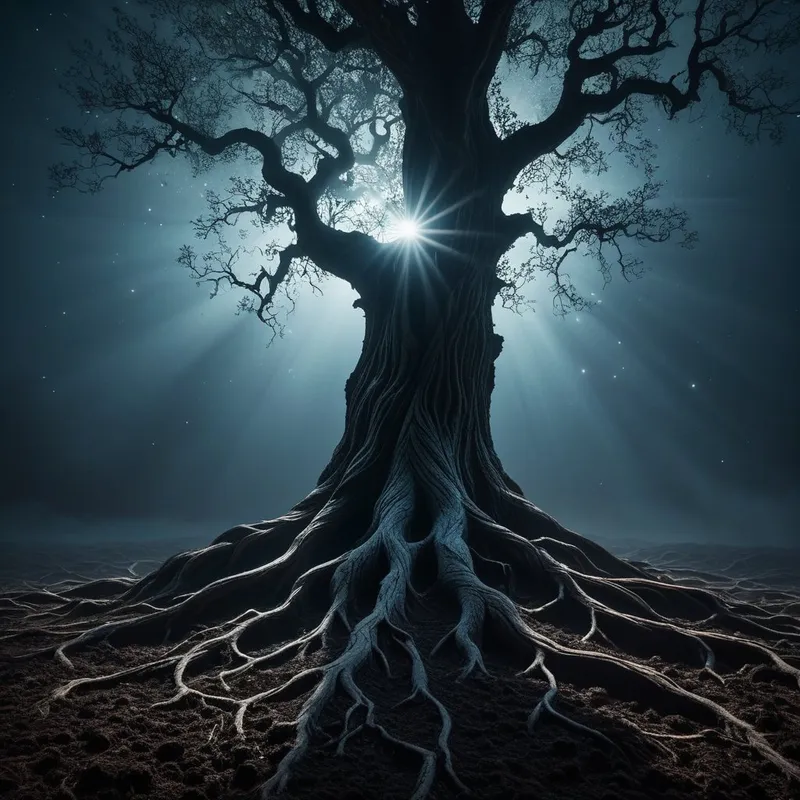
Listen. Before the first name was spoken, before the first mountain rose from the primal waters, there stood a tree. But this was no ordinary tree of earth and bark. Its roots were not buried in soil, but were anchored in the highest heaven, in the luminous, unmanifest realm of Brahman. From that ineffable source, its great roots descended, plunging through the veils of the cosmos like pillars of solidified light.
And its branches? They spread downward. They did not reach for the sun, for they were born from a sun beyond suns. They unfurled into the world of form, into the realm of Maya, becoming the very fabric of the manifested universe. Its leaves were the sacred Vedic hymns, rustling with the breath of creation. This was the Asvattha, the Peepal tree, the Tree of Life—and it was utterly, terrifyingly upside-down.
The sages, the Rishis, who sat in deep meditation beneath its earthly shade, did not see its true form with their physical eyes. They felt it. In the silence between heartbeats, they perceived the great inversion. They understood they were not sitting on the ground looking up at a tree, but were, in truth, clinging to its lower branches, gazing up into an abyss of roots that vanished into infinity. The solid earth beneath them was but a single, broad leaf in the vast canopy of manifestation.
Then came a voice, not of wind or thunder, but of pure knowing. It was the voice of Vishnu, the All-Pervading. He spoke from within the heart of the tree itself. "Know this," the voice whispered and roared simultaneously, "I am the Asvattha, with roots above and branches below. The Vedas are my leaves. He who knows this knows the Veda."
But to know it was not merely to hear it. To know it was to undergo a great turning. The conflict was not of armies, but of perception. The rising action was the slow, agonizing reorientation of the soul, realizing its own position—hanging from the branches of the temporal world, mistaking the fleeting for the real. The resolution was not an escape, but a recognition. To cut this tree down, the voice declared, was not with an axe of steel, but with the sharp weapon of non-attachment, of Jnana. Only then could one follow the path of the roots back upward, against the downward flow of creation, to merge with the source from which the great tree sprang.
Cultural Origins & Context
The myth of the Asvattha is not a folktale with a single author, but a philosophical revelation embedded in the very bedrock of Hindu thought. Its most famous exposition is found in the Bhagavad Gita (Chapter 15), where Krishna reveals it to the warrior Arjuna. This places the myth within the epic narrative of the Mahabharata, a text of immense cultural and moral weight.
However, its roots—appropriately—dig deeper, into the earlier Upanishads, such as the Katha and the Mundaka. Here, it was not a story told for entertainment, but a upadesha (instruction) passed from guru to disciple in the forest hermitages. Its societal function was ontological cartography. It provided a model of the cosmos and the individual's place within it, offering a visual and symbolic framework for the central Vedic quest: understanding the relationship between the eternal (Atman) and the transient world.
The living Asvattha tree, the Peepal (Ficus religiosa), is itself a ubiquitous cultural presence, often planted near temples and revered as the abode of deities. The myth thus bridges the abstract and the tangible, giving profound sacred meaning to a familiar natural object, transforming a tree into a temple and a map of reality.
Symbolic Architecture
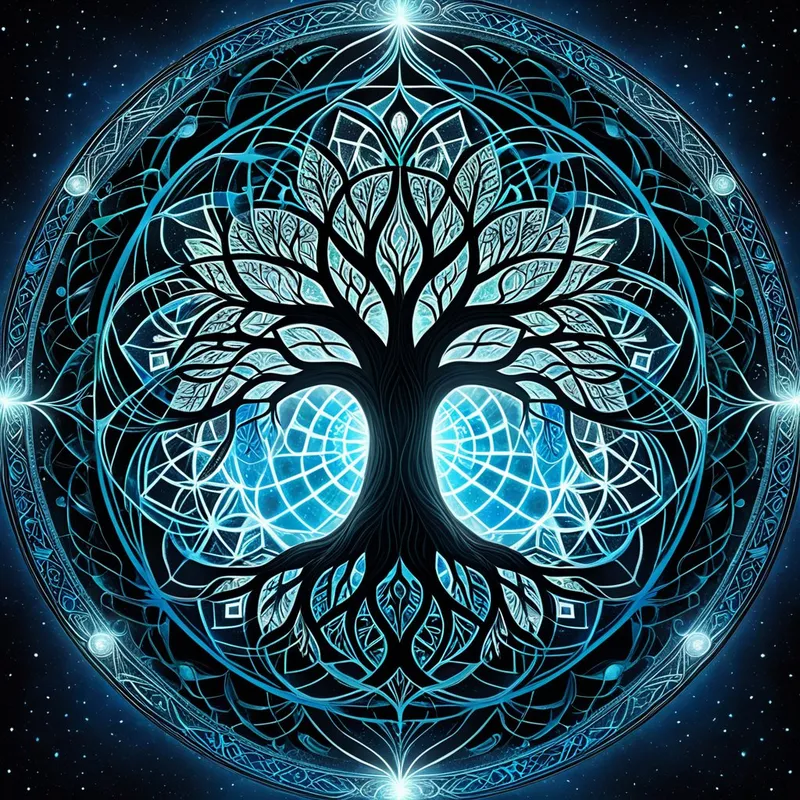
The Asvattha is the ultimate symbol of inverted reality. It represents the entire cosmos as a process of emanation, where the cause is above and the effects branch out below. Our ordinary perception is thus a profound misunderstanding.
We believe we are rooted in the world, but the myth insists we are dangling from it. Our true home is not the soil of circumstance, but the sky of pure consciousness.
The roots in heaven symbolize the unmanifest, eternal source—Brahman, the divine ground of being. The branches below represent the manifested universe in all its diversity, including the realms of the gods, humans, animals, and the underworlds. The leaves as the Vedas signify that all sacred knowledge and the laws of nature (Dharma) are the living, breathing expressions of this cosmic structure.
Psychologically, the tree maps the human psyche. Our conscious mind, with its myriad thoughts, desires, and experiences, is the spreading canopy. Our personal history and ego are the trunk. But our deepest, often unconscious, foundation—the Self, the core of our being—is not in the personal past or the body. It is "above," in the transpersonal, archetypal realm. We spend our lives focused on the leaves (our daily concerns), unaware of the divine roots that sustain us.
The Dreamer's Resonance
When this myth stirs in the modern unconscious, it often manifests not as a literal tree, but as a profound sensation of inversion or disorientation within a dream. One might dream of a house where the furniture is on the ceiling, or of climbing a mountain only to find the summit is a deep well leading upward. There is a somatic feeling of gravity reversing.
This dream pattern signals a critical psychological process: the beginning of a re-orientation of the ego. The dreamer's psyche is challenging the foundational assumption that identity is built from biography, achievements, and relationships (the "branches"). The dream introduces the unsettling, yet liberating, possibility that these are effects, not causes. The discomfort is the ego's resistance to looking "up" into the unknown roots of its own existence, to sourcing its identity from the transpersonal Self rather than from the temporal world. It is the soul feeling the first tug of the "axe of non-attachment" beginning its work.

Alchemical Translation
The alchemical work modeled by the Asvattha myth is the opus contra naturam—the work against nature. Here, "nature" is the downward, branching flow of identification with the phenomenal world. The process of individuation, of becoming whole, requires a radical reversal of this flow.
The alchemical goal is not to destroy the tree of life, but to learn to climb it backwards, from leaf to twig, from branch to bough, from trunk to root, against the current of manifestation.
First comes Nigredo, the blackening: the disillusionment with the "branches." Success, status, even personal narratives lose their nourishing sap. One feels cut off, dangling. This is the necessary despair that prepares the ground for insight.
Then, Albedo, the whitening: the dawning recognition of the inversion. Through meditation, introspection, or crisis, one "sees" the tree's true form. This is the moment of Jnana, the sharp axe. It is not an emotional release, but a cognitive shift that severs the primary identification with the ego-personality.
Finally, Rubedo, the reddening: the journey upward along the roots. This is the integration. One does not abandon the world (the branches), but now engages with it from a new, grounded-in-the-above perspective. Actions flow from the source, not from the clamor of the leaves. The individual becomes a conscious vessel, a point where the root touches the branch, where the eternal expresses itself in time. They become, in a sense, a living embodiment of the Asvattha itself—in the world, but not of it.
Associated Symbols
Explore related symbols from the CaleaDream lexicon: