Astronomical Observatories Myth Meaning & Symbolism
A tale of ancient sky-watchers who built stone eyes to read the celestial script, bridging the earthly and divine to birth time, law, and the self.
The Tale of Astronomical Observatories
Listen. Before there were cities, before there were kings, there was the dark. And in the dark, a terror. The sun, our father, would grow weak and flee. The moon, our mother, would hide her face. The stars would wander lost, and the rains would forget the earth. The people huddled in the cave of chaos, their lives ruled by the whim of sky and soil.
Then came the First Watchers. They were not gods, but men and women with fire in their minds. While others slept, they kept vigil. They saw how the North Star held its ground while its brethren danced in a great wheel. They marked the place on the horizon where the sun, shivering and pale, would be reborn after the longest night. They learned the rhythm of the Great Wanderers.
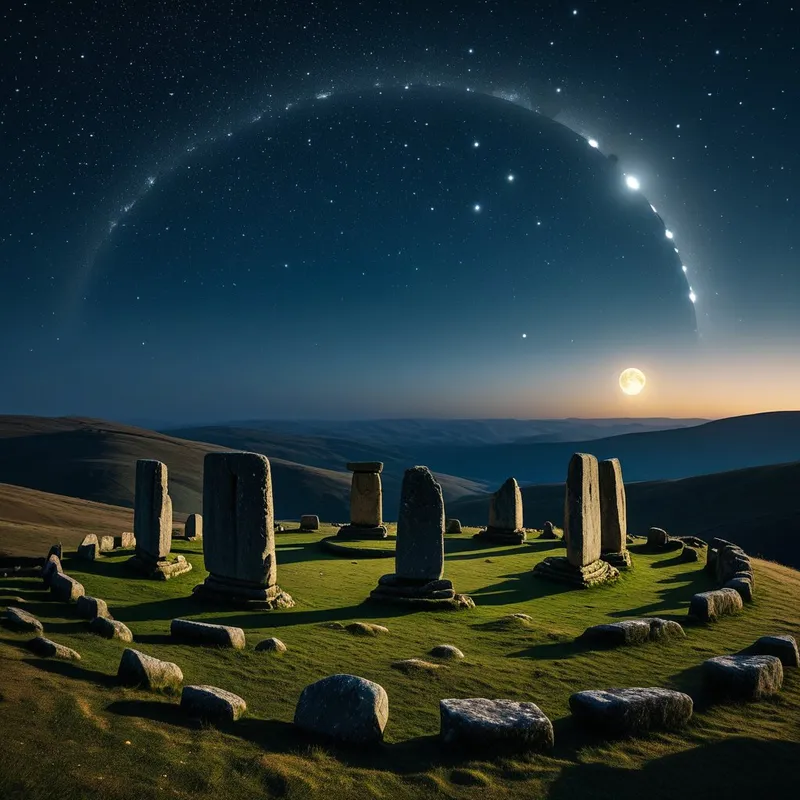
But memory is a frail thread. So they spoke to the stone. With calloused hands and ropes of sinew, they began to build an eye for the earth. They hauled the grey bones of the mountains and set them upright—menhirs like silent sentinels. They laid the lintels across their brows, creating doorways that framed nothing but sky.
The work was the prayer. For generations, they labored, aligning heel-stone to sunrise, post-hole to moon-set. They carved channels that caught the starlight like water. They built towers that were not for defense, but for sight; pyramids that were not just tombs, but stairways to the zenith. They created the Observatory—a vast, stone clock, a calendar etched into the landscape.
And then, the moment. On the dawn of the winter solstice, the eldest Watcher stood in the heart of the circle. The people gathered, breath held. A sliver of light pierced the long dark. It crept across the frozen ground, a blade of gold. It touched the altar stone. It slid, perfectly, through the narrow gate of the farthest trilithon, a spear of certainty thrown from the heart of the dying sun. A cry went up, not of fear, but of recognition. The sky had spoken. The covenant was written in light and shadow. Time was born from chaos, and the universe was revealed not as a capricious spirit, but as a text that could be read.

Cultural Origins & Context
This is not one myth, but a pattern etched across the dreaming of humanity. We find its fragments in the oral traditions surrounding Stonehenge, in the priestly lore of the Zat ec, in the Vedic hymns to Rta, and in the ancestral memory of the Ancestral Puebloans at Chaco Canyon. It was passed down not as a single story, but as a sacred science, taught by astronomer-priests to initiates through direct observation and ritual re-enactment.
Its societal function was foundational. It was the myth that made civilization possible. By predicting the solstices, it dictated the agricultural cycle—when to plant, when to harvest, when to make offerings. It created a shared, objective time, allowing for the coordination of large-scale societies. More profoundly, it established a cosmic law. The regularity of the heavens became the model for earthly law, social order, and moral truth. The observatory was the pivot point between the human and the divine, the place where cosmic order (Kosmos) was made manifest in the human world.
Symbolic Architecture
Psychologically, the observatory is not merely a building; it is the architecture of the emerging conscious mind. The chaotic, unpredictable "sky" represents the undifferentiated unconscious—a realm of powerful, archetypal forces (sun, moon, stars) that govern our inner lives with seemingly arbitrary power. The terror of the dark is the anxiety of living at the mercy of these unconscious impulses and moods.
The act of observation is the first act of consciousness. To mark a cycle is to distinguish it from the flux, to name it, and thus to begin to have a relationship with it.
The First Watchers symbolize the nascent ego, the part of the psyche that can step back, observe patterns, and seek meaning. The immense, patient labor of building with stone represents the effort required to structure consciousness—to create enduring psychic frameworks (beliefs, values, disciplines) that can contain and measure the flow of inner experience. The perfect alignment of stone and celestial event is the moment of symbolic realization, where an inner truth (an archetypal pattern) becomes concretely understood and integrated into the framework of the self.
The Dreamer's Resonance
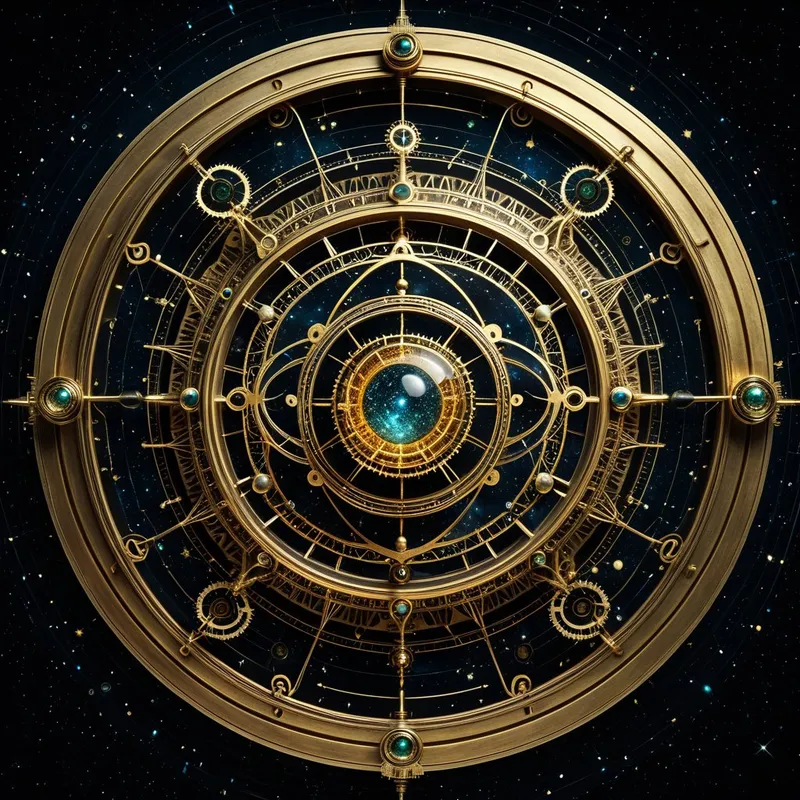
When this myth stirs in the modern dreamer, it often manifests as dreams of intricate structures, precise alignments, or viewing portals. One might dream of finding a hidden room in their house with a telescope pointed at a strange constellation, or of trying to assemble a complex, clock-like mechanism that measures something intangible.
Somatically, this can correlate with a felt need for order during a period of internal chaos or transition. The psyche is attempting to "build an observatory"—to create an internal vantage point from which to witness and make sense of powerful, unconscious contents (a "solstice" of emotion, a "lunar cycle" of a relationship pattern) without being overwhelmed by them. The dream is an expression of the Self's impulse toward orientation and meaning-making. The frustration in the dream—the mechanism that won't fit, the telescope that's out of focus—mirrors the struggle to find the right perspective or framework to understand one's life.
Alchemical Translation
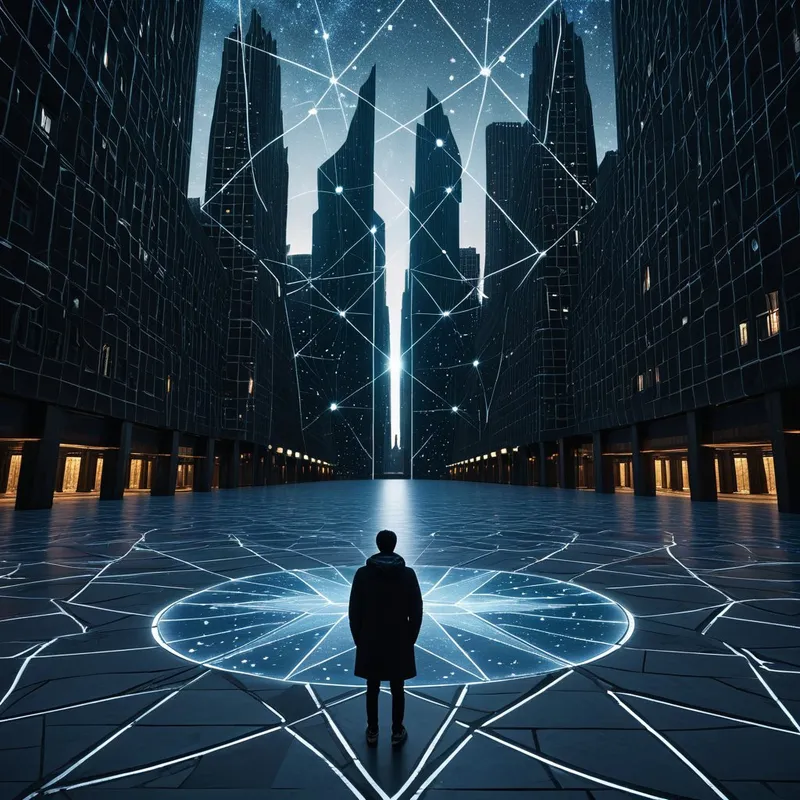
The alchemical process mirrored here is coagulatio—the making solid, the embodiment of spirit into matter, or in psychological terms, the crystallization of unconscious insight into conscious structure. The modern individual's journey of individuation is, in part, the building of a personal observatory.
Individuation requires that we become both the Watcher and the Builder. We must observe the recurring patterns of our complexes (the "wandering stars" of our psyche), and we must then labor to construct a durable, ethical framework—a personal cosmology—that can align with and honor those truths.
The "chaotic sky" is the raw material of our unlived life, our shadows, our potentials. The "solstice alignment" is that moment of profound self-knowledge, where a lifelong pattern finally makes sense in the light of awareness, and clicks into place within our understanding. This is not a one-time event, but a continual process. We build our psychic stone circles over a lifetime, adjusting the alignments as our consciousness grows. The triumph of the myth is not control over the cosmos, but a sacred partnership with it. The modern individual learns to read their own inner celestial script, to predict their own seasons of growth and retreat, and in doing so, transforms existential terror into participatory awe. The observatory, in the end, is the psyche itself—a vessel built for witnessing the magnificent and orderly drama of one's own becoming.
Associated Symbols
Explore related symbols from the CaleaDream lexicon: