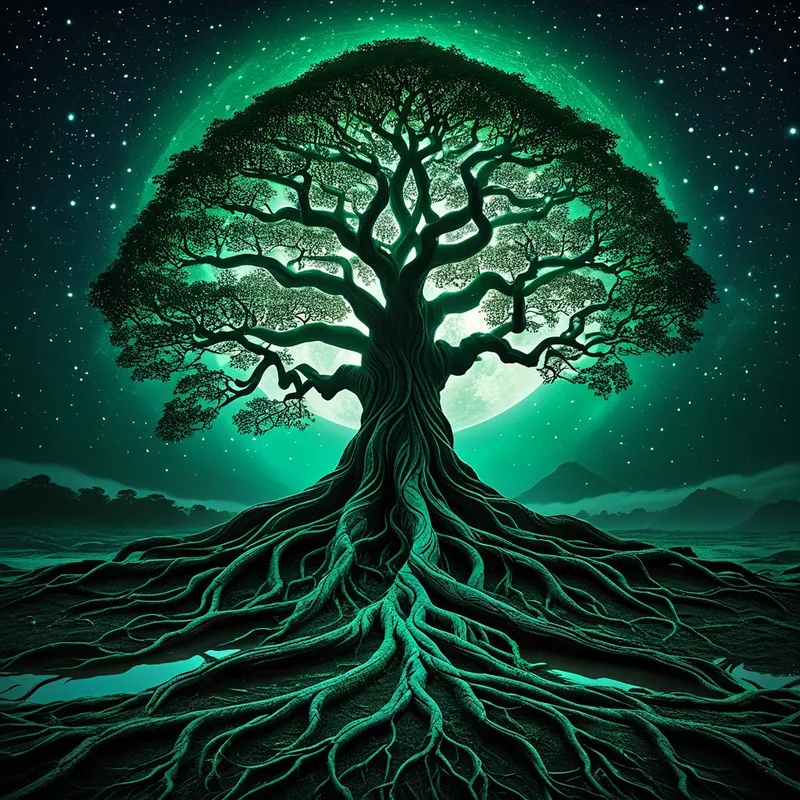
Ashvattha Myth Meaning & Symbolism
The Ashvattha is the cosmic inverted tree, its roots in heaven and branches on earth, embodying the soul's journey from the eternal to the temporal.
The Tale of Ashvattha
Listen, then, to the vision that was shown to the prince who saw beyond the veil of the world.
In a time before time was measured, the great seer Kashyapa sought the ultimate truth. He journeyed beyond the seven mountains, past the rivers of dawn, to a place where the air itself hummed with the primordial syllable Om. There, he beheld it—not a tree as the forests know, but the Tree. Its name was Ashvattha, the Horse-Stander, for its power was such that even the steeds of the sun would halt in awe.
But its form was a paradox to shatter the mind. Its roots, thick as mountain ranges and white as moonstone, were not buried in the dark earth. They plunged upward, into the blinding radiance of Svarga. From those roots in the Highest, a nectar flowed—the Amrita of pure consciousness. And its branches? They spread downward, into the soil of mortal realms, becoming the manifold world of names and forms, of sorrow and joy, of birth and death. Each leaf was a Veda, rustling with the knowledge of all that is, was, and will be.
The sight was too vast for mortal eyes. Kashyapa’s vision swam. He saw the great Vishnu, dark as a raincloud, reclining upon the serpent Ananta Shesha within the very heartwood of the tree. He was its keeper, its indweller. And he saw the brilliant, fierce Agni as a tongue of flame dancing among the high roots, the consumer who would one day reduce the great tree to seed at the end of an age.
A voice then resonated, not through the air, but through the very sap of the tree. It was the voice of the Brahman itself, speaking through the form of the tree. “The wise,” it whispered, a sound like wind through infinite leaves, “know me as the eternal Peepul, with roots above and branches below. The world is my leaf. He who cuts this tree—this tree of attachment, with the strong axe of non-attachment—finds the path from which there is no return.”
And so the vision faded. But the prince of seers, Krishna, would later recount this same mystery to the warrior Arjuna on the battlefield of Kurukshetra. He declared, “I am the Ashvattha among trees.” The tree was not merely seen; it was known as the very structure of existence, and the one who perceived it correctly held the key to liberation.
Cultural Origins & Context
The myth of the Ashvattha is not a folktale with a linear plot, but a metaphysical vision embedded in the most foundational layers of Hindu thought. Its earliest roots are in the Rig Veda (1.24.7), where a cosmic tree is hinted at. It finds its most explicit and philosophically charged descriptions in the later Upanishads, particularly the Katha Upanishad (6.1) and the Shvetashvatara Upanishad (3.9).
Its most famous exposition, however, is in the Bhagavad Gita (Chapter 15). Here, Krishna uses the Ashvattha as the central metaphor to explain the entire structure of reality to the confused Arjuna. This was not a story told around a fire for entertainment; it was a teaching imparted in the crucible of existential crisis, meant to reorient the listener’s perception of the universe and their place within it.
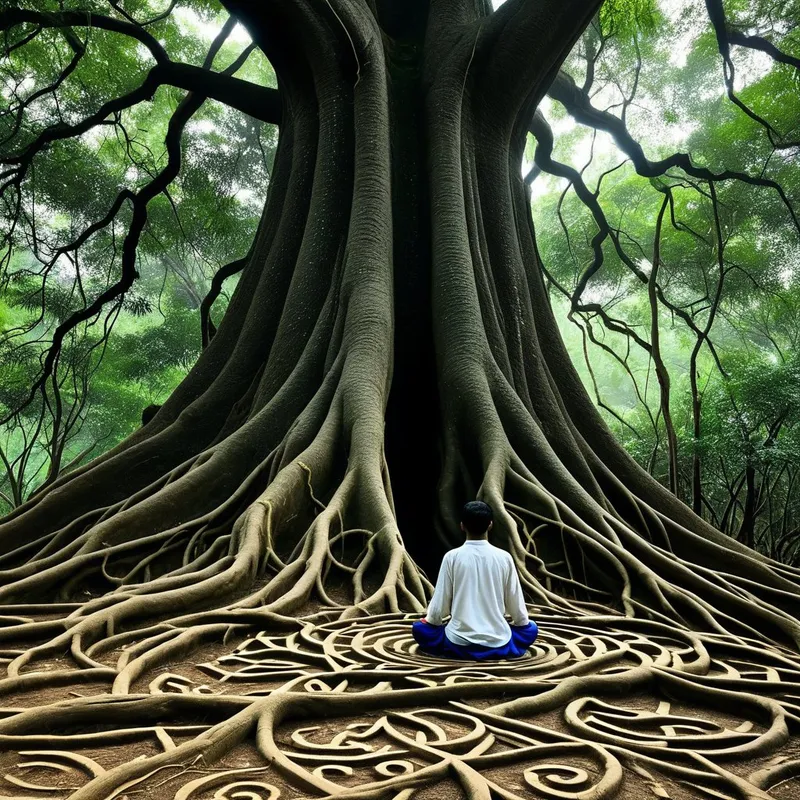
The myth was transmitted orally by gurus to disciples, by sages to kings, as a visual and conceptual tool for meditation. Its societal function was profound: to provide a map of the cosmos that inverted ordinary perception. It taught that the source of life (the roots) is in the spiritual, not the material, and that our earthly experience (the branches) is an emanation from that divine source. To know this was to have one’s values and priorities utterly transformed.
Symbolic Architecture
The Ashvattha is the ultimate symbol of the inverted psyche. Its primary symbolic shock is the reversal of expectation: life does not spring from the dirt upward toward the light, but from the light downward into manifestation.
The roots are in the heavens, for consciousness precedes form. The branches are in the earth, for the material world is the furthest flowering of a divine idea.
The roots in the divine symbolize the unmanifest source, the Brahman, the realm of pure potential and eternal law (Dharma). The trunk represents the axis mundi, the channel through which divine energy flows into creation, often associated with the individual soul (Atman) that connects the two realms. The downward-spreading branches and leaves are the entire phenomenal universe—the senses, the elements, all living beings, and the intricate web of cause and effect (Karma).
Psychologically, this maps the human condition perfectly. We experience ourselves as egoic beings (a leaf) caught in a vast, bewildering network of relationships, desires, and sufferings (the canopy). We feel rooted in our bodies, our histories, our traumas. The myth insists this is the illusion. Our true root is in a deeper, transpersonal consciousness. The “axe of non-attachment” is not a call to heartlessness, but to the disciplined cutting of identification with the transient branches, so that one may trace one’s being back to the immortal root.
The Dreamer's Resonance
When the Ashvattha appears in a modern dream, it is rarely as a literal tree. The dreamer’s psyche translates the archetype into contemporary symbols of connection and inversion.
A person may dream of their family tree diagram, but the names at the top are not ancestors but luminous, abstract principles like “Truth” or “Love,” with the dreamer’s own name on a lower, branching line. They may dream of a skyscraper whose foundation is in the clouds, its floors descending into the bedrock. Or they may experience the somatic sensation of growing upward into the ground and downward into the sky, a dizzying reorientation of the body’s felt sense.
Such dreams often accompany a psychological process of source questioning. The dreamer is, often unconsciously, asking: “What is the true root of my identity? My job? My family role? My trauma? Or something prior to all that?” The dream presents the answer as an image: your source is above, in a realm of unity and clarity, not below in the tangled undergrowth of personal history. This can feel both liberating and deeply unsettling, as it challenges the very foundation of the ego’s self-narrative. The dream is an invitation to invert one’s seeking—to look for strength and origin not in the past or in external validation, but in a deeper, inner axis of being.
Alchemical Translation
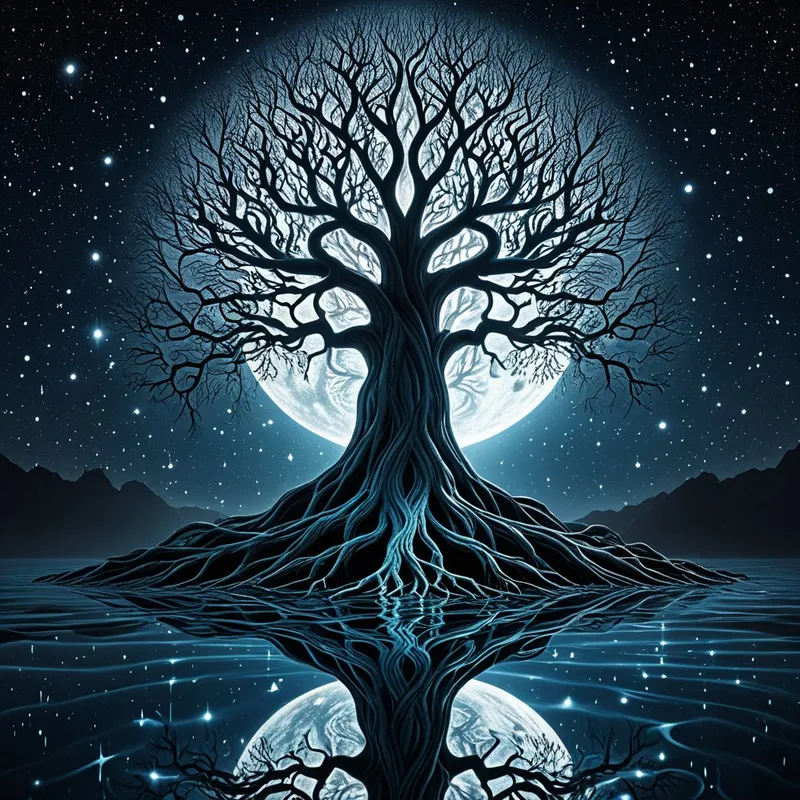
The alchemical work modeled by the Ashvattha myth is the opus contra naturam—the work against nature, meaning against our ordinary, fallen perception. Our default state is to be identified with the leaf, believing we are solely the product of the branches (our genetics, our upbringing, our culture). The process of individuation, in this framework, is the conscious, arduous journey up the tree.
Individuation is not about becoming a unique leaf, but about discovering you are the sap that connects the leaf to the root.
The first stage is Recognizing the Inversion. This is the shock of insight, the “Aha!” moment when one realizes that seeking happiness, peace, or self in the external world of branches (achievement, possessions, relationships) is ultimately fruitless because it is seeking the effect, not the cause. This is the “axe”—the sharp discrimination (Viveka) that begins to cut the bonds of false identification.
The second stage is Navigating the Trunk. This is the sustained practice of meditation, self-inquiry, or any discipline that turns attention inward. It is the path of the Yogi, climbing the central axis of consciousness, navigating past the knots of personal complex (the tree’s gnarls) and the seductive whispers of the senses (the rustling leaves).
The final stage is Rooting in the Source. This is not an acquisition, but a remembrance. It is the realization that one’s true self (Atman) was never not connected to the root (Brahman). The struggle was in the looking. The branches—the world, the personality, the life—do not disappear. They are now seen for what they are: a glorious, temporary flowering of the eternal root. One lives in the world, but is no longer of the world. The inverted tree is seen right-side-up, and in that seeing, the seeker finds the peace that stands firm, like the Ashvattha, while all the worlds turn in its shade.
Associated Symbols
Explore related symbols from the CaleaDream lexicon: