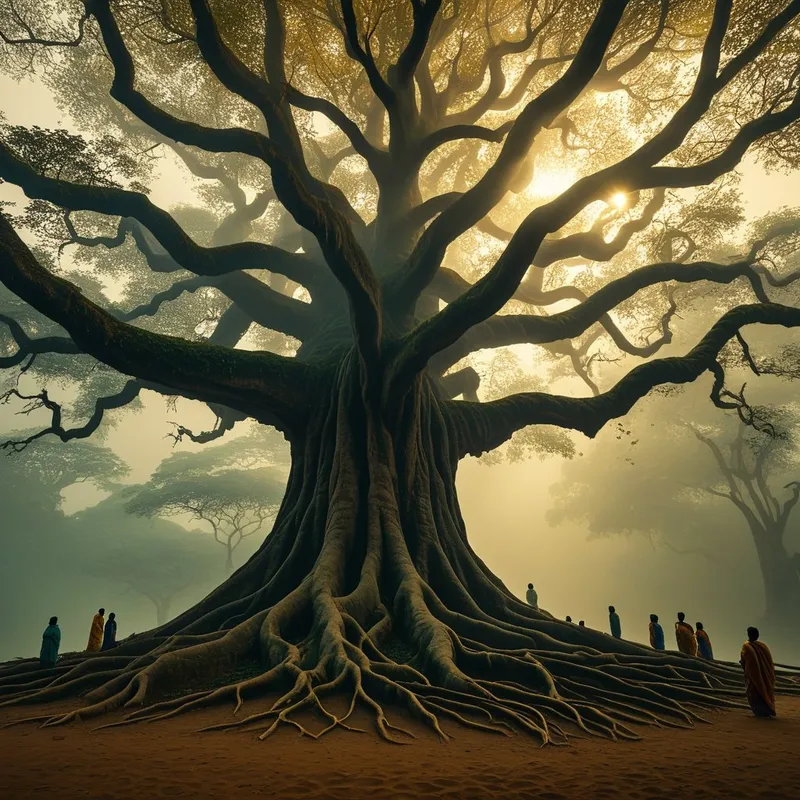
Ashvattha Tree Myth Meaning & Symbolism
The cosmic upside-down fig tree, with roots in heaven and branches on earth, symbolizing the inverted nature of reality and the path to liberation.
The Tale of Ashvattha Tree
Listen. In the beginning, before time was measured, there was a sound—a single, endless syllable that vibrated in [the void](/myths/the-void “Myth from Buddhist culture.”/). From that vibration, a form began to grow. Not from [the earth](/myths/the-earth “Myth from Hindu culture.”/) upward, as all things you know grow, but from the heavens downward. It was the [Ashvattha](/myths/ashvattha “Myth from Hindu culture.”/), [the World Tree](/myths/the-world-tree “Myth from Celtic culture.”/).
Its roots were not buried in soil, but were anchored in the highest, purest realm of reality, [Brahman](/myths/brahman “Myth from Hindu culture.”/). Those roots were white and brilliant, drinking from the nectar of immortality. From that unseen source, the great trunk descended, passing through the veils of the gods, the ancestors, and the subtle realms of mind and dream. And then, its branches burst forth… here. In this world. They spread across our sky, heavy with the fruit of all actions, the leaves of all scriptures, the flowers of every desire. We, the mortals, dwell in its shade, believing the branches to be the whole of existence, unaware that the true source is above, inverted, hidden from our ordinary sight.
This secret was known to the wise. It is said that the great warrior [Arjuna](/myths/arjuna “Myth from Hindu culture.”/), standing on the field of Kurukshetra, his heart heavy with doubt, beheld a terrifying vision. His charioteer, who was none other than the lord [Krishna](/myths/krishna “Myth from Hindu culture.”/), granted him the divine eye. And [Arjuna](/myths/arjuna “Myth from Hindu culture.”/) saw.
He did not see a tree of wood and leaf. He saw a tree of time itself, ablaze with the fire of cosmic dissolution. He saw all beings—heroes and kings, mothers and children—rushing like moths into its flaming maw, unable to escape the relentless cycle of birth and [death](/myths/death “Myth from Tarot culture.”/). Its branches reached into every corner of the universe, fed by the three fundamental qualities of nature: sattva, rajas, and tamas. He saw the tree’s roots entangled in action, its shoots being the sensory pleasures that bind the soul. The vision was overwhelming, a spectacle of divine, terrifying truth.
And then, the voice of Krishna cut through the cosmic roar. “This,” he said, “is the Ashvattha, the everlasting. Its roots are above, its branches below. The wise call it immortal. Its leaves are the Vedas. He who knows this, knows.”
But knowing is not enough. To be free of this burning, inverted tree, one must take up the axe of non-attachment, forged in the fire of discernment. One must sever the deep roots of egoic identification, the clinging to the sweet and bitter fruits of action. The path is not one of fleeing [the world](/myths/the-world “Myth from Tarot culture.”/), but of cutting the attachment to it. Then, Krishna revealed the supreme goal: beyond the tree, even beyond its luminous roots, lies the primal ground from which the eternal tree first sprouted. Having reached that place, one does not return to this tangled, branching existence. The cycle ends. The vision fades. Arjuna, trembling, understood. The battle was not just outside him, but within the very architecture of his perception.

Cultural Origins & Context
The myth of the Ashvattha is not a single story told around a fire, but a profound metaphysical concept woven into the very fabric of Hindu philosophical thought. Its most famous exposition is in the [Bhagavad Gita](/myths/bhagavad-gita “Myth from Hindu culture.”/) (Chapter 15), a dialogue set on a battlefield, which serves as the ultimate context for its teaching: even in the midst of life’s most intense conflicts and moral dilemmas, one can perceive the underlying structure of reality.
The symbol predates this text, appearing in the earlier Vedas and Upanishads. It was a tool for sages and renunciates to explain the nature of the cosmos and the individual’s place within it. The tree, specifically the Ficus religiosa or Peepal tree, is a living cultural artifact. It is revered, protected, and worshipped across India, often found at temple complexes and village centers. The telling of this myth was an act of spiritual instruction, moving from the tangible, sacred tree one can touch, to the cosmic principle it represents. Its societal function was to reorient the listener’s consciousness—to turn their understanding of reality upside down, prompting a search for the root cause of existence rather than being lost in its manifold effects.
Symbolic Architecture
The Ashvattha is the ultimate [symbol](/symbols/symbol “Symbol: A symbol can represent an idea, concept, or belief, serving as a powerful tool for communication and understanding.”/) of Maya—the divine, creative play that manifests as the [universe](/symbols/universe “Symbol: The universe symbolizes vastness, interconnectedness, and the mysteries of existence beyond the individual self.”/). Its inverted [structure](/symbols/structure “Symbol: Structure in dreams often symbolizes stability, organization, and the framework of one’s life, reflecting how one perceives their environment and personal life.”/) is its first and greatest teaching.
We perceive the world of effects (the branches), but are ignorant of the world of causes (the roots). Our consciousness is naturally oriented outward, toward the sensory and the material. The Ashvattha demands we invert our gaze.
Its roots in [heaven](/symbols/heaven “Symbol: A symbolic journey toward ultimate fulfillment, spiritual transcendence, or connection with the divine, often representing life’s highest aspirations.”/) symbolize the unmanifest, transcendental [source](/symbols/source “Symbol: The origin point of something, often representing beginnings, nourishment, or the fundamental cause behind phenomena.”/)—Brahman, pure [consciousness](/symbols/consciousness “Symbol: Consciousness represents the state of awareness and perception, encompassing thoughts, feelings, and experiences.”/), the divine law ([Dharma](/myths/dharma “Myth from Hindu culture.”/)). The branches on [earth](/symbols/earth “Symbol: The symbol of Earth often represents grounding, stability, and the physical realm, embodying a connection to nature and the innate support it provides.”/) represent the manifested world of name and form, the diversity of [life](/symbols/life “Symbol: The symbol of ‘Life’ represents a journey of growth, interconnectedness, and existential meaning, encompassing both the joys and challenges that define human experience.”/), thought, and experience. The leaves are the Vedic hymns, indicating that even sacred [knowledge](/symbols/knowledge “Symbol: Knowledge symbolizes learning, understanding, and wisdom, embodying the acquisition of information and enlightenment.”/) is a manifestation, a part of the [tree](/symbols/tree “Symbol: In dreams, the tree often symbolizes growth, stability, and the interconnectedness of life.”/), not its [source](/symbols/source “Symbol: The origin point of something, often representing beginnings, nourishment, or the fundamental cause behind phenomena.”/). The axe of non-attachment is not a [weapon](/symbols/weapon “Symbol: A weapon in dreams often symbolizes power, aggression, and the need for protection or defense.”/) of destruction, but of precise discrimination (Viveka). It represents the disciplined mind and [spirit](/symbols/spirit “Symbol: Spirit symbolizes the essence of life, vitality, and the spiritual journey of the individual.”/) that can cut through the binding tendrils of desire, aversion, and ego.
Psychologically, the tree maps the structure of the [psyche](/myths/psyche “Myth from Greek culture.”/). The conscious mind, with its myriad thoughts, feelings, and perceptions, is the branching canopy. [The personal unconscious](/myths/the-personal-unconscious “Myth from Jungian Psychology culture.”/), with its complexes and memories, is the [trunk](/symbols/trunk “Symbol: The trunk in dreams typically denotes the core structure or foundation of one’s identity, values, or beliefs.”/) and lower branches. But the deep, luminous roots? Those tap into the [collective unconscious](/symbols/collective-unconscious “Symbol: The Collective Unconscious refers to the part of the unconscious mind shared among beings of the same species, embodying universal experiences and archetypes.”/)—the transpersonal, archetypal [realm](/symbols/realm “Symbol: The symbol of ‘Realm’ often signifies the boundaries of one’s consciousness, experiences, or emotional states, suggesting aspects of reality that are either explored or ignored.”/) that is the source of all psychic life, the ground of being itself. Our suffering stems from mistaking the canopy for the whole tree.
The Dreamer’s Resonance
When this myth stirs in the modern unconscious, it often manifests in dreams of profound disorientation and reorientation. A dreamer may find themselves in a vast forest, but the trees are growing upside down from the ceiling of a cave or [the sky](/myths/the-sky “Myth from Persian culture.”/). They might be trying to climb a tree, but the higher they go, the further they seem from any solid ground, descending into a bewildering thicket. Alternatively, they may dream of cutting vines or roots that are entangling them, often with a sense of urgent, liberating necessity.
Somatically, this can correlate with feelings of being “ungrounded” in a positive, transformative sense—a vertigo that comes not from fear, but from the psyche’s recognition that its old orientation is false. It is the psychological process of de-integration: the necessary breakdown of a perceived stable reality (the world-as-branches) to make way for a connection to a deeper, more authentic source ([the self](/myths/the-self “Myth from Jungian culture.”/)-as-root). The dreamer is undergoing a fundamental shift in perspective, where old values, identities, and attachments are seen as secondary growths to be understood and, ultimately, transcended.
Alchemical Translation
The journey mapped by the Ashvattha is the alchemical opus of individuation—the process of becoming an integrated, whole Self. It begins with the [nigredo](/myths/nigredo “Myth from Alchemical culture.”/), the blackening: Arjuna’s despair on the battlefield, the dreamer’s confusion in the inverted forest. This is the confrontation with the shadowy, entangled nature of one’s own life, seen as a burning, consuming cycle.
The axe of non-attachment is the tool of [separatio](/myths/separatio “Myth from Alchemical culture.”/) and discriminatio. In modern terms, this is the disciplined practice of self-observation, therapy, meditation, or artistic creation—any process that allows one to distinguish between the compulsive patterns of the personality (the branches) and the essential core of being (the roots). It is not about annihilating the personality, but about ceasing to identify with it exclusively.
The goal is not to destroy the tree, but to realize one’s identity is not with the tree, but with the space in which the tree grows.
The final stage is the discovery of the “primordial ground” from which the tree springs. In alchemy, this is the [rubedo](/myths/rubedo “Myth from Alchemical culture.”/), the reddening or realization of the Philosopher’s Stone. In psychology, it is the conscious connection to the Self, the central archetype of wholeness. The individual no longer experiences life as a bewildering array of branching events to which they are helplessly bound. Instead, they live from the root—from a center of gravity in the transpersonal. Actions flow from this rootedness, but are not entangled by their fruits. The world of branches remains—vivid, engaged, real—but it is known for what it is: a magnificent, temporary expression of a source that is both within and infinitely beyond. The individual becomes, like the sage who knows the Ashvattha, both in the world and utterly free of it.
Associated Symbols
Explore related symbols from the CaleaDream lexicon: