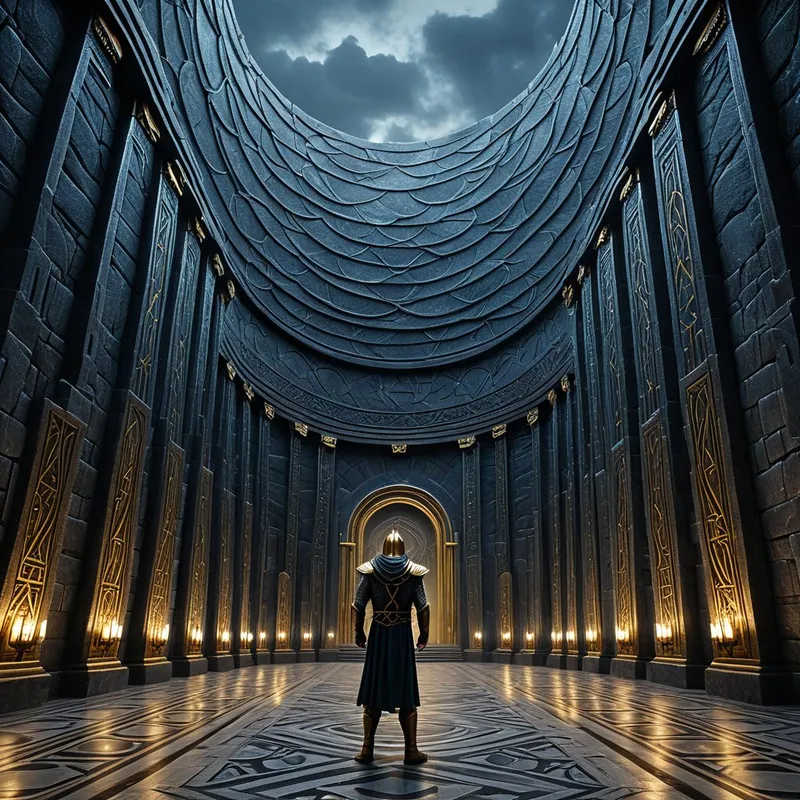
Asgard Wall Myth Meaning & Symbolism
A giant builds Asgard's wall for the sun, moon, and goddess Freyja, but the gods break their oath, revealing the price of order and the shadow of betrayal.
The Tale of Asgard Wall
Listen, and hear of the time the gods were afraid.
The war with the [Jötnar](/myths/jtnar “Myth from Norse culture.”/) was a fresh wound. [Asgard](/myths/asgard “Myth from Norse culture.”/) stood glorious, its halls of gold and silver gleaming, but it stood open. Its divine inhabitants, the Æsir, felt [the wind](/myths/the-wind “Myth from Various culture.”/) from the wild worlds at their backs. They felt exposed. The memory of battle, of giants at their very gates, whispered through their golden mead-halls. A fortress needs a wall, and theirs was a realm of spirit and power, not of piled stone. They were builders of destinies, not masons.
Into this unease came a stranger. He was a master smith of the Hrimthursar, a mountain of a being with hands that could shape bedrock. He offered them a bargain. He would build a wall so mighty, so impregnable, that no giant, no army, no force of [chaos](/myths/chaos “Myth from Greek culture.”/) could ever breach it. It would encircle all of Asgard, a bastion for the ages. His price? The sun, [the moon](/myths/the-moon “Myth from Tarot culture.”/), and the goddess [Freyja](/myths/freyja “Myth from Norse culture.”/) as his bride.
The gods laughed, a brittle sound. It was an impossible task. No being could raise such a wall in a single winter. They agreed, adding a cruel clause of their own: he must work alone, aided only by his stallion, Svadilfari. They smiled, sure of his failure, sure they would gain a half-built wall for free.
But they had not reckoned on the giant’s strength, nor the power of his horse. As the first snows fell, the builder began. Svadilfari hauled blocks of stone larger than mountains. The giant fitted them with a silence more terrible than any crash. Through the crushing dark of the [Fimbulwinter](/myths/fimbulwinter “Myth from Norse culture.”/), he worked. The wall rose, a scar of grey against the twilight, course by impossible course. It was seamless, perfect, and it grew with terrifying speed.
Three days before the deadline, the wall was nearly complete. The laughter in Asgard had died. The gods looked at the looming rampart and saw their doom within it. To give Freyja was unthinkable. To give the sun and moon was to surrender [the world](/myths/the-world “Myth from Tarot culture.”/) to eternal night. In their panic, they turned on Loki. “This was your counsel,” they accused. “Find a way out, or we will break you bone by bone.”
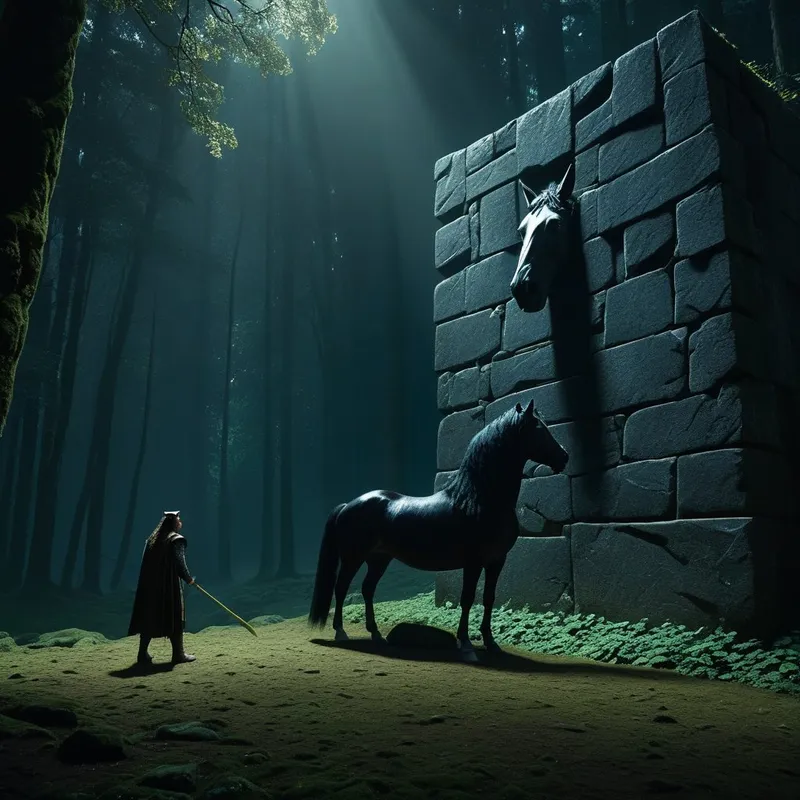
Loki’s mind, a [labyrinth](/myths/labyrinth “Myth from Various culture.”/) of schemes, whirred. That night, as the giant drove Svadilfari to haul the final stones, a marvel appeared in the woods. A mare, of such exquisite beauty and enticing scent that the great stallion could not resist. He broke his harness, trumpeting, and chased the mare into the deep, dark forest. The giant roared, but his foundation was gone. He could not move the stones alone. The sun rose on the last day, and the wall stood unfinished, a single gap remaining.
The giant’s fury was a storm. He had been cheated. The gods, their oath broken, now summoned their true nature. Thor returned from his travels. There was no bargaining now. The hammer [Mjölnir](/myths/mjlnir “Myth from Norse culture.”/) fell, and the builder’s skull was shattered into flint. The price for the wall was paid in blood, not bridal gold. Asgard had its protection, but its foundation was now mortared with deceit and a giant’s corpse.
And from that union in the dark forest, forced by trickery and desperation, Loki the mare gave birth to a foal. It was [Sleipnir](/myths/sleipnir “Myth from Norse culture.”/), the greatest of all horses, who would carry Odin himself between the worlds. From the broken oath came a new power. From the chaos of the solution sprang a wonder.
Cultural Origins & Context
This myth, preserved primarily in the Prose Edda of Snorri Sturluson, is not a simple bedtime story. It is a foundational narrative about the cost of civilization. In the harsh, honor-bound world of the Norse, an oath (eiðr) was a sacred bond, the glue of society. To break one was to invite disaster and profound shame. The myth holds a mirror to this tension: the gods, the supposed upholders of order, become oath-breakers to preserve that very order.
Told in halls during the long winter, the story served multiple functions. It explained the origin of Asgard’s iconic wall and Odin’s steed. More profoundly, it was a cautionary tale about the dangers of underestimating an opponent and the catastrophic consequences of ill-considered bargains. It validated a hard truth: security and order are never free. They are purchased, often with a currency darker than gold—with deception, violence, and a piece of one’s own honor. The storyteller, perhaps a skald, would weave this tale to remind the listeners that even the gods operate in a moral grey area, that creation is often preceded by destruction, and that every fortress contains the ghost of the sacrifice that built it.
Symbolic Architecture
The [Wall](/symbols/wall “Symbol: Walls in dreams often symbolize boundaries, protection, or obstacles in one’s life, reflecting the dreamer’s feelings of confinement or security.”/) of Asgard is far more than a physical [barrier](/symbols/barrier “Symbol: A barrier symbolizes obstacles, limitations, and boundaries that prevent progression in various aspects of life.”/). It is the [Persona](/symbols/persona “Symbol: The social mask or outward identity one presents to the world, often concealing the true self.”/) of the divine [realm](/symbols/realm “Symbol: The symbol of ‘Realm’ often signifies the boundaries of one’s consciousness, experiences, or emotional states, suggesting aspects of reality that are either explored or ignored.”/)—the constructed [identity](/symbols/identity “Symbol: Identity represents the sense of self, encompassing personal beliefs, cultural background, and social roles.”/), the face presented to the outer [chaos](/symbols/chaos “Symbol: In Arts & Music, chaos represents raw creative potential, uncontrolled expression, and the breakdown of order to forge new artistic forms.”/). It is [the ego](/myths/the-ego “Myth from Jungian culture.”/)’s desperate, magnificent project to define itself against the overwhelming pressures of the unconscious (the Jötnar). We all build such walls: careers, reputations, routines, beliefs—structures to keep the terrifying formlessness of our inner and outer worlds at bay.
The wall we build to keep chaos out becomes the structure that defines, and ultimately confines, the self.
The giant builder represents the [shadow](/symbols/shadow “Symbol: The ‘shadow’ embodies the unconscious, repressed aspects of the self and often represents fears or hidden emotions.”/) [aspect](/symbols/aspect “Symbol: A distinct feature, quality, or perspective of something, often representing a partial view of a larger whole.”/) of creation: the immense, focused, amoral power of the unconscious [psyche](/myths/psyche “Myth from Greek culture.”/) when harnessed to a [task](/symbols/task “Symbol: A task represents responsibilities, duties, or challenges one faces.”/). He is raw potential, the instinctual force that can achieve the impossible. His price—Freyja, the sun, the [moon](/symbols/moon “Symbol: The Moon symbolizes intuition, emotional depth, and the cyclical nature of life, often reflecting the inner self and subconscious desires.”/)—is the total cost of wholeness. Freyja symbolizes eros, [connection](/symbols/connection “Symbol: Connection symbolizes relationships, communication, and bonds among individuals.”/), and [life](/symbols/life “Symbol: The symbol of ‘Life’ represents a journey of growth, interconnectedness, and existential meaning, encompassing both the joys and challenges that define human experience.”/)-giving [beauty](/symbols/beauty “Symbol: This symbol embodies aesthetics, harmony, and the appreciation of life’s finer qualities.”/); the sun and [moon](/symbols/moon “Symbol: The Moon symbolizes intuition, emotional depth, and the cyclical nature of life, often reflecting the inner self and subconscious desires.”/) represent [consciousness](/symbols/consciousness “Symbol: Consciousness represents the state of awareness and perception, encompassing thoughts, feelings, and experiences.”/) itself, the rhythms of [life](/symbols/life “Symbol: The symbol of ‘Life’ represents a journey of growth, interconnectedness, and existential meaning, encompassing both the joys and challenges that define human experience.”/). To pay his price would be to surrender the [psyche](/myths/psyche “Myth from Greek culture.”/)’s vitality and light entirely to the singular drive for [security](/symbols/security “Symbol: Security denotes safety, stability, and protection in one’s personal and emotional life.”/), resulting in a sterile, perfect, lifeless [fortress](/symbols/fortress “Symbol: A fortress symbolizes security and protection, representing both physical and psychological safety from external threats.”/).
Loki’s [solution](/symbols/solution “Symbol: A solution symbolizes resolution, clarity, and the overcoming of obstacles, often representing a sense of accomplishment.”/) is the quintessential [trickster](/symbols/trickster “Symbol: A boundary-crossing archetype representing chaos, transformation, and the subversion of norms through cunning and humor.”/) intervention. He does not meet [strength](/symbols/strength “Symbol: ‘Strength’ symbolizes resilience, courage, and the ability to overcome challenges.”/) with strength but subverts the very [foundation](/symbols/foundation “Symbol: A foundation symbolizes the underlying support systems, values, and beliefs that shape one’s life, serving as the bedrock for growth and development.”/) of the project (the stallion, the driving instinctual [energy](/symbols/energy “Symbol: Energy symbolizes vitality, motivation, and the drive that fuels actions and ambitions.”/)). He dissolves the contract through chaos, forcing a [regression](/symbols/regression “Symbol: A psychological or spiritual return to earlier states of being, often involving revisiting past patterns, memories, or developmental stages for insight or healing.”/) into a more primal, animal state (becoming a mare). This is the psyche’s self-correcting function. When the ego’s project becomes suicidal, the unconscious disrupts it, often in embarrassing, messy, and transformative ways. The [birth](/symbols/birth “Symbol: Birth symbolizes new beginnings, transformation, and the potential for growth and development.”/) of Sleipnir from this chaotic act is the ultimate [symbol](/symbols/symbol “Symbol: A symbol can represent an idea, concept, or belief, serving as a powerful tool for communication and understanding.”/): from the deconstructed, shameful mess emerges a new [capacity](/symbols/capacity “Symbol: A measure of one’s potential, limits, or ability to contain, process, or achieve something, often reflecting self-assessment or external demands.”/) for transcendent travel between realms of being.
The Dreamer’s Resonance
When this myth stirs in the modern dreamer, it often manifests as dreams of immense, unfinished construction projects, of being trapped by one’s own defenses, or of making a catastrophic bargain. You may dream of a house you are building that has no doors, of a contract you signed without reading the fine print, or of a powerful, silent figure to whom you owe an impossible debt.
Somatically, this can feel like a tightening in the chest, a weight on the shoulders—the literal burden of the wall you are building. Psychologically, you are at the precipice where a once-necessary structure of your life (a job, a relationship, a self-image) has become a prison. The dream signals that the cost of maintaining this “wall” is now your Freyja—your joy, your creativity, your very light. The unconscious is presenting the bill. The looming figure of the giant is your own neglected power, your repressed drive, now demanding its due. The dream is an invitation to acknowledge [the shadow](/myths/the-shadow “Myth from Jungian culture.”/) builder before you are forced to break your oath to yourself in a crisis.
Alchemical Translation
The alchemical process mirrored here is the [Nigredo](/myths/nigredo “Myth from Alchemical culture.”/)—the blackening, the putrefaction, the necessary [death](/myths/death “Myth from Tarot culture.”/) of an old form. The gods’ perfect, golden self-image (Asgard) is blackened by their own deceit and violence. The individuation journey requires this stage. We must confront the fact that our conscious [persona](/myths/persona “Myth from Greek culture.”/), however shiny, is built on repressed instincts, broken inner promises, and unacknowledged bargains.
The myth models the path of psychic transmutation not as a straight line to enlightenment, but as a crisis of integrity. First, we foolishly contract with a part of ourselves we do not understand (the giant/drive). Then, we must face the terrifying reality of its power and our impending enslavement to it. The solution is not to fight it directly with our conscious will (the gods’ initial panic), but to allow a tricksterish, creative regression—a “going down” into a more instinctual, even shameful state (Loki as mare). This is the dissolution of the old, rigid stance.
Individuation is not about building a higher wall, but about giving birth to the Sleipnir within—the capacity to ride the tensions between order and chaos, consciousness and the unconscious.
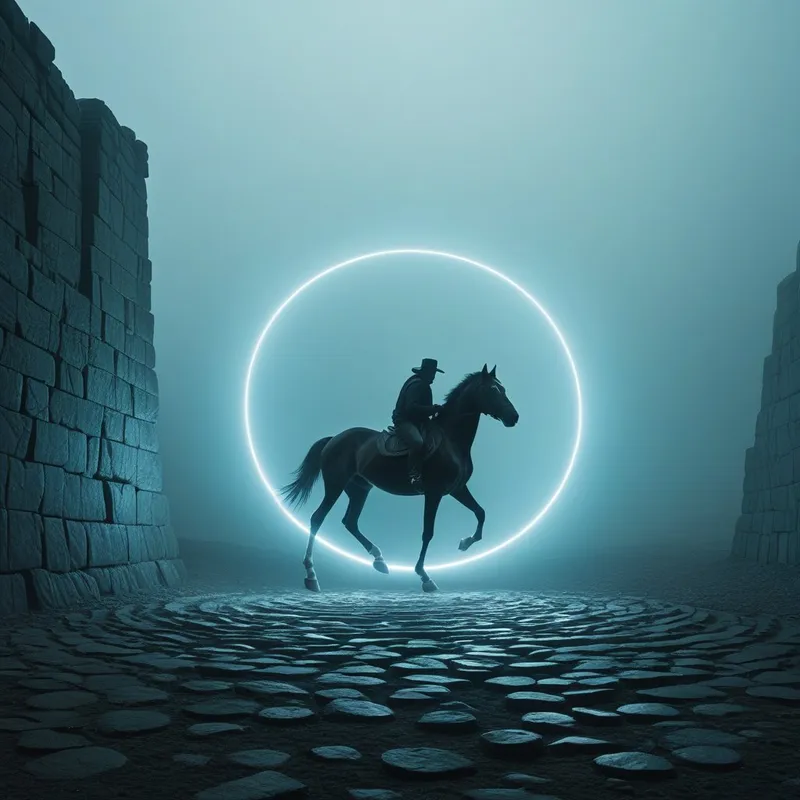
The new symbol, Sleipnir, born from the messy, ambiguous solution, represents the transcendent function. It is the psyche’s new ability to navigate the previously walled-off realms. The unfinished wall remains—the ego is never perfectly whole—but the gap is now a gate, guarded not by fear, but by the hard-won wisdom of the cost of walls and the fertile chaos that lives at their foundation. The goal is not an impregnable fortress-self, but a dynamic, mobile consciousness, able to carry the weight of its own paradoxical origins.
Associated Symbols
Explore related symbols from the CaleaDream lexicon: