Ascetic Siddhartha Myth Meaning & Symbolism
The story of Prince Siddhartha's extreme ascetic quest, a pivotal crucible of suffering that led to the discovery of the Middle Way.
The Tale of Ascetic Siddhartha
Listen. Before the Buddha, there was Siddhartha. And before the sage of the Middle Way, there was a ghost.
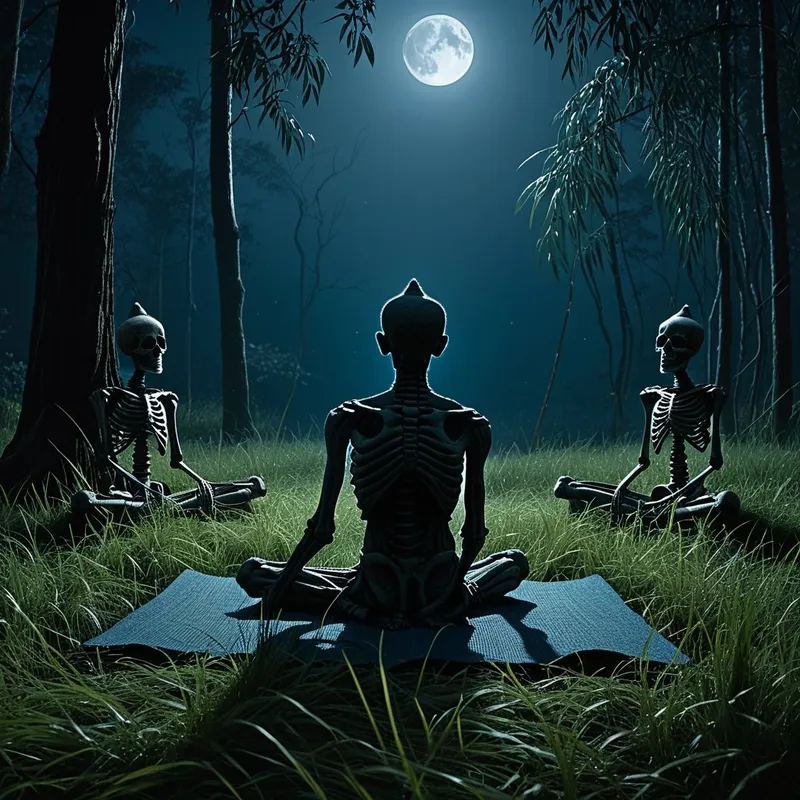
He was a prince who had become a phantom, haunting the groves of Magadha. The silks of the palace were a memory, a dream of another man’s life. Now, his skin clung to his bones like parchment stretched over a frame of sticks. His eyes were sunken pools reflecting not the world, but the relentless furnace of his own will. This was Siddhartha Gautama, the ascetic.
He had fled the gilded cage, witnessed the specters of old age, sickness, and death, and found the life of a wandering mendicant. But mere wandering was not enough. The answer, he was convinced, lay in the utter annihilation of the flesh, for the flesh was the root of all suffering. He sought masters, learned their severe disciplines. He held his breath until thunder roared in his skull. He sat unmoving in the blazing sun and the monsoonal chill, letting the elements scour him. He reduced his food to a single grain of rice a day, then a sesame seed, then nothing but dew and air.
His body became a landscape of torment. He could feel his spine through his belly. His joints were knots of pain. When he touched his stomach, his fingers met the ridge of his backbone. The five companions who followed him—Kondanna, Bhaddiya, Vappa, Mahanama, and Assaji—watched in reverent awe. “Surely,” they whispered, “this is the most disciplined being on earth. Liberation must be near.”
But liberation was a mirage. Six years passed in this crucible of self-mortification. The mind, instead of becoming clear, grew faint and delirious. Visions flickered at the edge of sight. Memories of a lotus pond, a gentle wife, a sleeping infant—these were not temptations, but haunting proofs of a life he could not transcend. The great conflict was not with desire, but with the method itself. The rising action was the slow, agonizing dawning that the path of extreme denial was a mirror of the indulgence it sought to escape: both were prisons, one of pleasure, the other of pain.
The resolution came not with a shout, but with a whisper of exhaustion. Near death, he recalled a moment from his youth, sitting in the cool shade of a rose-apple tree, watching a field being plowed. He had fallen into a state of spontaneous, joyful, effortless concentration. That memory was a key. In that moment of recollection, a village girl named Sujata approached. Seeing the holy man, she offered a bowl of rich milk-rice. His body screamed for it; his discipline forbade it. In the space between that scream and that command, he chose. He accepted the bowl. He ate.
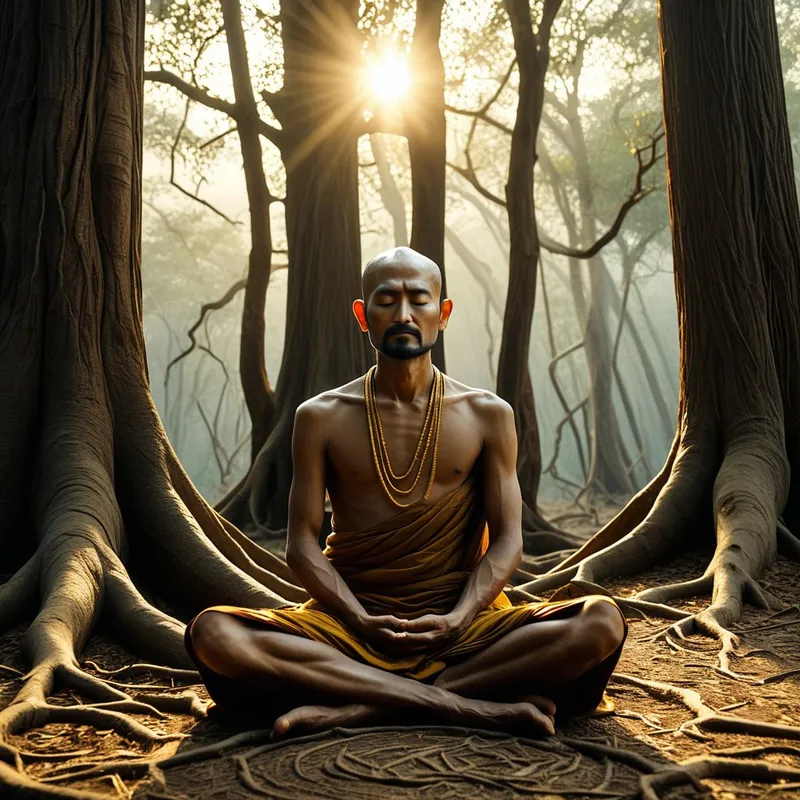
The five companions recoiled in horror. “He has abandoned the quest! He has given in to luxury!” They left him, disgusted. Alone, nourished, Siddhartha walked to the foot of a great Bodhi tree. He laid a mat of kusha grass. He sat. And he vowed not to rise until he had found the truth. The ghost of the ascetic dissolved. The seeker remained.
Cultural Origins & Context
This chapter of the Buddha’s life is not a standalone myth but the pivotal middle act of his biography, foundational to all Buddhist traditions. It is preserved in the earliest texts, the Sutta Pitaka, most notably in the Ariyapariyesana Sutta (The Noble Search). It was passed down orally for centuries by monastic communities before being committed to writing.
Its societal function was multifaceted. For early monastic communities, it served as a definitive rejection of the extreme asceticism prevalent in the Sramana movement of 5th-century BCE India. It established the doctrinal cornerstone of the Majjhima Patipada: the path to awakening lies not in punishing the body, but in mastering the mind. The story legitimized the monastic rule of moderate sustenance, distinguishing Buddhist monks from other ascetic groups. Furthermore, it modeled the ideal of relentless, pragmatic inquiry—the willingness to abandon even a deeply held practice when it proves to be a dead end.
Symbolic Architecture
The myth of Ascetic Siddhartha is a masterclass in the symbolism of the failed heroic quest. It represents the necessary, devastating disillusionment with the ego’s most cherished strategies for salvation.
The ego believes it can think, will, and discipline its way to wholeness. The ascetic phase is the ultimate expression of this heroic ego, attempting to conquer the psyche by force.
Siddhartha the prince represents identification with the persona—the social mask of luxury and privilege. His flight is the first rupture, the call to adventure. His extreme asceticism, however, is not the answer but a substitution. He trades the golden chains of the palace for the iron chains of self-denial. The emaciated body is the perfect symbol of a psyche starved by one-sidedness, a consciousness so focused on transcending “the worldly” that it severs its own roots in life.
The five companions symbolize the collective approval of a misguided path. Their awe and subsequent abandonment highlight how our most extreme efforts are often performed for an internalized audience, and how true insight often requires the courage to lose that audience’s respect.
Sujata and her milk-rice are profoundly alchemical. She represents the rejected feminine principle—not as sensuality, but as nourishing, compassionate, embodied life. Accepting her offering is the symbolic act of self-compassion, the reintegration of the body and the material world as the necessary vessel for the spirit. It is the moment the hero stops waging war on himself.

The Dreamer's Resonance
When this myth stirs in the modern dreamer, it often manifests as dreams of extreme deprivation, futile effort, or being trapped in a barren landscape. You may dream of being lost in a desert, searching for water but refusing to drink from an offered spring. You may dream of studying for an impossible exam, your notes turning to dust. You may dream of a house where you’ve locked yourself in an empty, white room, refusing to enter the lush, overgrown garden outside.
Somatically, this can correlate with periods of burnout, anorexia of the soul, or a rigid, self-punishing discipline in work, diet, or spiritual practice that has ceased to bear fruit and now only produces exhaustion and despair. Psychologically, you are in the “ascetic phase” of a personal transformation. The ego has correctly identified a problem (a life of unconscious “sleep”) but has incorrectly prescribed a cure based on suppression and force. The dream is the psyche’s rebellion against this one-sidedness, signaling that the current path is a dead end and that nourishment—often in a humble, unexpected, and “impure” form—must be accepted.
Alchemical Translation
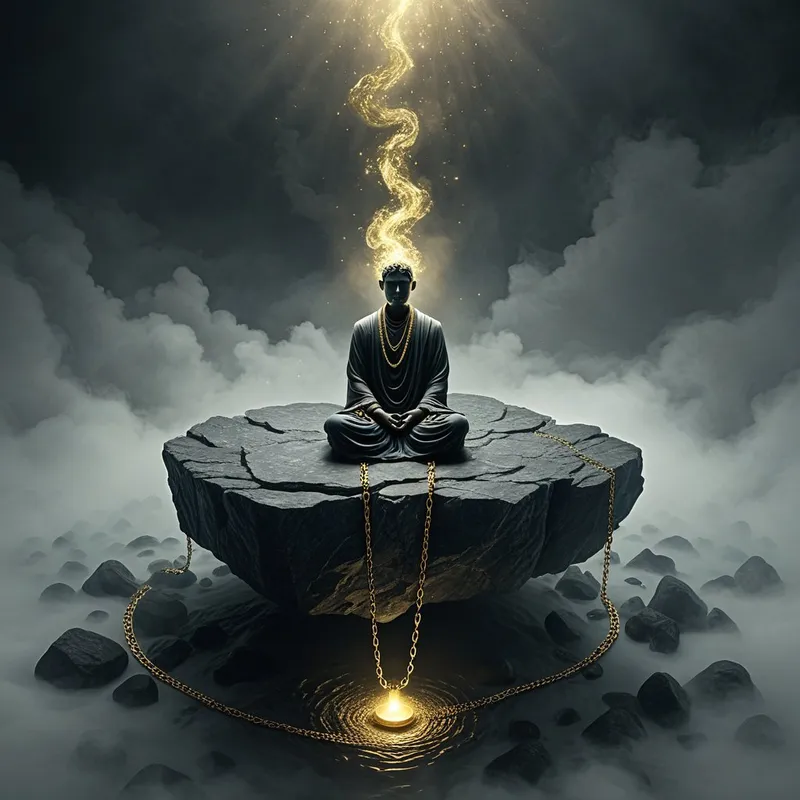
The alchemical journey is one of solve et coagula—dissolve and coagulate. The myth of the ascetic is the ultimate solve. Siddhartha dissolves his princely identity, then systematically dissolves his physical form. But he discovers that to dissolve everything is to annihilate the vessel in which the transformation must occur.
The great work requires a vessel. The body, the heart, the messy reality of human life, is that vessel. To reject it is to reject the alembic of the soul.
The alchemical translation for the modern individual is the movement from asceticism to authentic discipline, and from self-rejection to self-acceptance as the ground of work. The psychic transmutation modeled here is the realization that wholeness (individuation) is not achieved by cutting away parts of oneself deemed “inferior” or “worldly,” but by integrating them with consciousness.
The “Middle Way” is the alchemical coagula—the bringing together of opposites. It is the point of tension where spirit does not deny matter, and discipline does not deny compassion. The ascetic’s failure is the precondition for the sage’s success. For us, this means recognizing when our striving has become another form of imprisonment. It means having the courage, as Siddhartha did, to accept the “milk-rice”—the help, the rest, the pleasure, the human connection—that our rigid ideals tell us we must refuse. This acceptance is not a failure of will, but the birth of a wiser, more embodied will. It is the moment we stop seeking liberation from existence and start seeking liberation within it.
Associated Symbols
Explore related symbols from the CaleaDream lexicon: