
Asagao Myth Meaning & Symbolism
A tale of a celestial maiden who descends to earth as a morning glory, embodying the poignant beauty of a love that blooms for a single, perfect day.
The Tale of Asagao
Listen, and let the veil between worlds grow thin. In a time when the kami still walked softly through the rice paddies and the mountains were young, there lived a humble farmer. His days were a quiet rhythm of soil and sun, his heart as simple and deep as the earth he tended. He was a man of few words, but his eyes held the patience of the seasons.
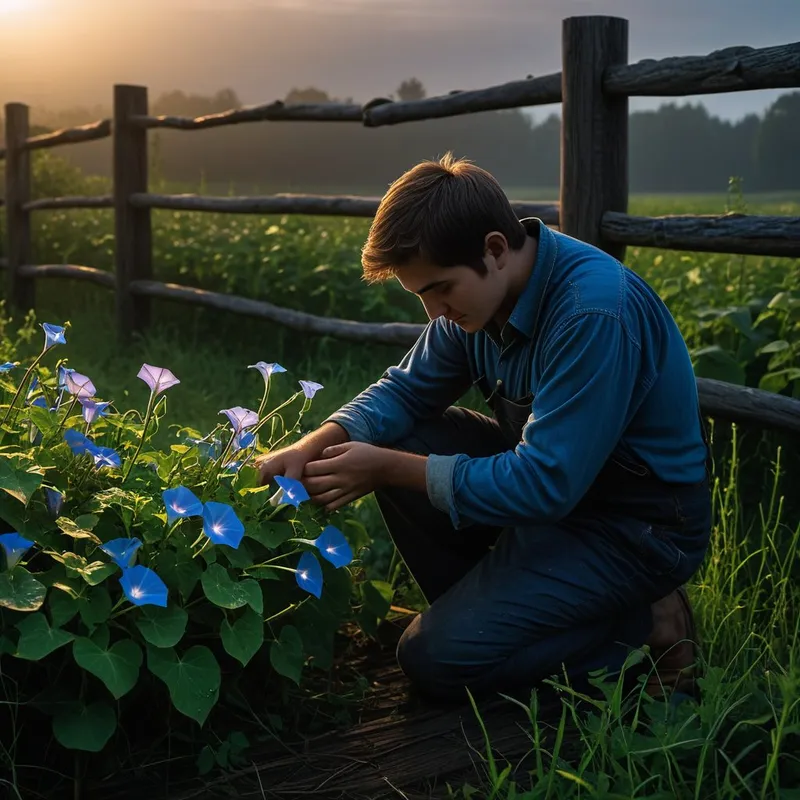
One evening, as the last light bled into indigo, he saw a sight that stole his breath. A streak of silvery light, like a falling star made gentle, descended into his humble garden. Where it touched the earth, no scorch mark was left, only a delicate vine that had not been there before. And upon that vine, a single bud, tightly furled and holding the promise of the coming dawn within its deep blue heart.
The farmer, moved by a reverence he could not name, tended to the vine. He spoke to it of the day’s warmth and the night’s coolness, of his small hopes and quiet labors. He did not know he was keeping vigil for a visitor from the Takamagahara.
As the first sliver of sun gilded the horizon, the bud began to stir. It unfurled, not as a common flower, but as a living sapphire, a trumpet of celestial blue that seemed to drink the light of the new day. And from within its depths stepped a maiden. Her robes were the color of the dawn sky, her hair like spun twilight. She was Asagao-hime, the Lady of the Morning Face.
“You have cared for my earthly form with a pure heart,” she said, her voice the sound of dew dripping from a leaf. “For your kindness, I will grace your garden each morning.”
Thus began a silent covenant. Each dawn, as the farmer rose, he would find her, a vision of serene beauty, standing beside her blossoming form. They shared no grand passion, no stolen kisses. Their communion was in the shared silence of the waking world, in the appreciation of a moment too perfect to last. He found in her presence a peace that rooted him more deeply than any crop; she found in his steadfast watch a gentle anchor to the mortal realm.
But the laws of heaven and earth are strict. A spirit of the sky cannot long endure the heavy pull of the soil. Her essence was of the fleeting moment between night and day, of the single, glorious bloom that opens and closes within one sun’s journey. The farmer, in his earthly time, began to sense the fragility of their meeting. He saw how she faded as the sun climbed, how her form grew translucent with the advancing morning.
The climax was not a storm, but a quiet, inevitable cresting. One morning, the bloom was more radiant than ever, a blue so profound it seemed to hold the memory of all nights. Asagao-hime’s smile was both joyful and infinitely sad. “My season here ends,” she whispered. “My form must return to the vine, and my spirit to the sky-road from whence I came. Remember me not with grief, but with the gladness of the dawn.”
As the sun fully cleared the horizon, she did not vanish in a flash. She simply… faded. Like mist burned away by the day, her image dissolved into the light, leaving behind only the perfect morning glory, which itself began to gently close its petals. The farmer felt a pang of loss so sharp it was physical, yet it was cleansed of bitterness. He had not lost a possession, but had been granted a glimpse of a truth: the most beautiful things are often those we cannot hold.
Cultural Origins & Context
The tale of Asagao is woven from the dual threads of Shinto animism and the poignant aesthetic of mono no aware. It belongs not to the grand, state-sponsored cycles of the Kojiki or Nihon Shoki, but to the softer, more intimate folklore passed down by villagers and farmers. This is a myth of the hearth and the field, not the palace.
It was told on summer evenings, when the morning glories planted by the fence were a daily reminder of the story’s truth. The myth served a profound societal function: it was a narrative container for the universal human experience of ephemeral beauty and bittersweet parting. It taught emotional resilience, framing loss not as a theft, but as the natural conclusion of a gift. In a culture deeply attuned to the seasons, the story of Asagao ritualized the daily “death” of the dawn, making it beautiful and meaningful. It affirmed that even the humblest person, through pure-hearted attention, could commune with the divine, if only for a moment.
Symbolic Architecture
At its core, the myth of Asagao is a masterful allegory for the soul’s encounter with the numinous—the divine or spiritually transcendent—in a form it can momentarily perceive. The farmer represents the grounded ego, the conscious self rooted in daily life and duty. Asagao-hime is the anima figure, but of a specific kind: she is the ephemeral anima, the soul-image that appears not as a lifelong companion, but as a transformative visitation.
The most profound truths often arrive not to stay, but to change us. Their power lies in their passing.
The morning glory itself is the perfect symbol. It blooms with defiant brilliance at dawn, only to wilt by afternoon, a daily memento mori. This represents the nature of inspiration, spiritual insight, and deep love—they are not permanent states to be acquired, but fleeting experiences to be fully inhabited. The vine is the enduring connection to the unconscious or the divine realm, while each individual bloom is a single, conscious manifestation of that connection. The farmer’s error would be to try to keep the flower open; his wisdom is in learning to honor its cycle.

The Dreamer's Resonance
When this myth pattern stirs in the modern unconscious, it often surfaces in dreams of poignant, fleeting connections. One might dream of a luminous stranger on a train who shares a profound glance before disappearing into a crowd, or of a breathtaking landscape that vanishes upon waking. The somatic feeling is one of a sweet ache in the chest—a simultaneous fullness and emptiness.
Psychologically, this signals a process of conscious grieving for the transient. The dream-ego is encountering a part of the psyche—an ideal, a potential, a memory of a perfect moment—that is fundamentally not meant to be integrated as a permanent fixture. The work is not to "solve" the dream or make the figure stay, but to practice the difficult art of letting a beautiful psychic content be what it is: a temporary gift. This dream asks the dreamer to hold two truths at once: the deep reality of the experience and the inevitability of its end, without allowing bitterness to poison the memory.

Alchemical Translation
The alchemy modeled here is not of turning lead into gold, but of turning grief into gratitude, and attachment into reverence. The farmer’s journey is one of psychic transmutation. His initial state is one of simple, unconscious being. The descent of Asagao is the influx of the transcendent function, a reconciling symbol from the unconscious that disrupts his ordinary life.
His conscious tending of the vine is the stage of incubation, where the ego makes space for the mystery without demanding to understand or possess it. The daily meetings represent the conjunction, the sacred marriage of the conscious and unconscious minds. This is not a permanent union, but a series of conscious, appreciative moments.
Individuation is not about collecting eternal truths, but about learning the sacred rhythm of greeting and release.
The climax—her fading—is the crucial mortificatio or solutio. It is the dissolution of the form. The spiritual challenge is to avoid a nigredo of despair, to not let the loss darken the soul. Instead, the successful outcome is an albedo, a whitening or purification. The farmer is left not with a goddess, but with her essence internalized: a deepened capacity for awe, a quiet heart that can love the dawn precisely because it does not last. The myth concludes with the stage of illumination: he now sees his entire world—the garden, the sky, the cycle of day and night—through the lens of that one perfect, lost bloom. His consciousness has been expanded not by an addition, but by a sublime subtraction. He has learned the alchemy of the morning.
Associated Symbols
Explore related symbols from the CaleaDream lexicon: