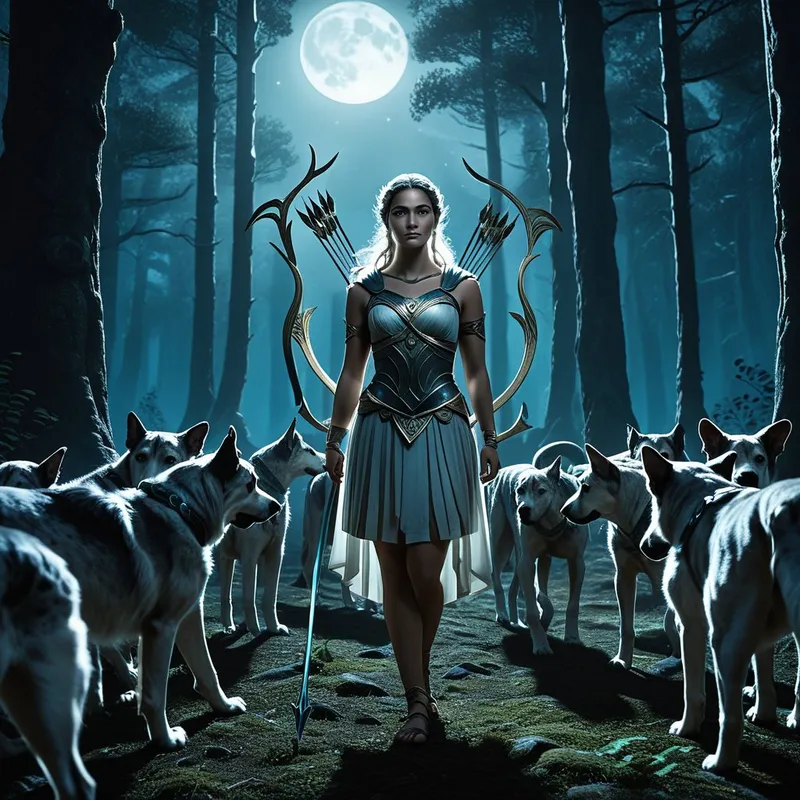
Artemis's Hounds Myth Meaning & Symbolism
The myth of Actaeon, who stumbled upon Artemis bathing and was transformed into a stag and torn apart by his own hounds for his transgression.
The Tale of Artemis's Hounds
Let the fire burn low and the night grow deep. I will tell you a tale not of glorious heroes, but of a man who saw what was never meant to be seen, and paid the price in blood and terror.
In the high, lonely places of the world, where the cypress trees whisper secrets to the wind and the only light is the cold silver of the moon, there dwelled the goddess Artemis. She was the untamed heart of the wild, a spirit of fierce independence whose only companions were her band of nymphs and the creatures of the forest. Her sanctuary was the grove, her temple the open sky, and her law was the sharp, clean flight of an arrow.
One day, a young hunter named Actaeon, grandson of a king, roamed the foothills of Mount Cithaeron with his companions. He was skilled and proud, leading a pack of fifty swift hounds, the finest in the land. The sun was high, the hunt was long, and the heat lay heavy on the land. Seeking respite, Actaeon strayed from his friends, drawn by the sound of cool, trickling water into a deep, hidden valley he had never seen before.
The air grew still and sacred. The moss was thick and soft underfoot. He pushed through a final screen of laurel and myrtle, and there he stopped, his breath catching in his throat.
He had stumbled into the goddess’s most secret place. In a clear, rock-bound pool, Artemis and her nymphs were bathing. The water shimmered on skin like polished marble. The scene was one of divine, unguarded intimacy—a world apart from men, a sanctuary of female sovereignty. For a heartbeat, perhaps two, Actaeon stood transfixed, a mortal trespasser in a divine moment.
Then, the goddess sensed him. Not with a start, but with a cold, gathering fury that chilled the very air. The water seemed to freeze. The nymphs cried out, scrambling to shield their mistress, but Artemis needed no shield. Her eyes, like chips of winter sky, found the mortal who dared to look upon her naked divinity. No word passed her lips that mortals could hear, but the command was absolute.
She flicked water from her fingertips towards the intruder. It was no mere spray, but a curse of transformation. “Go now,” her voice echoed in his soul, “and tell, if you can, that you have seen Artemis unveiled.”
A seizing pain shot through Actaeon’s limbs. His spine arched, his neck thickened. A coarse pelt sprouted from his skin. His own hands, which had held spear and bow, twisted and hardened into sharp, cloven hooves. His mind screamed in human terror as it was trapped inside a new form—the form of a magnificent, panicked stag. He tried to cry out, but from his throat came only the bleating, guttural sound of the beast.
He turned to flee, his new legs clumsy and strange on the familiar earth. He crashed through the undergrowth, back towards the sound of his own hunting party, towards his own faithful hounds. He could hear their baying now, but the scent they followed was new, primal, irresistible—the scent of the stag.
He burst into the clearing where his men waited. “Here! A stag!” they shouted. And his own hounds—Laelaps the relentless, Melampus the black-footed, all fifty with names he had given them—raised their heads. They saw not their master, but prey. With a unified, savage roar, they surged forward.
Actaeon ran as he had never run before, but the stag’s body was not his own. The hounds were swift, bred and trained by his own hand. He felt the first hot breath on his haunches, then the first searing bite. He fell. The world dissolved into a chaos of snapping jaws, tearing flesh, and the triumphant cries of his friends urging on the kill. The last thing he knew was the sight of his own hounds, eyes wild with the thrill of the hunt, consuming the man who had loved them.

Cultural Origins & Context
This haunting story comes to us primarily from the Roman poet Ovid, in his epic Metamorphoses, though earlier fragments exist in Greek sources like the historian Pausanias. It was a tale told not to glorify the gods in a simplistic way, but to illustrate the terrifying, awe-inspiring, and often inexplicable nature of divine power—the phthonos of the gods.
In a culture where boundaries—between mortal and immortal, sacred and profane, civilized and wild—were the pillars of cosmic order, Actaeon’s crime was ultimate transgression. He violated temenos, the inviolable sanctuary. The myth served as a powerful social and religious caution. It reinforced the idea that certain mysteries, particularly those pertaining to the divine feminine in its untamed aspect (Artemis was also Potnia Theron), were strictly off-limits. It was a story about the consequences of accidental, yet profound, sacrilege.
Symbolic Architecture
At its core, this is a myth about the collision of consciousness with a numinous, autonomous psychic reality it is not prepared to integrate. Artemis represents the archetypal Wild Feminine, the instinctual, self-contained, and fiercely private realm of nature and the unconscious. She is not a goddess of love or hearth, but of the unmediated, often ruthless, laws of the wild.
Actaeon represents the conscious ego, the “hunter” identity that seeks to track, know, and possess. His “hounds” are his own trained instincts, his drives, and his faculties of perception. The tragedy is not that he is evil, but that his consciousness, through a combination of chance and perhaps a deeper, fateful curiosity, stumbles into a realm where his identity is meaningless.
The gaze that seeks to possess the sacred is met not with communion, but with a metamorphosis that reveals the beast within the man.
His transformation into a stag is the central alchemical image. He becomes the very thing he hunted—the embodiment of the wild soul. His hounds turning on him symbolize the most terrifying psychological truth: the tools of our conscious striving—our ambition, our intellect, our trained instincts—can, when we encounter a core, unintegrated part of our own psyche, turn and rend us. The self is devoured by its own unrecognized energies.
The Dreamer's Resonance
When this myth stirs in the modern dreamer, it often manifests as dreams of being pursued by animals, particularly dogs or wolves, or of a shocking, involuntary transformation. The dreamer may find themselves naked and exposed in a public or sacred space, or witness a forbidden scene.
Somatically, this can correlate with feelings of being “hunted” by one’s own anxiety, of being betrayed by one’s body (through illness or panic), or of a deep, shameful exposure. Psychologically, it signals a profound encounter with a tabooed or repressed aspect of the Self—often related to wild instinct, sexuality, or a fierce, independent spirit (the Artemis within) that the conscious personality has tried to ignore or civilize. The dream is the psyche’s enactment of the curse: you have seen this hidden thing, and now you must become it, and face the consequences of that integration, which initially feels like dismemberment.
Alchemical Translation
The individuation process modeled here is brutal but essential. Actaeon’s journey is one of enantiodromia—the tragic reversal into one’s opposite. The proud hunter becomes the hunted beast. This is the dark night of the soul where the ego’s structures are shattered by an encounter with the Self.
The first alchemical stage is the violation, the accidental seeing. In our lives, this is the moment of unavoidable insight—a trauma, a sudden awareness of a buried complex, a confrontation with a power greater than our persona. We have trespassed into our own inner sanctuary.
The second is the metamorphosis. This is the dissolution (nigredo). The old identity (the hunter) must die. We are forced into a new, alien, and often painful form—the stag. We feel beastly, unrecognizable to ourselves, governed by instincts we don’t understand.
The hounds of the psyche do not turn on us out of malice, but out of a loyalty to a deeper truth: they must hunt the shape we have become.
The final, horrific stage is the dismemberment by our own hounds. This is the conscious assimilation of the insight. Our own critical faculties, our old ways of thinking, our trained behaviors (the hounds) attack and break apart the fragile, new, instinctual form. It is a psychic crisis, a feeling of being torn apart by inner conflicts.
Yet, in the deepest symbolic reading, this dismemberment is not merely punishment; it is a savage form of sacrifice. The mortal, trespassing ego is devoured so that something new might eventually be reborn from the union of the human and the divine wild. The hunter and the stag, the seer and the seen, become one in a terrible communion. To integrate the Artemis within—the fierce, autonomous, untamed spirit—one must first be dismantled by it. The myth warns that the path to wholeness passes through the grove where we lose everything we thought we were, and are remade by the very forces we once sought to command.
Associated Symbols
Explore related symbols from the CaleaDream lexicon: