Aristotle's Categories Myth Meaning & Symbolism
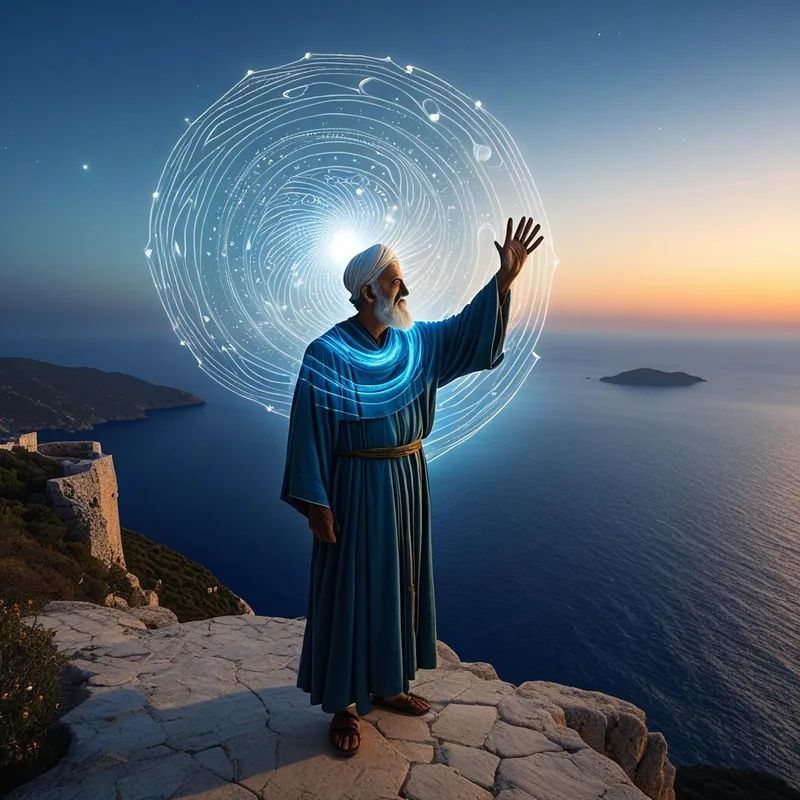
The philosopher Aristotle receives a vision of ten primordial categories, a divine framework that brings order to the formless chaos of existence.
The Tale of Aristotle's Categories
In the time when the wine-dark sea still whispered the secrets of the Titans to the shores of Attica, there lived a man whose mind was a vessel for the cosmos. His name was Aristotle, son of Nicomachus. He walked not with the aimless gait of other men, but with the measured pace of one listening to a rhythm beneath the earth.
The world, in those days, was a glorious cacophony. A tree was green, tall, older than the wall beside it, beloved by a poet, made of wood, planted on a Tuesday. Every thing shouted all its truths at once, a riot of qualities without hierarchy. The human soul, adrift in this sea of predicates, could find no harbor. It was a formless chaos, a Chaos of the intellect.
One evening, as the sun bled into the Saronic Gulf and the long shadows of the Lyceum colonnades stretched like fingers of twilight, Aristotle sat alone. The air was thick with the scent of thyme and old parchment. He closed his eyes, not to sleep, but to see. And in that inward gaze, the cacophony ceased.
From the silence, a form emerged. Not a god of flesh, but a principle of light. It was the first and sovereign form: Ousia. It stood immutable, a pillar of reality—this man, this horse, this altar. It declared: "I am that which is, in and of itself."
And from Ousia, like rays from a sun, the other forms unfolded. Poson (Quantity) appeared, measuring the world with lines of mathematics. Poion (Quality) followed, painting the pillar with hues of virtue, color, and texture. Pros ti (Relation) wove a net of golden threads, connecting father to son, master to slave, larger to smaller.
Then came Pou (Place), anchoring the pillar to the sacred earth of the Lyceum. Pote (Time) placed it in the flowing river of moments. Keisthai (Posture) showed it standing, sitting, reclining. Echein (State) clothed it in armor or robes. Poiein (Action) set it to building, teaching, cutting. And finally, Paschein (Passion) showed it being heated, being persuaded, being loved.
Ten luminous categories. Ten fundamental ways of being. They did not fight; they arranged. The chaos of the tree—its greenness, its tallness, its history—fell into silent, respectful order around the central truth of its treeness. Aristotle opened his eyes. The world had not changed, but it had been translated. The cacophony was now a chorus, each voice singing its proper part. He took up his stylus, and on a sheet of papyrus, still warm from the vanished vision, he began to write the grammar of reality itself.
Cultural Origins & Context
This is not a myth sung by bards at a symposium, but a myth enacted in the silent theater of the mind. Its origin is the Peripatos, the walking place of the Lyceum. Here, among disciples, Aristotle performed the sacred act of theoria—contemplative observation. The "myth" was passed down not through epic poetry, but through rigorous lecture notes (akroaseis), which themselves became sacred texts to his followers, the Peripatetics.
Its societal function was profound. In the wake of Plato's transcendent Forms, which seemed to reside in a heaven far from mortal touch, Aristotle's Categories brought divinity down to earth. They provided a logical and metaphysical toolkit for a society engaged in rhetoric, politics, natural science, and law. To define a thing—a citizen, a virtue, a crime—was to exercise a god-like power of ordering. The Categories were the constitution of thought itself, allowing the polis of the mind to govern the chaotic territory of experience. They were a bulwark against sophistry, the rhetorical chaos that threatened to unravel civic truth.
Symbolic Architecture
The myth is a map of consciousness erecting itself from the formless deep. Ousia, the primary substance, symbolizes the irreducible core of the Self—that which persists through change, the "I am" that underlies all our qualities, actions, and passions.
The journey of the soul begins not with asking what it feels, but who is feeling.
The other nine categories represent the manifold ways the core Self engages with and is shaped by the world. Poiein and Paschein are the eternal dance of agency and receptivity, the inhalation and exhalation of experience. Poion is the accumulation of character, the virtues and vices that color our essence. Pros ti is the entire web of our relationships, which define us as much as our intrinsic nature. The vision is not of a static self, but of a dynamic, relational entity constantly being articulated through these ten modes of being.
The Dreamer's Resonance
When this myth stirs in the modern unconscious, it often manifests as dreams of overwhelming, chaotic data or paralyzing categorization. You may dream of a vast, disorganized warehouse you must sort before dawn, or of trying to file endless, shape-shifting documents under labels that keep changing. This is the psyche's somatic cry against existential diffusion.
The psychological process is one of discernment. The dream-ego is drowning in the predicates (Poion, Pros ti) and has lost contact with the central Ousia. The anxiety is the fear of dissolution into mere qualities—"the employee," "the anxious one," "the partner"—without a solid core. The dream is an alchemical furnace, forcing the dreamer to distinguish what is accidental from what is essential, what is done by them from what is done to them. The resolution comes not when everything is neatly filed, but when the dreamer finds the still, central point—the "I am"—around which the chaos organizes itself.

Alchemical Translation
The individuation process modeled here is the construction of the psychic vessel. Chaos—the massa confusa of the alchemists—is the undifferentiated state of the psyche, where emotions, identities, and drives swirl without hierarchy. Aristotle's visionary act is the archetypal act of consciousness: imposing a liberating order.
Individuation is not becoming a different person, but becoming a person at all—distinguishing your substance from the accidents of history and circumstance.
The ten categories are the foundational grammar of self-knowledge. The work begins with asking the Ousian question: "What, at its core, is my authentic self, apart from its roles and attributes?" The subsequent labor involves consciously engaging with each category: Taking responsibility for one's Actions (Poiein), consciously undergoing one's Passions (Paschein</abbr), understanding oneself in Relation (Pros ti). This is not a dry taxonomy, but a dynamic practice of soul-making. The triumph is not a sterile list, but a coherent, articulate, and resilient Self, capable of holding the complexity of existence without fragmenting. One becomes, like the ordered cosmos itself, a harmonious whole—a microcosm reflecting the logical beauty of the macrocosm.
Associated Symbols
Explore related symbols from the CaleaDream lexicon: