Ariadne Myth Meaning & Symbolism
A princess offers a hero a thread to navigate a deadly labyrinth, only to be abandoned on a shore, finding ultimate transformation in divine love.
The Tale of Ariadne
Hear now the tale spun on the loom of fate, a story of a labyrinth, a monster, and the thread that binds them. In the great palace of Minos, beneath a sun that beat like a bronze gong upon the island of Crete, a shadow grew. It was the shadow of the Minotaur, born of a queen’s transgression and a king’s pride. Every nine years, the ship with black sails arrived from Athens, bearing a tribute of seven youths and seven maidens, a blood-price for a slain prince. They were led into the Labyrinth—a stone throat that swallowed them whole, from which only the bellows of the beast within ever echoed back.
Then came a new tribute, and among the Athenian youths walked a prince with purpose in his eyes: Theseus. He came not as victim, but as would-be slayer. And watching from the sun-washed colonnades was Ariadne. When her eyes met his, the world narrowed to a single, fateful point. Love, sudden and desperate, pierced her heart—a love that would demand treason against her father and her land.
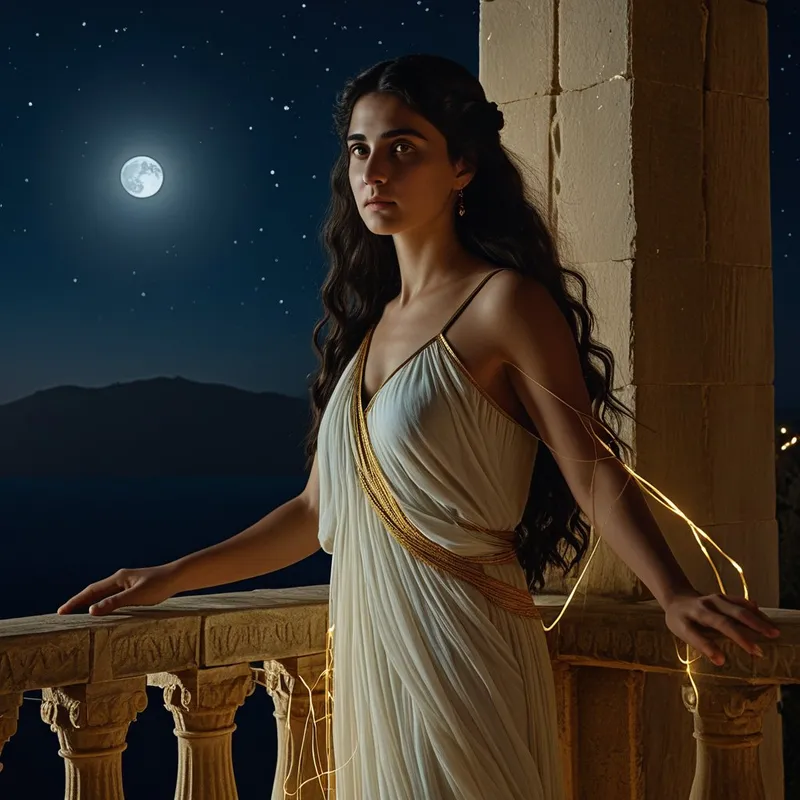
In the deep violet of a Cretan night, she sought him out. Her hands did not offer a sword, but a skein of thread. “Fasten this to the lintel of the gate,” she whispered, her voice the only sound in the heavy dark. “Unwind it as you go. It will be your silent guide back from the place where all paths are forgotten.” She gave him also a sword, and with it, a hope that was also a prayer.
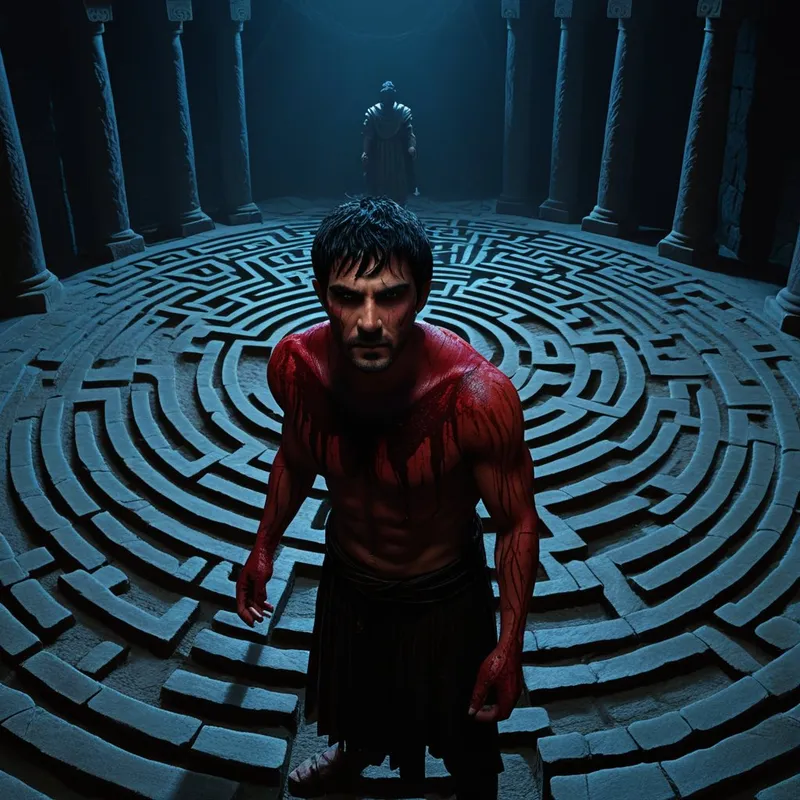
Theseus descended. The Labyrinth breathed around him—a cold, mineral breath. The roars of the Minotaur vibrated in the stone. He played out the thread, a lifeline through the madness, a slender tether to the world of light. The confrontation was brutal, a clash of hero and primal chaos in the heart of the maze. When it was done, Theseus, stained and triumphant, followed the crimson guide back, gathering the surviving Athenians in his wake.
He kept his promise to her. They fled Crete together, Ariadne abandoning her name, her title, her very history for the man who held her thread. The ship cut through the wine-dark sea toward Athens, toward a future she dared to imagine. But on the island of Naxos, as she slept exhausted on the shore, the ship slipped its moorings. She awoke to the sight of sails shrinking on the horizon, the taste of salt spray and betrayal sharp on her lips. The hero had taken her salvation and left her own behind.
Alone on the empty beach, her story seemed ended. But the gods weave patterns mortals cannot see. As despair wrapped around her, a new presence arrived—not a hero, but a god. Dionysus found her. In some tellings, he had loved her from afar; in others, her abandonment was his divine opportunity. He took her as his wife. For Ariadne, the mortal princess, this was a death. For Ariadne, the bride of Dionysus, it was a glorious rebirth. He placed among the stars the Corona Borealis, a diadem of eternal light, so that her radiance would never again be left in darkness.
Cultural Origins & Context
The myth of Ariadne is a palimpsest, written and rewritten across centuries of Greek storytelling. Its earliest known fragments appear in Homer’s Odyssey, but it was in the later Archaic and Classical periods, through the epic cycles and Athenian tragedy, that her story gained its full, poignant shape. It was a tale told by poets like Hesiod and dramatized by playwrights, each version reflecting the tensions of its time.
In the context of Athenian culture, which championed Theseus as its founding hero, Ariadne’s narrative served a complex function. It simultaneously justified Athenian dominance (by glorifying Theseus’s defeat of the Cretan monster) and explored the human cost of that heroism. Her abandonment was a problematic shadow on the hero’s resume, often explained away by divine intervention—Dionysus or Aphrodite commanding Theseus to leave her. This reveals the myth’s societal role: to navigate the conflict between heroic kleos (glory) and human fidelity, and to ultimately assimilate a powerful feminine figure into a safe, Olympian-sanctioned order through her marriage to a god.
Symbolic Architecture
At its core, Ariadne’s myth is a profound map of the psyche. The Labyrinth is the ultimate symbol of the unconscious mind—a chaotic, defensive structure built to contain the monstrous, unintegrated aspects of the self (the Minotaur). Theseus represents the conscious ego, venturing into this chaos with a singular goal: to slay the beast and claim victory.
Ariadne’s thread is the symbol of conscious connection, the slender but unbreakable link between the exploring ego and the anchoring self. It is not force, but relationship, that navigates the maze.
Ariadne herself embodies the anima, the mediating feminine principle that provides the crucial tool for navigation. She is insight, compassion, and the connective intelligence that makes confrontation with the shadow possible. Her betrayal by Theseus is the ego’s tragic failure to honor and integrate the very principle that saved it. The ego, having used the anima for its purpose, discards her, believing the heroic deed is the end of the work.
Her subsequent union with Dionysus is the alchemical correction. Dionysus, god of dissolution, ecstasy, and primal life force, represents a deeper, more transformative psychic energy than the heroic ego. Where Theseus conquered the maze, Dionysus transcends it through union. Ariadne’s apotheosis—her elevation to the stars—signifies the anima finding its true, divine partner not in the worldly hero, but in the spirit of transformative, non-rational wholeness.
The Dreamer's Resonance
When the pattern of Ariadne surfaces in modern dreams, it signals a critical navigation through a personal labyrinth. Dreaming of being lost in a complex, endless building or landscape points to a confrontation with a bewildering life situation or inner confusion. The somatic feeling is often one of chest-tightening anxiety, a desperate search for an exit that remains elusive.
To dream of finding or being given a thread, a string of light, or a clear voice offering direction marks the emergence of the Ariadne function within the dreamer’s own psyche. It is the intuitive insight, the therapeutic realization, or the creative idea that provides a way forward. Conversely, dreaming of being abandoned on a shore, watching a ship or car depart without you, encapsulates the profound betrayal wound—the feeling that after giving your crucial “thread” (your support, love, or insight), you have been left behind, your contribution forgotten. This dream often accompanies real-life experiences of ingratitude or emotional abandonment, and the body may awaken with a hollow ache of grief in the solar plexus.

Alchemical Translation
The myth models the complete arc of psychic transmutation, or individuation. The first stage is the recognition of the inner Labyrinth—the complex of trauma, addiction, or patterned behavior in which we are trapped. The Minotaur is the terrifying, repressed content at its center.
The heroic ego’s foray, armed with Ariadne’s thread, is the necessary work of analysis, shadow-work, and conscious engagement. We must follow the thread of awareness into our own darkness.
The critical alchemical moment, however, is not the slaying of the monster, but the fate of Ariadne. The ego’s triumph is a dead end if it does not lead to the redemption and integration of the guiding, connective principle.
The modern individual’s “abandonment on Naxos” is the depression, emptiness, or sense of meaninglessness that can follow a hard-won achievement. We slay the career monster, escape the toxic relationship, yet find ourselves empty on a barren shore. This is the myth insisting the work is incomplete.
The arrival of Dionysus is the invitation to a deeper surrender. It is the transformative power of art, embodied practice, ritual, or ecstatic experience that rewires us at a level beyond the cognitive. It is the process where the soul, abandoned by the ego’s projects, is courted by the divine. The “marriage” is the integration of the rational, navigating consciousness with the irrational, life-affirming spirit. The crown placed in the stars is the birth of a new, enduring identity—no longer the princess of a fallen kingdom, but a sovereign part of the cosmic order, whose light is now an eternal guide for others lost in their own becoming.
Associated Symbols
Explore related symbols from the CaleaDream lexicon: