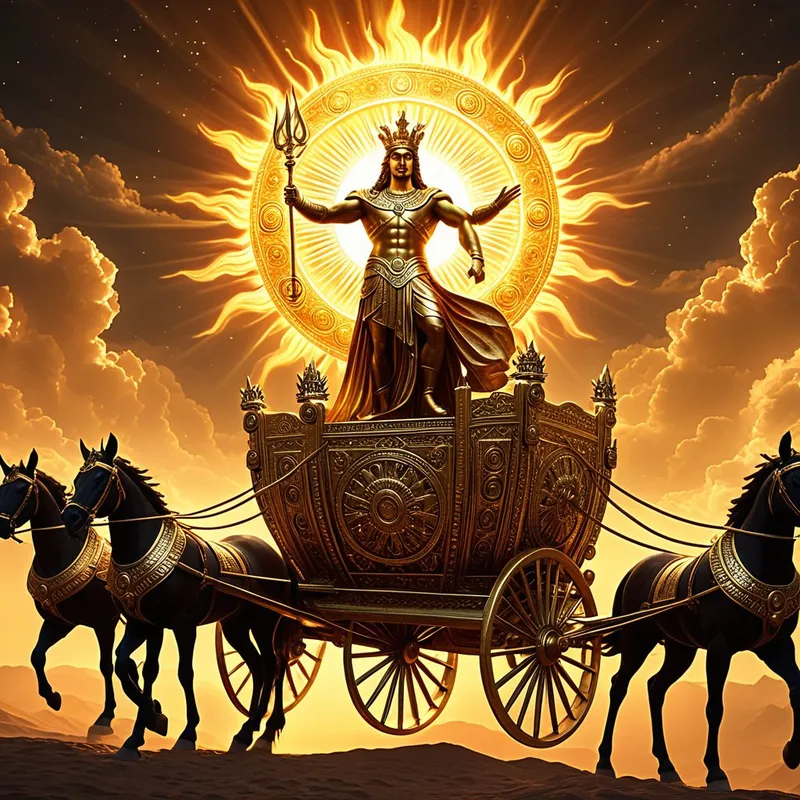
Apollo's Chariot Myth Meaning & Symbolism
A myth of divine responsibility, where Apollo's son, Phaethon, loses control of the sun chariot, scorching the earth and revealing the peril of unearned power.
The Tale of Apollo's Chariot
Hear now the tale of fire and fall, of a boy who reached for the sun and found only ash.
In the halls of Apollo, where lyre music hangs in the air like incense, a shadow fell. It was the shadow of a young man, Phaethon, son of the Sun God and a mortal woman. He came not to praise his father, but to demand proof. Tormented by the taunts of his peers who doubted his divine lineage, he sought the one thing that would silence them forever: to drive his father’s chariot for a single day.
Apollo’s heart, a furnace of paternal love and dread, grew cold. He placed his hand upon the Stygian oath, the most binding vow of the gods, and swore to grant his son any wish. When the wish was spoken, the light in the hall dimmed. “My son,” Apollo pleaded, his voice the sound of a cracking crystal, “ask for anything else. The steeds that draw the sun are not mere horses; they are Elementals of flame and breath. The path is steep and treacherous, brushed by the claws of celestial monsters. Even I must brace myself each dawn against their ferocious pull.”
But Phaethon’s pride was a wall, and his father’s warnings were moths beating against it. As the first hint of violet stained the eastern sky, Apollo anointed the boy’s face with sacred oil to ward off the heat, and with a heart heavier than the world, placed the reins in his unworthy hands. “Hold the middle path,” he whispered, a final prayer lost in the snorting of the beasts.
The Dawn Gates of the East swung open. For a moment, there was glory. Phaethon felt the incredible surge, the world falling away beneath him, the wind of creation in his hair. But the horses knew. They felt the unfamiliar, feeble grip on the reins, the lack of the god’s sovereign will. They shied, they bolted. The chariot lurched violently upward, then plunged terrifyingly downward.
The world became a canvas of catastrophe. As the chariot soared too high, the stars froze in terror and the moon fled. As it dove too low, the earth cried out. Great cracks opened in the plains, rivers boiled into steam, cities became glowing embers, and the skin of the Libyan desert was scorched black. Nymphs wailed from their evaporated springs. The great earth mother, Gaia, screamed up to the heavens, her flesh burning.
From his throne, Zeus heard the cry of the world. With a grim face, he hefted the only tool that could halt the chaos: his master bolt, the forge-fire of the cosmos. There was no malice in the act, only terrible necessity. The bolt flew, a streak of pure dissolution. It struck the chariot, shattering gold and boy into a thousand pieces. Phaethon, hair ablaze, fell like a shooting star into the wide waters of the river Eridanus.
Apollo, in his grief, hid his face for a day, and the world knew a darkness deeper than night. His sisters, the Horae, eventually coaxed the trembling horses back to their stable. Order was restored, but the scar on the world—and on the heart of the Sun God—would remain forever.
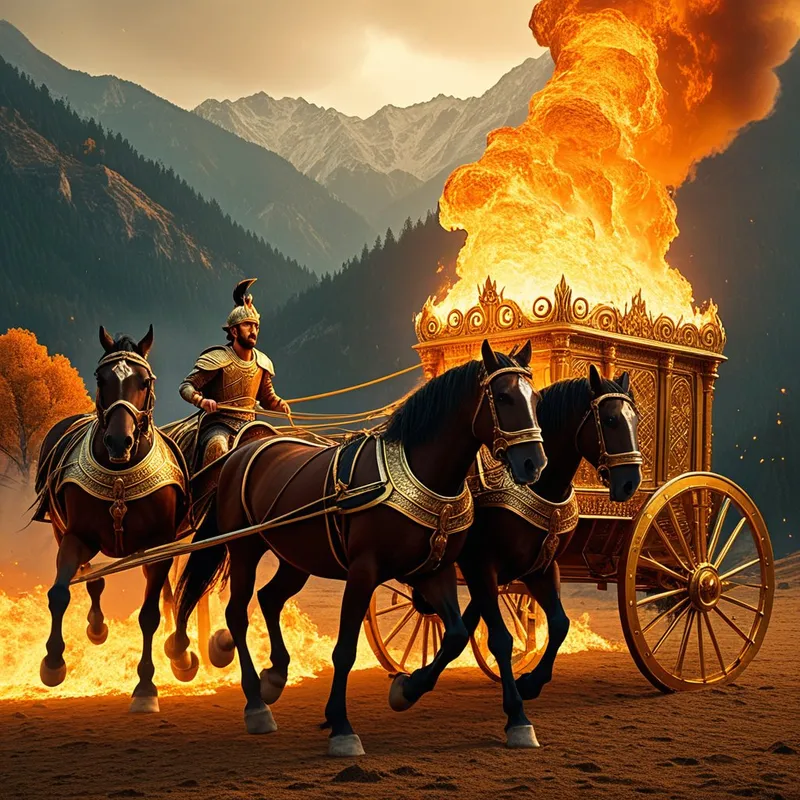
Cultural Origins & Context
This myth, primarily preserved in Ovid’s Metamorphoses, is a profound piece of Greek didactic storytelling. It was not merely a fantastical tale but a foundational narrative about limits. In a culture deeply concerned with hubris and sophrosyne (moderation), the story of Phaethon served as a powerful warning.
Told by bards and later written by poets, it functioned on multiple societal levels. For the ruling class, it was an allegory of the catastrophic results of unqualified leadership. For the common person, it explained natural phenomena—the arid deserts of Africa, the amber tears of poplar trees (said to be the mourning sisters of Phaethon), and the existence of shooting stars. Most importantly, it reinforced the cosmic hierarchy: a clear, immutable order where gods, humans, and nature each had a designated place and function. To transgress these boundaries was to invite chaos, requiring the supreme ruler, Zeus, to enact a devastating, restorative justice.
Symbolic Architecture
At its core, the chariot is not a vehicle but a symbol of conscious, directed power. The sun it carries represents the light of consciousness itself—the illuminating, life-giving, yet potentially scorching force of awareness, truth, and identity.
The chariot is the vehicle of the Self, and the reins are the ego’s fragile claim to steer it.
Phaethon represents the nascent, inflated ego—the part of us that claims a grand inheritance (a divine parentage, a special destiny) without having integrated the strength, discipline, and wisdom required to wield it. His demand is not for self-knowledge, but for the external validation of his status. The four fiery steeds are the powerful, instinctual, and archetypal energies of the unconscious—the libidinal drives, the raw creative force, the primal emotions. Without the consolidating, authoritative presence of the true Solar Principle (Apollo, the integrated consciousness), these forces become chaotic and destructive.
The catastrophic path—too high into frozen abstraction (psychic inflation, dissociation) and too low into scorching concretization (acting out, burning through relationships and resources)—maps the psyche’s ruin when the ego is either disconnected from the earth of reality or consumed by it. Zeus’s thunderbolt, while seemingly cruel, is the archetypal force that shatters a pathological identification. It is the necessary crisis that destroys an unsustainable fantasy to save the whole system.
The Dreamer's Resonance
When this myth stirs in the modern unconscious, it often manifests in dreams of catastrophic driving: losing control of a car that accelerates wildly, steering a ship into a storm, or piloting an aircraft into a dive. The somatic feeling is one of terrifying acceleration, helplessness, and impending incineration or impact.
Psychologically, this signals a “Phaethon Complex.” The dreamer is likely in a state where an inflated sense of self (a promotion, a new relationship, a creative project) has far outpaced their actual psychological capacity to manage it. They have seized the “reins of the sun”—perhaps taking on a role of excessive authority, making a grandiose life change, or claiming an identity that feels exciting but unearned. The dream is the psyche’s corrective, a dramatic enactment of the burnout, the relational scorched earth, and the internal collapse that is imminent if the course is not corrected. It is a plea from the Self for a humbling, for a relinquishment of a stolen or unintegrated power before it destroys one’s inner and outer world.
Alchemical Translation
The alchemical journey mirrored in this myth is not one of success, but of necessary, catastrophic failure as a precursor to integration. Phaethon’s journey is the nigredo—the blackening, the burning away of naive identification with the divine.
One must be utterly scorched by the sun one claims to own before one can truly serve its light.
The process of individuation requires that we, like Phaethon, reach for our own “sun”—our highest potential, our true vocation, our authentic Self. And we will inevitably fail at first, because the ego initially misunderstands this as a possession to be claimed, not a service to be rendered. The conflagration that follows—the burnout, the depression, the shattered projects—is the Zeusian bolt that strikes down the immature ego-structure. This is a brutal but essential separatio, dividing the mortal dross from the potential for genuine gold.
The true alchemical work begins in the aftermath, in the waters of the Eridanus where Phaethon falls. This is the solutio—the dissolution where the scorched fragments of the old identity are cooled and mourned. The one who eventually rises is not Phaethon, but the individual who has internalized Apollo’s grief and Zeus’s harsh lesson. They no longer wish to drive the chariot; they learn to align with it. The conscious ego (Apollo) must daily take up the reins, not as a triumphant hero, but as a responsible steward, guiding the fiery instincts (the horses) along the disciplined middle path of the sky, respecting the needs of the earth below and the cosmos above. The triumph is not in the claiming of power, but in the humble, daily return to duty—the sunrise earned through respect for the darkness that preceded it.
Associated Symbols
Explore related symbols from the CaleaDream lexicon: