Apollo's Bow Myth Meaning & Symbolism
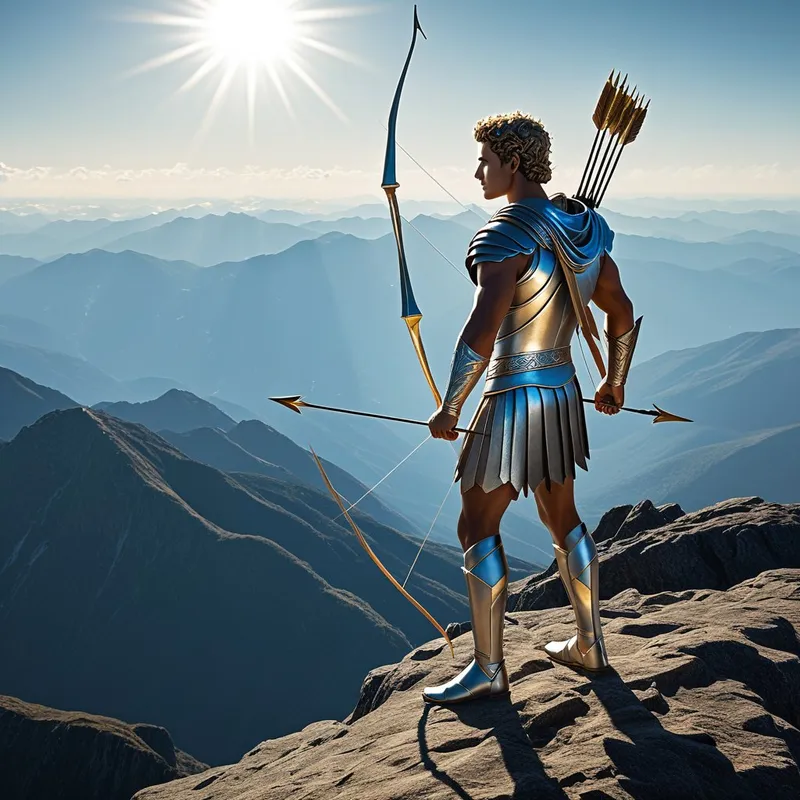
The sun god Apollo wields his silver bow to bring plague and healing, embodying the terrifying, clarifying power of focused truth.
The Tale of Apollo's Bow
Hear now, a tale not of gentle light, but of the searing, clarifying ray that burns away shadow. It begins not in Olympus, but in the dust and blood of the mortal world, where pride festers like an open wound.
The Achaean host lay siege to Troy, a city of high walls and higher sorrows. Among them was Agamemnon, king of men, whose heart had grown heavy with the spoils of war. From a raided temple, he claimed a prize: Chryseis, whose father was a priest of the Far-Shooter himself. The old man came, bearing ransom fit for a goddess, his hands trembling not with age but with sacred dread. He pleaded before the assembly, his voice a thread of pure silver in the coarse air of the camp. "Honor the god who strikes from afar! Return my child, and accept this wealth!"
But Agamemnon’s eyes were stones. He dismissed the priest with words that cut deeper than any sword, words that tasted of ash and arrogance. "Begone, old man! She is mine until age dims her beauty. Do not let me find you lingering, lest your prayers avail you nothing."
Broken, Chryses walked to the whispering shore. He raised his arms to the vast, empty sky where the sun blazed its daily path. His prayer was not a shout, but a sigh that carried across the wine-dark sea. "Hear me, Silverbow! If ever I have built you a fragrant shrine or offered the fat-thighs of bulls, let your arrow avenge my tears!"
And the god heard.
A silence fell, deeper than the sea’s abyss. Then, a sound—a faint, high hum, like the string of a celestial lyre plucked in wrath. From the sun’s chariot, a figure descended, not in glory, but in grim purpose. Apollo came, and in his hand was the bow of dread silver, and on his back a quiver that rattled with a sound like dry bones. His face was beautiful and terrible, a mask of cold justice. He did not stride among men. He stood at the edge of the camp, a silhouette against the setting sun, and let fly.
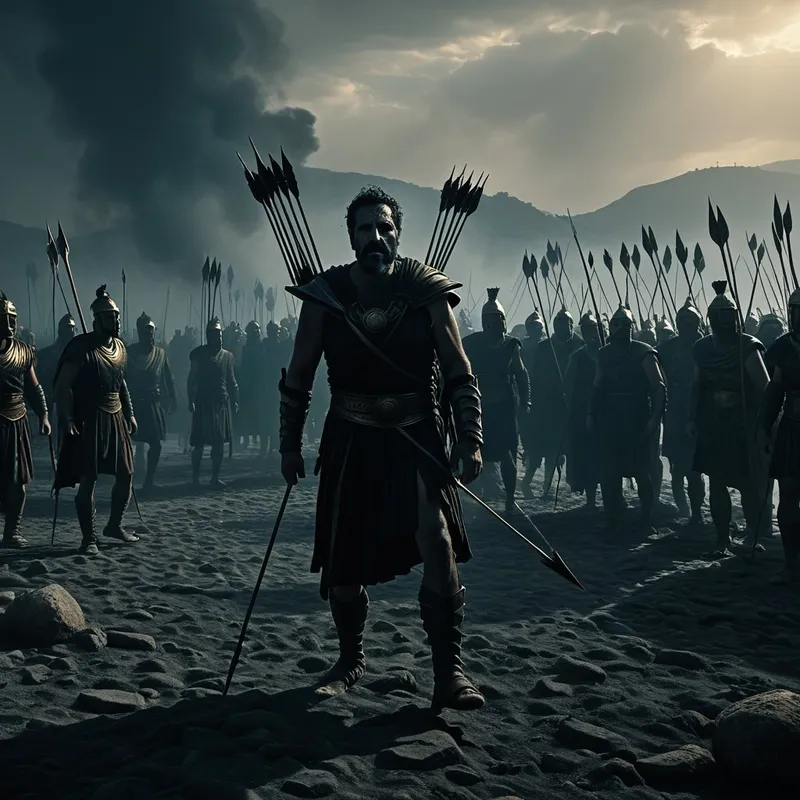
He shot no single arrow, but a cloud of them. They were invisible, save for the whispering death they carried. They were not of wood and bronze, but of pestilence—a miasma that coiled from his singing bowstring. It seeped into the Achaean camp, a palpable darkness that first touched the dogs and the mules, then found the men. A burning fever took them. Their strength melted like wax near a flame. Pyres for the dead multiplied, burning night and day, and the sweet stench of mortality hung thick over the ships.
For nine days, the arrows of the god fell. On the tenth, as the army unraveled like a frayed rope, the seer Calchas, his eyes wide with vision, spoke the truth that all feared: "The god is angered. The king’s insult must be repaid. Only the return of the girl, with a hecatomb of perfect beasts, will persuade Hecatebolos to stay his hand."
And so, against his pride, Agamemnon relented. The girl was returned to her father’s arms on a swift ship, and the smoke of a hundred sacred bulls rose to the heavens. Then, and only then, did the humming cease. The invisible arrows were recalled. The plague lifted like a curtain, leaving behind a camp scoured clean by suffering, and a lesson etched in fire: even for kings, there is a line that, when crossed, invites the purifying fire of the sun.
Cultural Origins & Context
This core narrative forms the opening act of Homer’s Iliad, the foundational epic of Greek culture. It was not a standalone folktale but the crucial catalyst for the poem’s central drama—the wrath of Achilles. For centuries, it was performed orally by bards (rhapsodes) at festivals and in the halls of the powerful. The story of Apollo’s bow served a profound societal function: it established a divine world-order where hubris against the sacred (eusebeia) invited immediate, catastrophic retribution. Apollo, as the god of order, reason, and boundaries, was the perfect enforcer of this cosmic law. His bow was the instrument that maintained the delicate balance between the human and divine realms, punishing transgressions that threatened the proper relationship between mortals and gods. It reminded listeners, from commoners to kings, that their world was governed by forces far beyond human control, where justice was delivered not through courts, but through divine arrows of disease and purification.
Symbolic Architecture
Apollo’s bow is not merely a weapon; it is a supreme symbol of focused, distant, and transformative power. It represents the principle of clarity itself, a force that cuts through complexity and illusion to strike at the heart of a matter.
The bow is the archetype of directed consciousness—the terrifying, necessary power of truth that first wounds in order to heal.
Apollo, as the god of light, prophecy, and medicine, embodies paradox. He is the source of both plague and cure. His bow is the tool of this duality. The plague it brings is not random violence, but a systemic purge, a fever meant to burn out the infection of arrogance and sacrilege. The target is never arbitrary; it is the collective body that harbors the spiritual disease. In this, the bow symbolizes the psychological necessity of confronting painful truths. The "infection" Agamemnon introduces—the theft of sacred property and the insult to a priest—is a psychic poison of unchecked ego. Apollo’s arrows are the unavoidable consequences, the psychic crisis that forces a correction.
The bow’s operation "from afar" (Ekáergos) is critical. It signifies action that is detached, objective, and inescapable. This is not the close-quarters rage of Ares; it is the impersonal, surgical strike of a cosmic principle. It represents the moment of shocking insight that arrives unbidden, the diagnosis that names the hidden illness, the sudden realization that dismantles a lifetime of self-deception. The suffering it causes is the birth pang of a new, more authentic order.

The Dreamer's Resonance
When the motif of Apollo’s Bow appears in the modern dreamscape, it signals a profound process of psychic purification underway. The dreamer is likely in a state where a long-ignored truth is forcing its way into consciousness.
To dream of being struck by such an arrow is to experience the somatic shock of this realization—a sudden, piercing clarity about a situation, relationship, or aspect of the self that can no longer be denied. It may feel like an attack, bringing anxiety, feverish unrest, or a sense of being "poisoned" by a truth. Conversely, to dream of wielding the bow suggests the dreamer is mobilizing this clarifying force, perhaps preparing to sever a toxic connection, speak a difficult truth, or purge a dysfunctional pattern from their life. The setting is often one of collective disorder (a chaotic workplace, a troubled family system) where one person’s actions (the "Agamemnon" figure) have created a systemic malaise. The bow’s appearance heralds the inevitable, and necessary, crisis that will collapse the old, diseased structure so a healthier one can be built.

Alchemical Translation
The myth of Apollo’s Bow provides a stark map for the alchemical stage of nigredo—the blackening, the descent into the dark night of the soul that precedes transformation. The individuation process requires the death of the inflated ego, the part of us that, like Agamemnon, claims what is not rightfully ours (energy, status, identity) and insults the sacred (the authentic Self).
The plague sent by the bow is the shadow made manifest, the collective suffering that forces the ego to its knees so the Self can be heard.
The alchemical work begins with the insult to the sacred—the ego’s rebellion against the inner law of the Self. The consequence is not punishment, but the natural, psychic disequilibrium that follows. The "plague" is the period of depression, confusion, and life falling apart as the old persona cracks. Calchas, the seer, represents the emerging voice of the Self, the inner wisdom that can diagnose the true cause of the suffering: "You must give back what you have taken. You must make amends to the divine."
The return of Chryseis and the offering of the hecatomb symbolize the necessary sacrifices of individuation. We must relinquish the stolen prizes of the ego—the false identities, the compulsive attachments—and offer our energy (the sacrificial bulls) consciously to the higher principle. Only this act of conscious surrender satisfies the "god" and ends the plague. The bow’s purpose is thus fulfilled: it has not destroyed, but purified. It has burned away the dross of arrogance, leaving the individual—or the psychic system—scoured, humbled, and ready for the next stage of integration. The silver bow, in the end, is the agent of the soul’s own fierce, compassionate truth, striking from the heights of consciousness to heal the depths of being.
Associated Symbols
Explore related symbols from the CaleaDream lexicon: