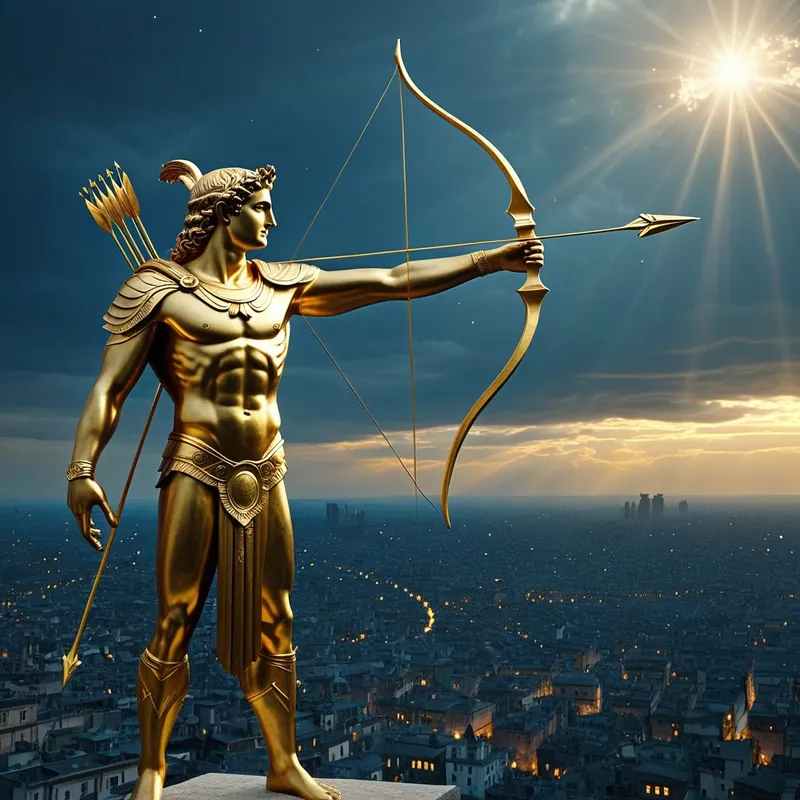
Apollo's Arrow Myth Meaning & Symbolism
A myth of divine retribution and sacred healing, where a god's arrow brings plague and a mortal's suffering becomes a path to purification and wisdom.
The Tale of Apollo's Arrow
Hear now the tale of the arrow that is not an arrow, the wound that is a gift, the plague that cleanses. The air over the Achaean camp was thick, not with sea mist, but with the stench of divine offense. For nine days, the pyres burned, not for honored dead fallen in glorious combat, but for men and beasts struck down by a silent, invisible foe. Their skin burned with invisible fire, their minds unraveled in fever dreams. This was no ordinary pestilence. This was the breath of Apollo, the Far-Shooter, made manifest.
It began with an insult, a slight against a priest. Chryses, old and desperate, had come to the high king Agamemnon, bearing ransom worthy of a god for his captured daughter. His pleas were met with arrogance, his sacred office as servant of the Silver-Bowed One spat upon and dismissed. The old man retreated to the shore, raised his arms to the pitiless blue sky, and called upon the name of his patron. He prayed not for his own vengeance, but for the god’s honor to be satisfied.
And Apollo heard. From the sun-drenched peaks of Olympus, he descended. His coming was like night falling at noon. He did not stride into camp; he became the sickness in the air. Over his shoulder was his silver bow; in his quiver, arrows that sang with a terrible music. He took his stance, invisible and terrible, at the edge of the camp. The god’s face was not one of rage, but of cold, surgical precision. He fitted an arrow to the string—not an arrow of wood and flint, but one forged from miasma, from corrupted air, from the principle of imbalance itself.
He drew. The sound was the first dry cough of a dying man. He loosed.
The arrow did not fly in an arc. It unfolded. It became the chill that entered a soldier’s lungs at dusk. It became the sudden heat behind a mule-driver’s eyes. It became the weakness in the knees of the mightiest warrior. It spread, not from man to man, but from the center of the insult outward, a ripple of divine correction. The dogs died first, then the mules, then the men. The pyres smoked ceaselessly, a grim incense offered to a god who demanded a different sacrifice: humility.
For nine days, the camp was a precinct of Hades. Only when the seer Calchas, shielded by the brave Achilles, spoke the truth—that the god’s wrath was for the stolen priestess—did the arrow’s work pause. Its removal required not a surgeon’s hand, but a king’s capitulation. The insult had to be undone, the balance restored. Only when the girl was returned, with hymns and hecatombs of sacrifice, did the Silver-Bowed One relent. The plague lifted as suddenly as it fell, leaving behind not just corpses, but a lesson etched in fire and fever: even a king is subject to the laws of the sacred.

Cultural Origins & Context
This foundational episode from the first book of Homer’s Iliad was not merely a plot device to start a quarrel. It was a core theological and societal concept broadcast across the Greek world for centuries by itinerant bards, or rhapsodes. Performed at festivals and in the halls of the powerful, the tale of Apollo’s arrow served a critical function: it modeled the cosmology of a universe governed by Dike and susceptible to miasma.
In a world without germ theory, sudden, collective illness was inherently religious. A plague was a message, a bill come due for a communal sin—often a violation of xenia (the sacred guest-host bond) or, as here, an offense against a god’s priest and property. The myth provided a framework for understanding suffering. It was not random. It had an author, a cause, and, most importantly, a cure that lay in ritual and social realignment. The story instructed leaders that their authority was secondary to divine law and that the health of the body politic depended on its spiritual hygiene. Apollo, uniquely embodying both plague and healing (Paean), perfectly represented this dual nature of divine power: the same force that wounds can make whole, but only after the fault is acknowledged.
Symbolic Architecture
The arrow of Apollo is the ultimate symbol of targeted, meaningful suffering. It is not chaos, but a precise instrument of divine justice.
The sacred wound is always diagnostic; it points unerringly to the locus of our inflation, our pride, our refusal of the law of the whole.
Apollo himself represents the principle of logos—order, clarity, boundaries, and form. His arrow, therefore, is not an eruption of irrational emotion, but the enforcement of a violated order. Psychologically, it represents any sudden, piercing insight or crisis that shatters our conscious complacency. It is the devastating diagnosis that follows years of ignored symptoms. It is the collapse of a career built on a false premise. It is the acute anxiety attack that forces us to confront a life lived out of alignment with our own truth.
The plague is the somatic and psychic consequence of this piercing—the “fever” that spreads through the entire psyche when a core value or truth has been violated. Agamemnon’s hubris is the archetypal inflation of the ego, believing itself above the sacred laws (the Self). The arrow is the Self’s non-negotiable corrective.
Chryses, the wronged priest, represents the ignored voice of the sacred, the inner truth-teller we dismiss. Calchas, the seer who names the cause, is the emerging consciousness, the ability to interpret the symptom and trace it back to its source. The resolution—returning the maiden (the stolen value), offering hymns (acknowledgment), and sacrifice (surrendering something of value)—maps the path of atonement and re-integration.

The Dreamer's Resonance
When this myth stirs in the modern unconscious, it often manifests in dreams of sudden, inexplicable illness or contamination. One might dream of a mysterious pandemic sweeping through their workplace or home, of being injected with a strange substance, or of a single, glowing thorn or splinter causing a systemic infection. The somatic feeling is one of acute, pervasive unease—a “psychic plague.”
These dreams signal that the dreamer’s psychological system is in a state of miasma. Some fundamental law of the psyche has been transgressed. Perhaps they have “stolen” their own energy by relentlessly overgiving (the caregiver’s hubris), or they have arrogantly ignored a deep calling (the priest’s plea). The “arrow” has struck, and the “plague” is the resulting psychic dis-ease: burnout, depression, chronic anxiety, or a feeling of pervasive meaninglessness.
The dream is the body’s and soul’s attempt to replicate Apollo’s diagnostic strike, to make the inner corruption so palpable it can no longer be ignored. The dreamer is in the nine days of the camp, suffering the consequences. The task is to become Calchas: to courageously look within and ask, “What sacred law have I broken? What truth have I arrogantly dismissed?” The healing begins only with that diagnosis.

Alchemical Translation
The alchemy of Apollo’s arrow is the transmutation of plague into paean, of curse into cure. It models the individuation process where a catastrophic neurosis becomes the starting point for wholeness.
The ego must be pierced by the Self for the gold of consciousness to be released. The wound is the vessel where the leaden weight of pride is dissolved.
The process begins with the inflation (Agamemnon’s hubris), where the ego identifies entirely with its power, status, or persona, and seizes what does not belong to it (the anima, represented by Chryseis). This creates a fatal disconnect from the Self. The piercing (the arrow) is the necessary, painful de-thronement. It is the failure, the breakdown, the depression that shatters the ego’s illusion of control.
The nigredo, or darkening, is the plague itself—the period of confusion, suffering, and “stinking” decomposition of the old attitude. This is a sacred, if terrible, phase. In the myth, the entire community suffers, indicating that the neurosis affects all aspects of the psyche. The albedo, or whitening, begins with the act of naming (Calchas). Consciousness dawns. We see the causal link between our action and our suffering.
The final transmutation is the ritual of return. The ego (Agamemnon) must surrender its ill-gotten prize. It must make a sacrifice—of its pride, its old story, its claim to absolute authority—and offer hymns of praise (acceptance) to a law greater than itself. This is the rubedo, the reddening, where the integrated psyche emerges, humbled but whole. The god of plague becomes the god of healing. The arrow that caused the wound is revealed to have been a surgical tool all along, cutting away the sickness to allow the organism to live, not as a tyrannical ego, but as a conscious participant in a larger, sacred order. The individual is no longer a king in a cursed camp, but a wiser soul in a world restored to balance.
Associated Symbols
Explore related symbols from the CaleaDream lexicon: