Apollo Smintheus Myth Meaning & Symbolism
A tale of Apollo's plague as a mouse god, sent to humble a proud king, revealing the divine in the lowly and the necessity of atonement.
The Tale of Apollo Smintheus
Hear now a story from the time when gods walked with men, and a king’s pride could shake the very foundations of the world. It begins not on lofty Olympus, but in the humble, sun-baked soil of the Troad, the land beneath the shadow of future Troy.
There ruled a priest-king, Chryses, a man devoted to the Far-Shooter, Apollo. His daughter, a prize of war, was held captive by the Achaean host camped upon the shore. With sacred fillets upon his staff and a heart full of father’s grief, Chryses came to the Greek camp. He offered ransom beyond counting, his words measured and respectful, invoking the god he served. But Agamemnon, the lord of men, heard him with a heart of stone. He sent the old priest away with threats and scorn, his pride a wall against mercy.
Chryses walked away in silence, a terrible quiet gathering around him. He went to the lonely shore, where the sea whispers secrets to the sand, and raised his arms to the pitiless sun. He called upon Apollo, by the names he knew him best: “God of the Silver Bow, hear me! If ever I have roofed a temple pleasing to you, if ever the fat thighs of bulls have smoked upon your altar, repay me! Let your arrows make the Danaans pay for my tears!”
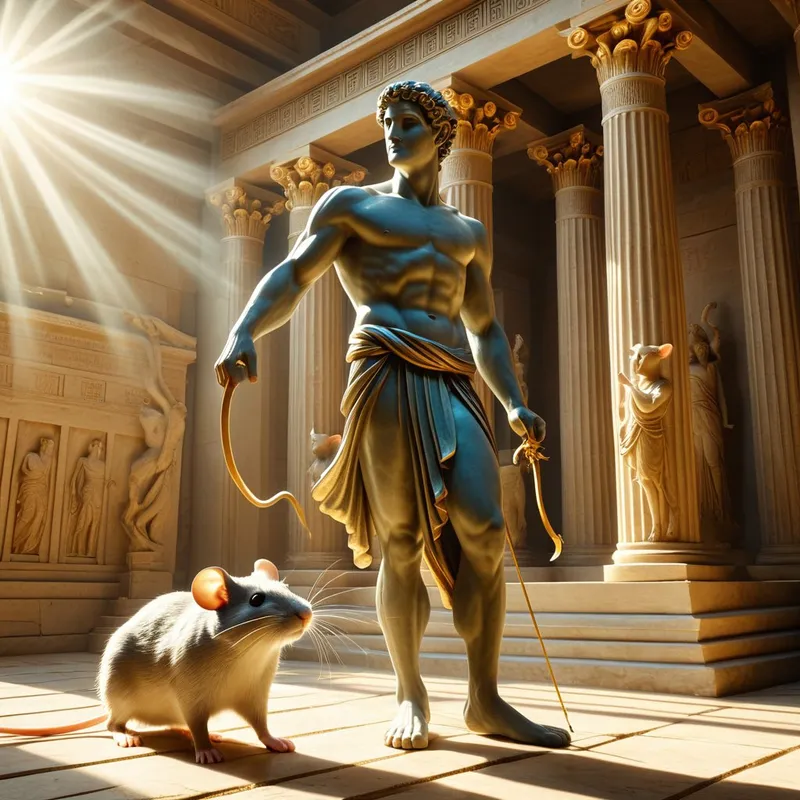
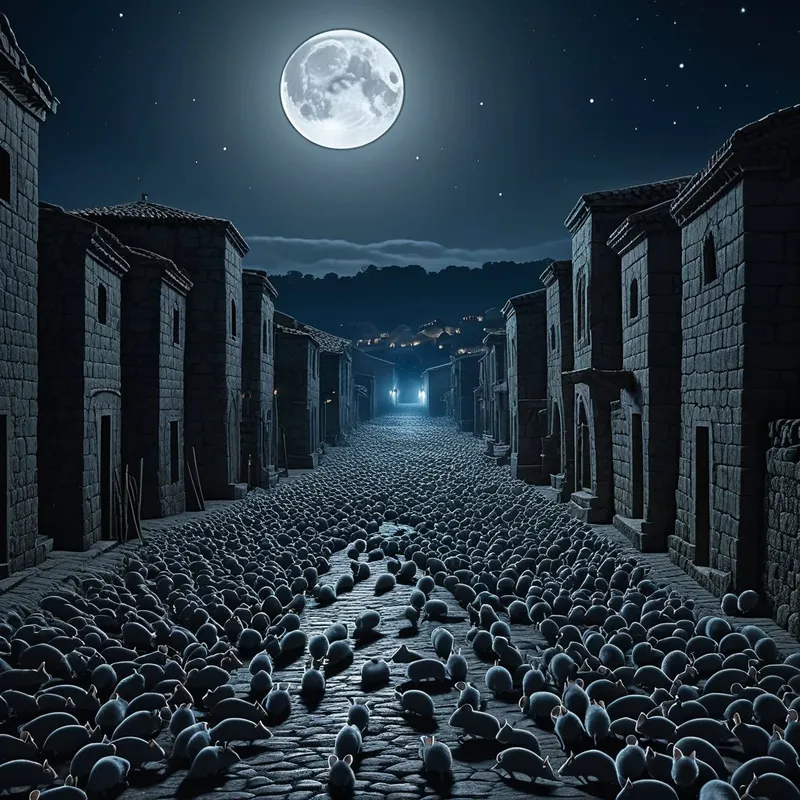
And the god heard. Not with thunder, but with a soft, skittering sound from the earth itself. He came not as the golden musician, but as Apollo Smintheus. Down from the peaks of Olympus he strode, his face darker than night, his quiver rattling with fate. He sat on a hill overlooking the black ships and let fly an arrow. But it was no single shaft. It was a sigh of pestilence, a breath of divine wrath made corporeal. The air grew thick and sweet with decay. Then came the sound—a rustling, a gnawing, a multitude of tiny feet. From the fields, from the ditches, from the very earth, they came: an army of mice. Not creatures of flesh alone, but incarnations of the god’s ire, carriers of a wasting sickness.
They flowed into the Achaean camp like a grey tide. They swarmed the grain stores, leaving husks and dust. They nibbled at bowstrings and shield straps in the night. And with them came the fever—a burning, racking plague that laid low man and beast alike. For nine days, the pyres burned continuously, the smoke of the dead rising as a grim offering to the offended god. The proud army was brought low, not by spear, but by the smallest of creatures. The mighty Agamemnon was powerless. The conflict, the mênis—the wrath—of Apollo, could only be resolved by atonement. The seer Calchas revealed the cause: the insult to the god’s priest. To appease the Mouse God, the girl had to be returned, and a sacred hecatomb offered. More than that, Agamemnon’s pride had to be publicly broken, his stolen honor replaced with ritual humility. Only when the correct prayers were sung, and the gleaming tripod and cauldron sent to Chryses, did the skittering plague cease. The mice vanished back into the earth, and the fever lifted, leaving behind a lesson etched in fire and loss: even the king of men must bow before the sacred.
Cultural Origins & Context
The epithet “Smintheus” is a relic of deep, pre-Olympian soil. It speaks of an Apollo not yet fully crystallized as the purely celestial god of later classical art. This Apollo is rooted in Anatolia, in the lands of the Troad and Crete, where he was worshipped as a god of agriculture and pestilence—two sides of the same chthonic coin. The mouse was his sacred animal, a creature of the earth that could destroy the harvest or, paradoxically, through its oracular nibblings (as in some local tales), reveal the future.
This myth reaches us primarily through the epic lens of Homer’s Iliad, where it serves as the catalyzing event for the entire poem. Its societal function was multifaceted. On one level, it was an etiological tale, explaining the origin of Apollo’s unusual cult title and mouse-associated rituals in specific locales like Chryse and Tenedos. On a deeper level, it was a foundational narrative about divine justice and cosmic order. It taught that the gods are not distant abstractions but active forces intimately connected to the natural world, and that their wrath could manifest through the lowliest of creatures. It reinforced the sacred duty of xenia (guest-friendship) and the proper treatment of priests and supplicants. To dishonor a priest was to dishonor the god, and the consequences would be ecological and somatic, a blight upon the land and the body politic.
Symbolic Architecture
The myth of Apollo Smintheus is a masterclass in symbolic inversion and the unity of opposites. Here, the god of light, order, and reason becomes the bringer of dark, chaotic, and instinctual plague. The mouse, typically a symbol of timidity, poverty, and insignificance, is transformed into the vessel of immense divine power.
The god reveals himself through that which we despise or fear, teaching that the foundation of order is a respectful relationship with the chaotic, fecund, and destructive undercurrents of life.
Apollo’s arrows, usually symbols of sudden, clean death from a distance, become a creeping, gnawing sickness. The plague is not an external punishment but an internal corruption, a miasma that must be purged. Agamemnon’s sin is one of hubris—an overweening pride that disrupts the sacred balance. The resolution requires not just restitution, but a ritual of humility. The return of Chryseis and the offering of the tripod are acts that re-knit the torn social and divine fabric. The mouse, therefore, symbolizes the chthonic, unconscious force that rises to correct a conscious, societal arrogance. It is the ignored “small voice” that, when unheard, becomes a devouring swarm.

The Dreamer's Resonance
When the pattern of Apollo Smintheus stirs in the modern dreamer, it often manifests as dreams of infestation. Dreaming of mice or rats swarming in one’s home, particularly in kitchens or pantries (places of nourishment), or gnawing at the structure of one’s life, signals a profound psychological process. This is the somatic intelligence of the psyche reacting to a state of “spiritual plague.”
The dreamer may be experiencing a situation where their values or integrity have been compromised—where they have acted with the pride of an Agamemnon, overriding the needs of others or their own inner truth for the sake of power or possession. The swelling “army of mice” represents the repressed consequences of that action: gnawing guilt, anxiety, a sense of inner corruption, or a wasting away of vitality. The body, in its wisdom, may even manifest this as low-grade illness, fatigue, or immune dysfunction—a literal “plague” upon the system. The dream is a call from the shadow, in its most basic, instinctual form, demanding acknowledgment and atonement.

Alchemical Translation
The alchemical journey modeled by this myth is the nigredo—the blackening, the putrefaction, the necessary descent into the dark and loathsome matter of the psyche as the first step toward wholeness. Agamemnon’s conscious position as “king of men” is his persona, his inflated self-image. His insult to the sacred (Chryses/Apollo) represents a rupture with the Self, the central archetype of order and totality.
The plague of mice is the alchemical solve: the dissolution of the rigid, prideful ego by the very elements it has deemed beneath it. The king must be humbled, his camp destroyed, so that a new, more conscious relationship with the divine can be built.
For the modern individual, the “alchemical translation” is the process of shadow integration. One must first recognize the “mice”—the small, ignored, perhaps despised aspects of oneself or one’s actions that are causing inner decay. This requires the humility of Agamemnon, forced to listen to Calchas (the inner seer, intuition) and acknowledge his fault. The “return of Chryseis” is the act of making amends, restoring what was taken, externally or internally. The “offering of the tripod” is the sacred act of dedicating something of value—time, energy, creative work—to the restored principle of inner order and respect.
In the end, Apollo Smintheus does not destroy the individual but purifies him. The ego is not annihilated but transformed, brought into a proper, humble relationship with the vast, paradoxical powers of the psyche, where the god of light and the lord of plague are understood as one. The mouse, from a pest, becomes a sacred guide, reminding us that wholeness is found not by ignoring the lowly and the dark, but by granting it its sacred due.
Associated Symbols
Explore related symbols from the CaleaDream lexicon: