
Aphrodite's Scallop Shell Myth Meaning & Symbolism
The goddess of love is born from primordial chaos, carried ashore on a giant scallop shell, a symbol of emergence from the unconscious into being.
The Tale of Aphrodite’s Scallop Shell
Listen. Before the world knew its own name, there was a churning, a violence in the heavens. Ouranos, the starry sky, lay heavy upon Gaia, the fertile earth. From their anguish, monstrous children were born, and from a terrible, liberating sickle-stroke wielded by their son Kronos, a part of Ouranos was severed and cast into the salt-void.
It fell, that immortal flesh, into the wine-dark, formless sea. For an age, it drifted. The sea, Pontus, received it, and time worked its alchemy. Around that divine seed, the waters began to churn and froth—aphros—a luminous, pearlescent foam born of celestial blood and primordial brine. The foam gathered, pulsed with a light that had never touched the deep. It swelled into a great, breathing mound upon the waves.
And within that radiant, bubbling nucleus, a form coalesced. Not crafted, but born from the union of severed sky and embracing sea. She was perfect, full-grown, her skin the color of dawn on the wave-crest, her hair the deep green of abyssal kelp forests, her eyes holding the calm and the storm of the ocean itself. She was Aphrodite, and the very elements sighed at her presence.
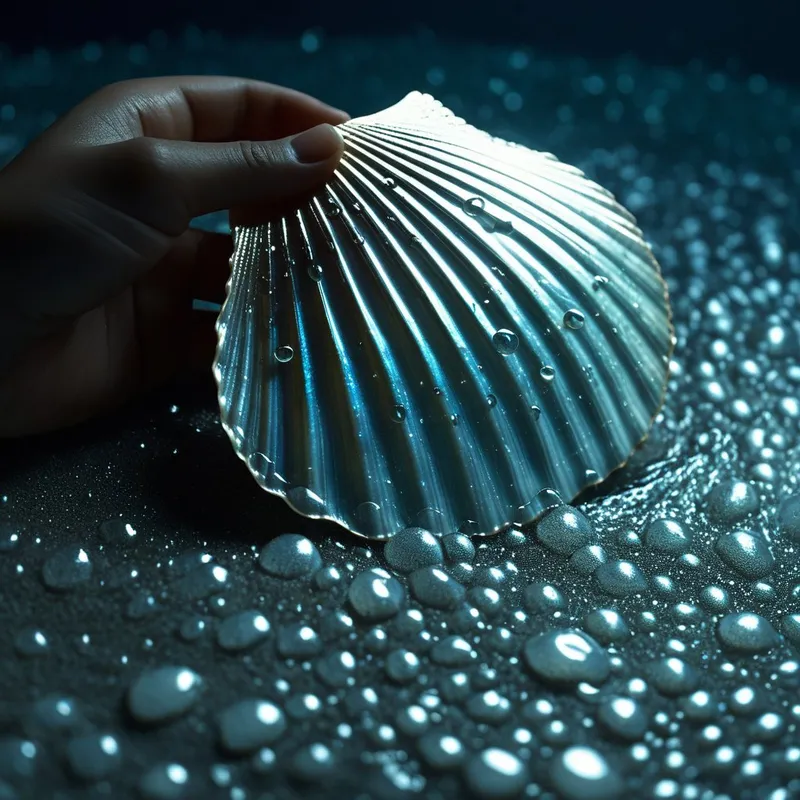
But she was adrift in the boundless deep, a consciousness newborn in chaos. Then, from the silent depths, a vessel arose. A giant scallop shell, its valves wide and welcoming, its interior smooth as polished moonstone. It rose beneath her, cradling her feet. The Zephyrs, the gentle west winds, felt her presence and swept down, their breath filling the hollow of the shell like a sail. They bore her, this impossible, foam-born goddess, across the trembling sea.
The shell carried her not to a rocky, desolate shore, but to the sacred isle of Cythera, and then onward to Cyprus. As the shell’s bow touched the sandy shore, the Hours, daughters of Themis, were waiting. They who bring the gentle progression of time and season stepped forward, their gowns the colors of spring blossoms, summer wheat, and autumn fruit. With reverence, they wrapped the goddess in a silken robe, embroidered with the flowers that would bloom at her command. They placed a crown of gold upon her head, and in that moment, the world knew beauty. The myth was complete. Love had arrived, borne on a shell, delivered by the wind, and greeted by time itself.
Cultural Origins & Context
The myth of Aphrodite’s birth is among the most ancient in the Greek corpus, with versions appearing in Hesiod’s Theogony (c. 700 BCE) and the so-called Homeric Hymns. Hesiod’s account is the primary source for the dramatic tale of the severed genitals and the sea foam. This origin story, known as Aphrodite Ourania (the Heavenly), distinguishes her as a primordial force, older than even Zeus, born directly from a pre-Olympian act of cosmic violence.
The imagery of the scallop shell, while not always explicitly detailed in the earliest texts, became inextricably linked to her iconography through art and cult practice. From painted pottery to monumental statues, Aphrodite is frequently depicted either emerging from a shell or with the shell as an attribute. This was not mere decoration. In the maritime cultures of ancient Greece and Cyprus, the shell was a tangible, beautiful object from the sea—a natural reliquary. The myth served a societal function beyond entertainment; it anchored the overwhelming, often terrifying power of eros (desire) and philia (affection) in a narrative of graceful arrival and natural order. It explained the sudden, overwhelming nature of love and beauty as something that emerges from chaos, is carried by unseen forces (the winds of fate or passion), and must be integrated into the civilized world (the robing by the Hours).
Symbolic Architecture
The myth is a perfect symbolic embryo, containing the entire process of a profound psychological event. The severed member of Ouranos represents fragmented, unintegrated potential—a creative principle cast into the unconscious (the sea). The sea itself is the psychic matrix, the dark, fertile, and salty womb of all possibilities.
The birth from foam (aphros) is the first moment of conscious distinction—the spark of awareness rising from the churn of undefined feeling and instinct.
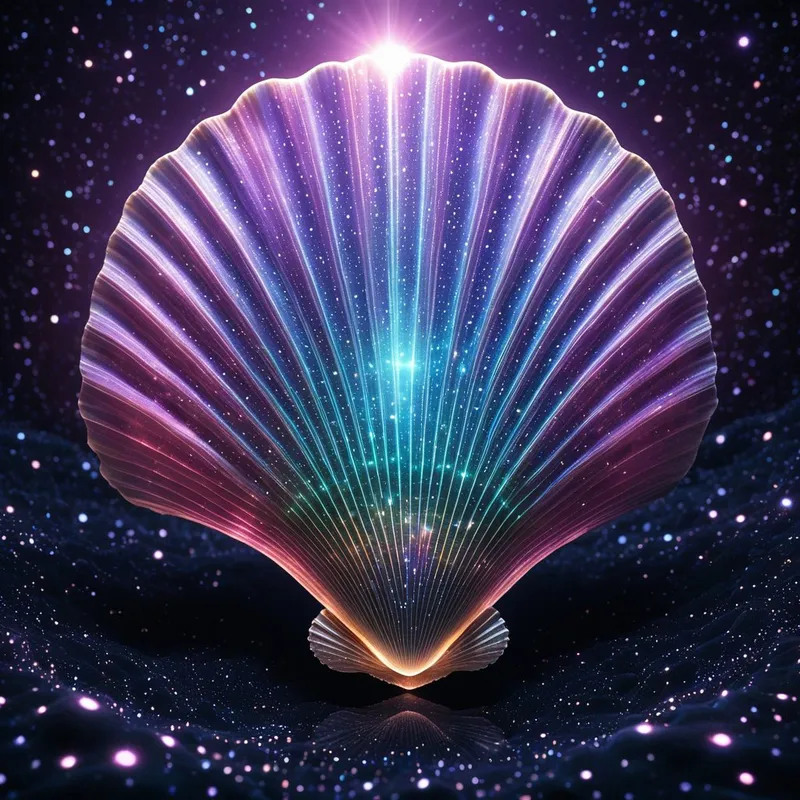
The scallop shell is the critical symbol. It is not the source, but the vehicle. It is the containing form that makes emergence possible. Psychologically, it represents the vas, the protective, nurturing structure that allows a fragile new consciousness or aspect of the self to safely navigate the depths of the unconscious and reach the shore of ego-awareness. Its ridges fanning outward symbolize radiation, influence, and the opening of a new capacity. The Zephyrs are the animating breath, the psychic energy or impetus that drives this emergence forward. Finally, the Hours and their robes represent the necessary process of integration. The raw, naked, divine potential must be clothed in the garments of time, custom, and personal reality to become a functioning part of the individual’s world.
The Dreamer’s Resonance
When this mythic pattern stirs in the modern dreamer, it signals a profound somatic and psychological process: the emergence of a new affective quality. This is not the birth of a logical idea, but of a feeling-toned complex related to love, beauty, creativity, or relational capacity.
Somatically, one might dream of water, floating, or a sensation of gentle rocking. The dream imagery could involve finding a beautiful shell, witnessing a radiant light on water, or feeling a warm, gentle wind. The core sensation is one of being carried, of a passive-yet-receptive journey. Psychologically, the dreamer is likely in a state where old, perhaps violent or cast-off parts of their history (the “severed Ouranos”) are finally, after a long gestation, producing something new and life-giving in their emotional world. There is often a sense of awe, vulnerability, and nakedness preceding the dream, followed by the comforting presence of a protective, natural form (the shell) and assisting forces. It is the psyche’s way of narrating the birth of eros from trauma, of beauty from chaos.

Alchemical Translation
For the modern individual seeking individuation, Aphrodite’s journey models the alchemical stage of ablutio—the washing clean in the sea—and subsequent emergence. The process begins with an acknowledgment of one’s own primordial “castration”—the wounds, rejections, or severed potentials we have thrown into our personal unconscious. We must allow these fragments to “drift” and be transformed by the saline depths of our own soul, which requires patience and non-interference.
The shell is the consciously cultivated attitude of self-containment and receptivity that makes psychic birth safe. One must grow an inner shell.
The alchemical work is to become both the sea that transforms and the shell that carries. We must allow the Zephyrs of intuition and synchronicity to guide us, trusting the movement toward our own “Cyprus”—the place of integration. The final, crucial step is the robing by the Hours. This is the often-overlooked work of embodying the new quality. A newfound capacity for self-love or creative beauty cannot remain a naked, shocking revelation; it must be dressed in the daily rituals, habits, and relationships that give it form and function in time. The myth, in its entirety, charts the transmutation of chaotic, primal material into a governing, life-enhancing principle of connection and aesthetic appreciation within the human soul. It teaches that love, in its fullest sense, is not a static trait but a continual birth, a graceful arrival from deep, turbulent waters onto the solid ground of a life being lived.
Associated Symbols
Explore related symbols from the CaleaDream lexicon: