
Aphrodite's Peplos Myth Meaning & Symbolism
A mortal woman weaves a peplos for Aphrodite, a sacred act of devotion that reveals the deep, binding threads between mortal love and divine power.
The Tale of Aphrodite’s Peplos
Hear now a tale not of thunderous war or cunning voyages, but of a quieter, more profound magic—the magic of the loom and the heart. It begins not on Olympus, but in the salt-tinged air of a humble coastal village, where the sound of [the sea](/myths/the-sea “Myth from Greek culture.”/) was the constant breath of [the world](/myths/the-world “Myth from Tarot culture.”/).
There lived a woman, a weaver of such skill that the very threads seemed to sing for her. Her name is lost to the ages, remembered only by her deed. While others wove for market or for dowry, she wove for the unseen. In the silent hours before dawn, by the flickering light of a single lamp, her shuttle danced. She did not weave simple wool, but gathered the finest threads she could spin, dyed them with the crushed petals of mountain roses and the rare purple of the murex shell. Her pattern was a secret hymn: intertwining roses for passion, doves for peace, and the intricate, endless knot of [Ananke](/myths/ananke “Myth from Greek culture.”/).
For whom did she labor through the turning seasons? For [Aphrodite](/myths/aphrodite “Myth from Global/Universal culture.”/). Not for a temple tax or a priest’s command, but for a devotion that rose from her soul like incense. She was crafting a [peplos](/myths/peplos “Myth from Greek culture.”/), a sacred robe, for the goddess who stirs the blood and softens the heart.
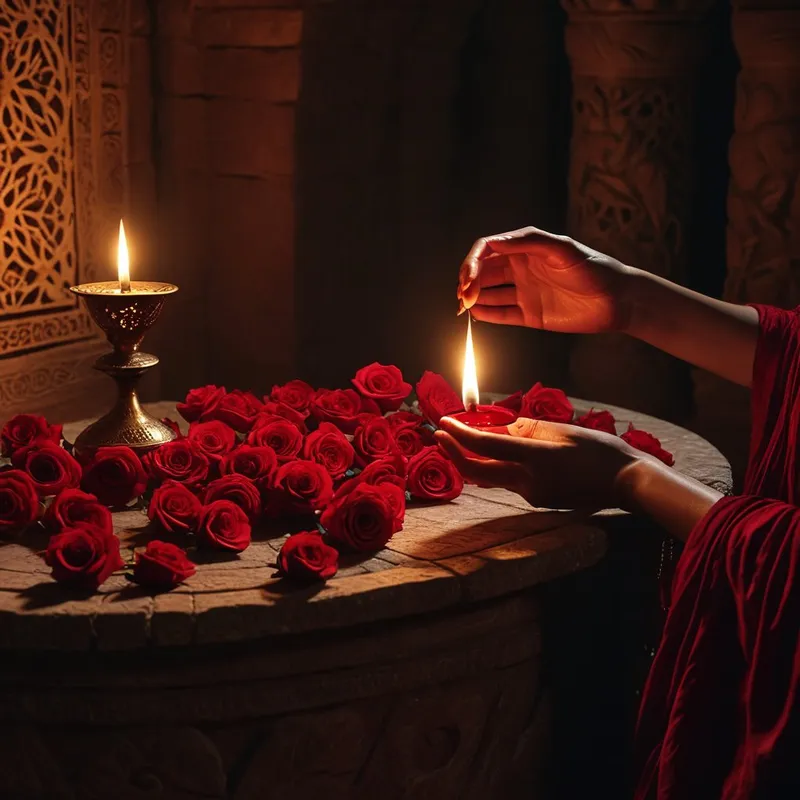
The day of the offering arrived, the festival of the Aphrodite Pandemos. The procession wound its way to the seaside shrine, a simple [altar](/myths/altar “Myth from Christian culture.”/) of worn stone kissed by spray. The people brought their wreaths and their prayers. But when the weaver stepped forward, the murmuring crowd fell silent. She unfolded her work.
It was as if she had captured a piece of the sunset sky and the deep wine-dark sea. The peplos shimmered, the embroidered doves seeming to flutter, the roses to release a phantom scent. It was not just a garment; it was an embodiment of longing, beauty, and the tender, terrifying power of Eros. As she laid it upon the altar, a hush deeper than reverence fell. The air grew heavy with the scent of myrtle and salt.
And then, She was there. Not in a blaze of terrifying light, but in a sudden, profound presence, like the moment one falls in love. Aphrodite stood before her altar, her form both human and more than human, her eyes the color of [the horizon](/myths/the-horizon “Myth from Various culture.”/) at dawn. She looked at the weaver, and her gaze was not that of a distant deity, but of deep recognition. She reached out, not for the peplos, but to touch the weaver’s calloused hand.
“You have not woven a robe,” the goddess said, her voice the sound of waves receding over smooth stones. “You have woven a prayer I can wear. In your threads, I see the mortal heart—its fragility, its enduring hope, its capacity to make beauty from longing.” As the goddess drew the peplos about her shoulders, it transformed, becoming light and sea-foam, yet retaining the essence of the mortal pattern. In that moment, the boundary between divine and mortal, between offering and essence, dissolved. The weaver did not ask for riches or a lover’s favor. She had already received the only gift that mattered: the visible, tender acknowledgment that her deepest inner work was seen, and was sacred.
Cultural Origins & Context
This myth, though less canonical than the epic cycles of [Homer](/myths/homer “Myth from Greek culture.”/), finds its roots in the lived, domestic religiosity of ancient Greece. It belongs not to the court bard but to the whispers of women at the loom, part of the vast tapestry of local cults and personal devotion. Stories like these were likely passed down through generations in the context of women’s work—in the gynaikeion—and during festivals like the Aphrodisia.
Its societal function was multifaceted. On one level, it sanctified the art of weaving, a primary economic and social activity for women, elevating it from chore to a potential channel of divine communion. It reinforced the cultural ideal of eusebeia (piety), showing that true devotion was a personal, creative act, not merely a ritual obligation. Furthermore, it presented a specific aspect of Aphrodite—not just the capricious goddess of irresistible passion, but as Aphrodite Pandemos, the goddess who presided over the bonds of community and the social, creative aspects of love. The myth served as a cultural script, teaching that through focused, heartfelt creation, a mortal could touch the divine and receive a grace that was personal and transformative.
Symbolic Architecture
At its core, the myth of the Peplos is a profound [allegory](/symbols/allegory “Symbol: A narrative device where characters, events, or settings represent abstract ideas or moral qualities, conveying deeper meanings through symbolic storytelling.”/) for the act of conscious creation as an act of love and [integration](/symbols/integration “Symbol: The process of unifying disparate parts of the self or experience into a cohesive whole, often representing psychological wholeness or resolution of internal conflict.”/). The peplos itself is the central [symbol](/symbols/symbol “Symbol: A symbol can represent an idea, concept, or belief, serving as a powerful tool for communication and understanding.”/)—a [temenos](/myths/temenos “Myth from Greek culture.”/), or sacred precinct, woven from mortal experience and offered to the archetypal force of relatedness.
The crafted offering is the made-soul, the conscious pattern extracted from the raw material of instinct and longing.
The weaver represents [the ego](/myths/the-ego “Myth from Jungian culture.”/), the part of the [psyche](/myths/psyche “Myth from Greek culture.”/) that can take raw [material](/symbols/material “Symbol: Material signifies the tangible aspects of life, often representing physical resources, desires, and the physical world’s influence on our existence.”/) (instinct, [emotion](/symbols/emotion “Symbol: Emotion symbolizes our inner feelings and responses to experiences, often guiding our actions and choices.”/), experience) and through disciplined [effort](/symbols/effort “Symbol: Effort signifies the physical, mental, and emotional energy invested toward achieving goals and personal growth.”/) (techne), shape it into a coherent, beautiful form. The act of weaving in solitude is the process of introspection and inner work. The specific patterns—roses ([beauty](/symbols/beauty “Symbol: This symbol embodies aesthetics, harmony, and the appreciation of life’s finer qualities.”/)/desire), doves ([peace](/symbols/peace “Symbol: Peace represents a state of tranquility and harmony, both internally and externally, often reflecting a desire for resolution and serenity in one’s life.”/)/[soul](/symbols/soul “Symbol: The soul represents the essence of a person, encompassing their spirit, identity, and connection to the universe.”/)), the [knot](/symbols/knot “Symbol: A knot symbolizes connections, commitments, complications, and the binding or untying of relationships and situations.”/) of Ananke ([acceptance](/symbols/acceptance “Symbol: The experience of being welcomed, approved, or integrated into a group or situation, often involving validation of one’s identity or actions.”/))—symbolize the integration of [life](/symbols/life “Symbol: The symbol of ‘Life’ represents a journey of growth, interconnectedness, and existential meaning, encompassing both the joys and challenges that define human experience.”/)’s core elements: [passion](/symbols/passion “Symbol: Intense emotional or physical desire, often linked to love, creativity, or purpose. Represents life force and deep engagement.”/), [tranquility](/symbols/tranquility “Symbol: A state of profound peace and calmness, often representing emotional balance, inner harmony, and freedom from disturbance.”/), and [destiny](/symbols/destiny “Symbol: A predetermined course of events or ultimate purpose, often linked to spiritual forces or cosmic order, representing life’s inherent direction.”/).
Aphrodite here is not an external deity but the [archetype](/symbols/archetype “Symbol: A universal, primordial pattern or prototype in the collective unconscious that shapes human experience, behavior, and creative expression.”/) of the [Anima](/symbols/anima “Symbol: The feminine archetype within the male unconscious, representing soul, creativity, and connection to the inner world.”/) (in a man’s psyche) or the essential Self (in a woman’s). She is the totality of the erotic, connective principle of life—[the force](/myths/the-force “Myth from Science Fiction culture.”/) that binds atoms, hearts, and communities. Her acceptance and wearing of the peplos symbolizes the [moment](/symbols/moment “Symbol: The symbol of a ‘moment’ embodies the significance of transient experiences that encapsulate emotional depth or pivotal transformations in life.”/) when a conscious creation is “recognized” and taken up by the deeper Self. The garment’s transformation into light and sea-[foam](/symbols/foam “Symbol: Foam represents ephemeral boundaries, cleansing processes, and the tension between substance and emptiness. It symbolizes what appears solid but dissolves easily.”/) shows that when personal work aligns with the archetypal, it transcends its mortal origins, becoming a permanent part of the soul’s raiment.
The Dreamer’s Resonance
When this mythic pattern stirs in the modern dreamer, it often signals a critical phase of psychic crafting. To dream of weaving a complex, beautiful garment, especially with a sense of sacred purpose or for a numinous, unseen figure, points to an active process of soul-making.
Somatically, the dreamer may feel a tension between fatigue and exhilaration—the tired hands of the weaver paired with the thrill of the emerging pattern. Psychologically, this is the labor of integrating disparate parts of one’s life or personality into a cohesive whole. The dream may arise during periods of recovery from heartbreak (mending the fabric of Eros), during artistic endeavor (giving form to inner vision), or when seeking deeper purpose (weaving a life of meaning). If the dream features a finished garment being rejected or unraveling, it may reflect anxiety that one’s deepest offerings—of love, creativity, or self—will not be accepted by the world or by the beloved. The climactic moment of the goddess’s appearance and acceptance is the dream’s potential resolution: the profound inner knowing that the work itself, done with integrity and devotion, is its own validation and connection to the sacred.

Alchemical Translation
The myth models the alchemical opus of individuation—the journey toward psychic wholeness—with exquisite clarity. The process begins with the [nigredo](/myths/nigredo “Myth from Alchemical culture.”/), the raw, dark wool of undifferentiated experience, instinct, and unconscious longing. The weaver’s lamp-lit solitude is the [albedo](/myths/albedo “Myth from Alchemical culture.”/), the whitening, where conscious attention is applied through the discipline of the craft.
The loom is the crucible of the soul, where the leaden threads of fate are spun into the gold of meaning.
The weaving itself is the citrinitas, the yellowing, where insight and pattern emerge. The weaver must hold the tension of opposites: [the rose](/myths/the-rose “Myth from Persian culture.”/) and the dove, passion and peace, individual will and the knot of fate. This is the transcendent function at work. The finished peplos is the [rubedo](/myths/rubedo “Myth from Alchemical culture.”/), the reddening, the perfected “philosopher’s stone” of this inner work—a tangible, beautiful synthesis of the psyche’s contents.
Presenting the peplos is the ultimate act of submission, not to an external god, but to [the Self](/myths/the-self “Myth from Jungian culture.”/). It is saying, “This is who I have made myself to be. I offer this synthesis to the totality of who I am.” Aphrodite’s acceptance and transformation of the garment is the final stage: the [coniunctio](/myths/coniunctio “Myth from Alchemical culture.”/), [the sacred marriage](/myths/the-sacred-marriage “Myth from Various culture.”/). The ego’s creation is taken up, sanctified, and united with the archetypal realm. For the modern individual, this translates to the moment when a life lived with conscious, loving effort ceases to feel like a struggle for identity and becomes simply, radiantly, an expression of it. The peplos is no longer something you offer; it is what you are, worn with the effortless grace of the divine.
Associated Symbols
Explore related symbols from the CaleaDream lexicon: