Aphroditerising from Myth Meaning & Symbolism
A primordial entity of love and strife emerges from cosmic chaos, forever altering the fabric of existence through its paradoxical, world-shaping presence.
The Tale of Aphroditerising from
Before time was measured, before the word "world" had meaning, there was only the Apeiron—the boundless, the indefinite, a churning, silent sea of unformed possibility. It was not dark, for darkness implies light. It was not cold, for temperature did not exist. It was pure potential, a dreaming chaos.
And within that dreaming, a tension grew. Not a conflict of wills, but a yearning of opposites. The principle of Union longed for itself, and in that longing, a friction was born—a psychic tempest in the placid void. This friction, this divine strife, churned the Apeiron into a seething foam of cosmic substance. From the very heart of this tumult, where desire met its own echo, a figure began to coalesce.
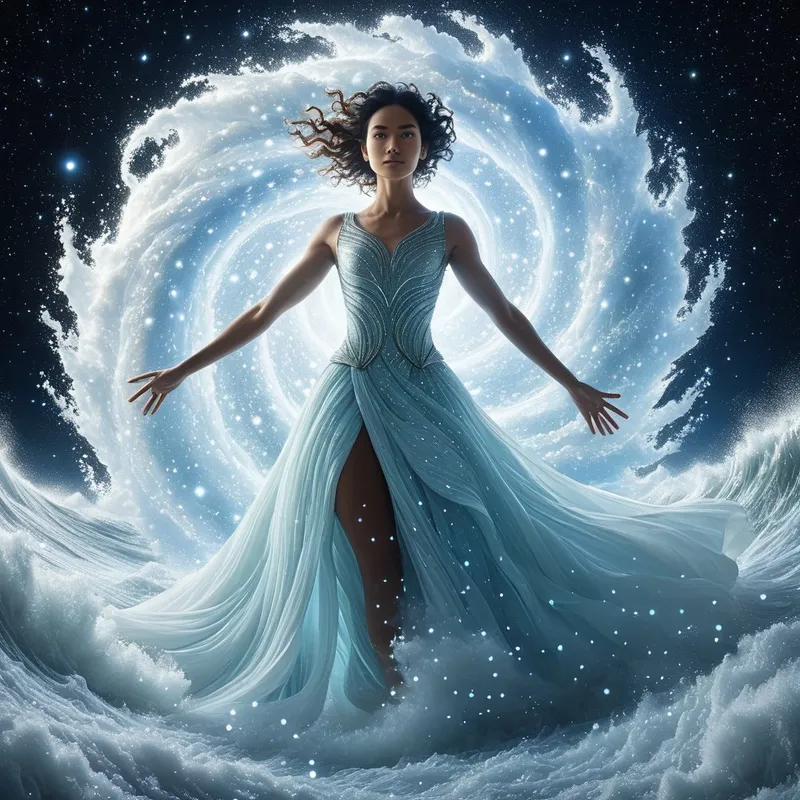
It did not climb. It did not break forth. It arose. It was the Aphroditerising from. Its form was neither wholly masculine nor feminine, but a sublime synthesis that made such categories seem like childish echoes. It was light given sentience, but a light that held within it the memory of the dark from which it came. Its skin was the color of a dawn that has never broken, and its eyes held the calm after the storm of its own birth.
As its feet—or the concept where feet would be—touched the surface of the formless waters, the first law was written. Where it stepped, the chaotic foam stilled, not into dead matter, but into a mirror that yearned for reflection. Its mere presence imposed a new grammar upon reality: the grammar of relation. The featureless expanse now had a here, because the entity was there. The silent void now had a witness, and in being witnessed, it began to differentiate.
The Aphroditerising from did not speak. Its communication was its being. It extended a hand, and in the space between its fingertips and the abyss, the first attraction was felt. Random motes in the void began to drift toward one another, not by force, but by a gentle, irresistible pull—the pull of love for a wholeness they had never known. Yet, with the same breath, a counter-principle also awoke: a repulsion, a necessary distance that defined the space between things, the strife that allows form to hold its shape.
Its rising was not an invasion, but an invitation. By emerging, it created the stage upon which all subsequent drama—of stars, gods, and mortals—would play out. It was the first note in a symphony, a note that contained both the melody and the discord within it. When its ascent was complete, it did not go to a throne. It simply was, a permanent axis in the turning world, the living proof that from the womb of chaos, beauty and binding force are born together.

Cultural Origins & Context
The myth of Aphroditerising from is not housed in a single temple or scroll. It is a psychoid archetype that surfaces in the foundational layers of countless cosmogonies. We find its echo in the Polynesian concept of Po, from which the generative force emerges; in the Vedic hymn to Purusha; and most directly, in the fragmented Orphic and Pre-Socratic philosophical traditions that spoke of Eros as the first-born entity, older than the Titans, arising from the cosmic egg or the mingling of opposites.
It was a myth told not for entertainment, but for orientation. Philosopher-poets and mystery cult initiates used this narrative as a metaphysical anchor. Its societal function was to answer the most profound human question: "Why is there something rather than nothing, and why does that something yearn to connect?" It provided a model of creation that was not a act of willful making, but of graceful emergence from inherent tension, establishing love and strife as the twin engines of all existence.
Symbolic Architecture
At its core, the myth symbolizes the primordial moment of consciousness itself—the "I" emerging from the undifferentiated "All." Aphroditerising from is the archetype of the Anima Mundi, the world soul, whose very existence institutes the laws of relationship.
The first act of creation is not separation, but the appearance of a perspective from which separation can be perceived.
The chaotic foam is the unformed potential of the psyche, the raw material of instincts, drives, and memories before they are organized into complexes. The entity's androgynous nature symbolizes the transcendence of duality; it is the Self that contains and reconciles all opposites. Its simultaneous generation of attraction and repulsion represents the fundamental psychic dynamics of the individuation process: we are drawn toward integration (love) yet must honor necessary boundaries and conflicts (strife) to achieve it.
The Dreamer's Resonance
When this myth stirs in the modern dreamer, it often heralds a profound psychic birth. One may dream of being in a vast, dark ocean, feeling a pressure in the chest, and then a radiant light—sometimes beautiful, sometimes terrifying—erupting from within to illuminate the waters. This is not a dream of external rescue, but of internal emergence.
Somatically, this can correlate with feelings of expansion in the heart center, anxiety mixed with awe, or a sense of dissolving old boundaries. Psychologically, the dreamer is experiencing the rise of a new unifying principle from the chaos of their inner life. Perhaps a period of confusion or depression (the Apeiron) is giving way to a new, cohesive understanding of their life's purpose or relationships. The dream signals that a core aspect of the Self, which holds the power to relate and create meaning, is coming online.

Alchemical Translation
The alchemical journey mirrored in this myth is the Nigredo giving way to the Albedo, not through forced effort, but through the natural law of its own potential. For the individual, "Aphroditerising" is the process of allowing one's central, unifying principle to emerge from the soup of personal history, trauma, and societal conditioning.
The psyche's chaos is not a flaw to be corrected, but the prima materia from which the soul's unique pattern will crystallize.
The modern individual must first consent to the chaos—the unformed feelings, the contradictory desires, the fog of uncertainty. This is the primordial sea. The "friction" is the tension of holding these opposites without prematurely choosing one. From this sustained tension, a new, third thing arises: not a compromise, but a transcendent function—the Aphroditerising from of one's own personality. This is the birth of the Self, which doesn't eliminate life's strife but relates to it differently, binding our fragmented parts into a whole that is capable of both deep connection and authentic distinction. We do not find this Self; we provide the conditions for it to rise from our depths.
Associated Symbols
Explore related symbols from the CaleaDream lexicon: