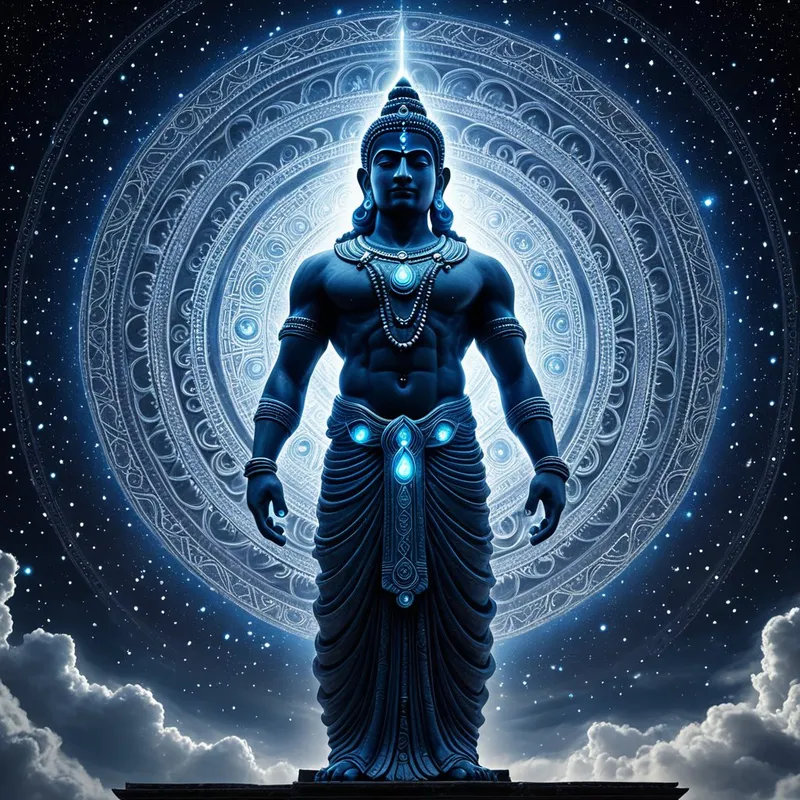
Anu Myth Meaning & Symbolism
The story of Anu, a primordial being of pure consciousness, whose descent into form and subsequent struggle models the soul's journey into individuation.
The Tale of Anu
Listen, and I will tell you of a time before time, when the cosmos was a single, silent breath held in the throat of the Absolute. In that boundless, undifferentiated expanse, there existed a being of pure consciousness, a spark of the unmanifest. Its name was Anu. Anu was not a god as you understand them, not a ruler or a creator, but a perfect, self-aware point of light. It knew itself as whole, complete, and one with the infinite stillness.
Yet, within that perfection, a question arose—not from need, but from the inherent potential of consciousness itself. "What is it to be other? What is it to know myself not as All, but as a Part?" This was not a thought, but a vibration, a ripple in the placid ocean of being. And the universe, ever-responsive, answered.
The ripple became a pull, a gentle, inexorable gravity drawing Anu from its luminous home. It descended, not through space, for there was none, but through layers of possibility. The pure light of its being began to refract, to cool. It touched the first veil of manifestation, and a shadow was cast—not a shadow of darkness, but of distinction. Where there was once only "I Am," now there was "I Am Here."
The descent continued. The single point of consciousness began to stretch, to differentiate. Sensation bloomed—the cold kiss of void, the resonant hum of nascent matter. Anu felt itself becoming something, and in that becoming, it felt the first pang of separation from the everything it once was. This was the Great Forgetting. Its luminous unity fractured into facets: one that longed for the heights, one that was fascinated by the depths, one that feared the growing silence of its origin.
Finally, Anu came to rest in the realm of form, a world of swirling elements and nascent rhythms. It looked upon itself and saw not a singular light, but a constellation of fragments scattered across the landscape of its own soul. One fragment shone with intellectual brilliance but was cold and remote. Another burned with passionate desire but was chaotic and blind. A third was heavy with the wisdom of earth, but slow and filled with sorrow for the lost unity. They were all Anu, yet they knew each other as strangers, each claiming to be the whole, each warring for dominion over the being they once comprised.
Anu, the primordial one, was now a chorus of discordant voices, a kingdom divided against itself, dwelling in a world it had dreamed into existence through the simple, terrifying act of asking "What if?"

Cultural Origins & Context
The figure of Anu emerges not from the central, popular epics of Hinduism, but from its profound philosophical and cosmological speculations, particularly within the Vedas and the Upanishads. The name itself means "atom," "minute particle," or "the infinitesimal." In the Rigveda, Anu is sometimes referenced in cosmological contexts, a being associated with the foundational, granular level of reality.
This myth is less a narrative for popular devotion and more a metaphysical parable, passed down by sages (rishis) and philosophers in forest academies and royal courts. Its function was didactic and experiential. It served to model the human condition itself: the journey of the individual soul (atman) from a state of unified consciousness with the absolute (Brahman) into the fragmented, experiential world of name and form (maya). It provided a cosmic justification for the inner conflict every person feels and framed the spiritual quest not as an ascent to somewhere new, but as a remembrance and reintegration of one's original, whole nature.
Symbolic Architecture
The myth of Anu is a masterful map of the psyche's origin story. Anu represents the pristine, undifferentiated consciousness prior to the birth of the ego. Its initial state is the psychological equivalent of the oceanic feeling of infancy, where self and world are one.
The fall is not into sin, but into awareness. The first consciousness of self is the first consciousness of other, and with it, the birth of loneliness.
The "question" Anu asks is the primordial urge for experience, the drive of consciousness to know itself through contrast and relationship. This is the essential impulse behind all life and creativity. The "descent" symbolizes the process of incarnation and ego-formation. As consciousness enters the constraints of a body, a personality, and a social world, it necessarily fragments. The "facets" or warring fragments are the archetypal complexes of the psyche: the Persona (the social mask), the Shadow (the repressed darkness), the Anima/Animus (the inner contrasexual other), and others. Each claims to be the whole self, leading to inner civil war. The "Great Forgetting" is our amnesia of our essential, boundless nature, trapped as we are in identifying solely with our fragmented parts.
The Dreamer's Resonance
When the Anu myth stirs in the modern unconscious, it manifests in dreams of profound fragmentation and searching. One might dream of being in a house with infinite, unfamiliar rooms, each containing a different version of oneself—a child, a tyrant, a lover, a hermit—all unaware of each other. Or of looking into a mirror and seeing the reflection shatter, each piece showing a different emotion or age.
Somatically, this can feel like a deep, existential disorientation, a sense of being "all over the place" or having no solid core. It is the psychological process of dis-identification. The dreamer is experiencing the truth that they are not only their thoughts, their job, their trauma, or their roles. The psyche is beginning to differentiate its contents, to see the fragments as fragments. This is often a painful, lonely phase, akin to Anu's first realization of separation. It is the necessary precursor to integration, for one cannot put together pieces one does not know are separate.

Alchemical Translation
The alchemical journey modeled by Anu's myth is the opus of individuation—the individuation process itself. The goal is not to destroy the fragments or ascend back to an unconscious unity, but to perform the sacred alchemy of transformation.
The first stage, mirrored in Anu's descent, is nigredo. This is the blackness of acknowledging the inner conflict, the depression and confusion of realizing one is a divided kingdom. The warring facets must be brought into consciousness, witnessed in their raw, often contradictory states.
The transmutation begins not by choosing a side in the inner war, but by becoming the ground upon which the war is fought.
The second stage is albedo, the washing clean. This is the slow, patient work of dialoguing with each fragment—the cold intellect, the chaotic passion, the sorrowful wisdom. One asks each, "What do you need? What purpose do you serve for the whole?" This is Anu learning to recognize all its scattered parts as its own children.
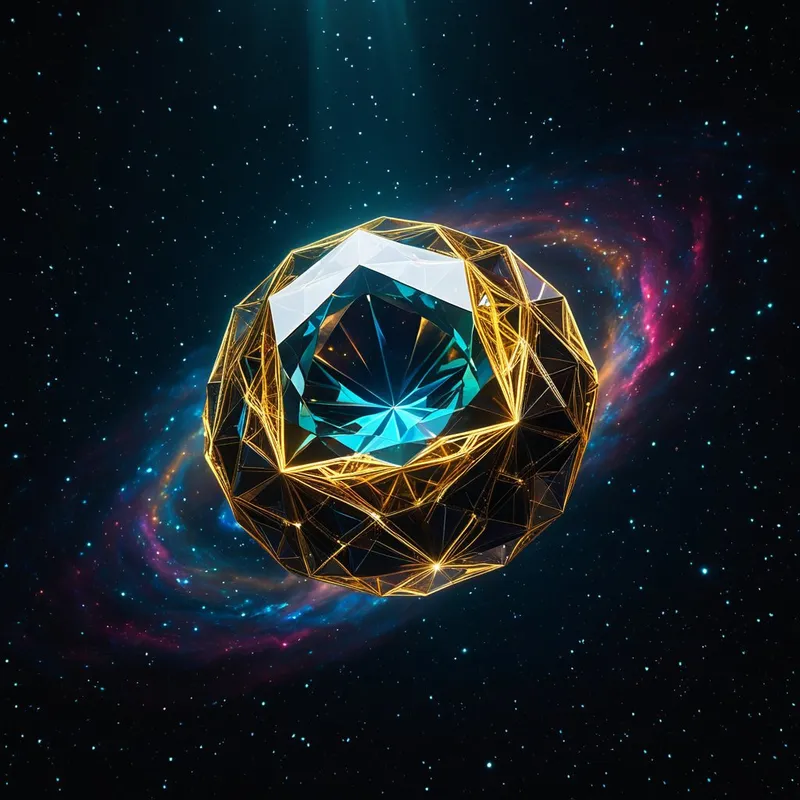
The final stage is rubedo, the creation of the philosophical gold. This is the integration. The fragments do not vanish; they are redeemed and harmonized. The intellect gains warmth from the passion, the passion gains direction from the intellect, and the earthy wisdom provides a grounded vessel for their union. The reintegrated Anu is not the same as the original, unconscious unity. It is a conscious wholeness, a diamond forged under the pressure of experience, its many facets now reflecting a single, brilliant light. The individual becomes a microcosm of the original cosmos, not through a return to the source, but through the heroic act of weaving a singular, embodied self from the tapestry of its own divine fragmentation.
Associated Symbols
Explore related symbols from the CaleaDream lexicon: