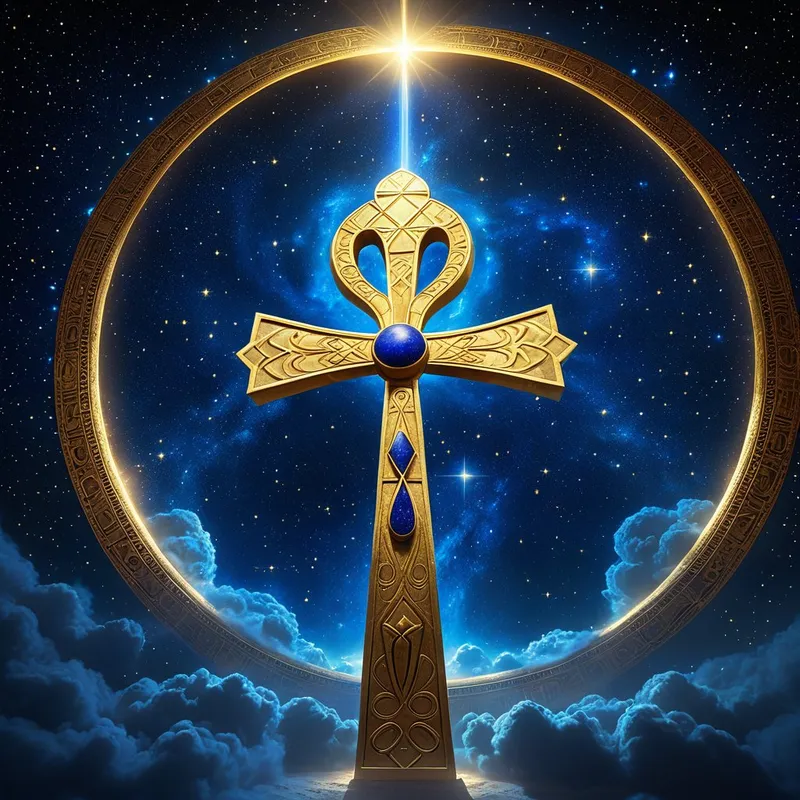
Ankh Myth Meaning & Symbolism
The Ankh is not merely a symbol but a living myth of divine breath granting life, a key held by gods and pharaohs to the gates of eternity.
The Tale of the Ankh
Hear now the whisper that rides on the desert wind, the secret told in the silence between heartbeats. Before time was measured in the flood and ebb of the Hapy, there was only the dark, silent waters of Nun. From this nothingness, a spark of will stirred. It was Khnum at his potter’s wheel, but his clay was inert. It was Shu, holding aloft the star-studded body of Nut, but the world below was a breathless sculpture.
Then came the moment. The sun god Atum, in his first act of loneliness and love, brought his children Shu and Tefnut into being. But life was not yet living. It was form without spirit, a statue in a hall of echoes. The gods looked upon the nascent world—the green valley, the stone cliffs, the creatures of the field—and saw a profound stillness. Something was missing. The word was there, but not the breath to speak it.
So the great council gathered in the hidden chamber of the horizon. Osiris, lord of the fertile black earth, held his crook and flail crossed over his still chest. Isis, she of ten thousand names, wove spells of protection with her hands. Horus watched with his keen solar eye. They conferred in a language of light and vibration. The problem was the seal. Existence was a closed loop, perfect and complete, yet trapped within its own perfection. It needed a key.
And from this divine consensus, from the union of male and female, earth and sky, order and potential, the key was forged. Not in fire, but in intention. It took the shape of a sandal strap, the practical bond between the walker and the path. It took the shape of a mirror, reflecting the self back to itself. But ultimately, it took its true form: a loop above a cross. The loop, the eternal, unbroken circle of the heavens held by Nut. The cross, the stable, earthly plane of Geb. Where they met, at the crux, was the point of infusion.
The god Ptah spoke the divine utterance. Seshat recorded its measure. And then, Isis, using the power she would later use to resurrect Osiris, took the symbol and pressed it to the lips of the first pharaoh. She did not blow. She offered. And the pharaoh inhaled. It was not air that filled his lungs, but ankh—the very substance of life. The stillness shattered. The heart beat. The word was spoken. The key had turned, and the gate between mere existence and vibrant, conscious life swung open forever. From that day forth, the gods held it to the noses of the righteous dead, and the pharaohs held it before the people, a sacred promise written in the very shape of breath and bone.
Cultural Origins & Context
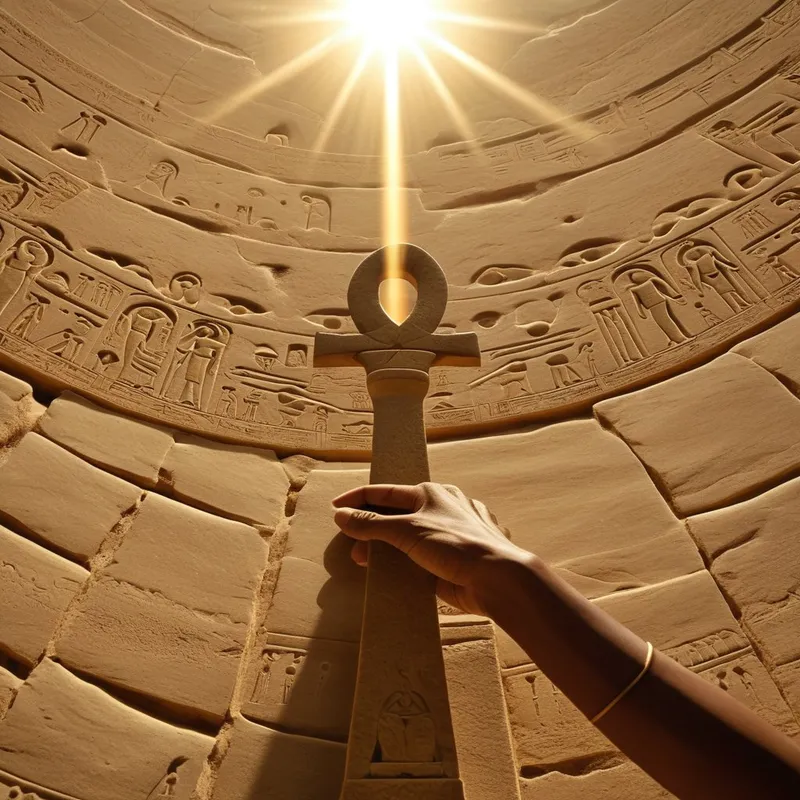
The Ankh, or 'nh, meaning "life" or "to live," predates dynastic Egypt, with roots stretching into prehistoric Nilotic culture. It was never merely an amulet but a functional hieroglyph, a word made flesh in ritual. Unlike formal myths recorded in papyri like the Book of the Dead, the "myth" of the Ankh is not a single narrative. It is a pervasive, lived theology woven into the fabric of daily and eternal existence.
It was told not by bards, but by practice. Priests wielded it in temple rites to animate cult statues, a ritual called "The Opening of the Mouth," where an adze—a tool—in the shape of an Ankh would touch the statue’s lips, granting it the breath of life. Pharaohs, as the intermediary between gods and people, were depicted incessantly being offered the Ankh by deities, or holding it before the noses of their subjects in art, transmitting divine vitality to the nation. It was the ultimate symbol of legitimate power—not power over, but power to give life. In funerary art, gods like Osiris or Nut would hold it to the deceased's nose, promising a revived existence in the Field of Reeds. Its societal function was total: it was the metaphysical engine of the state, the guarantee of cosmic order (Maat), and the personal hope of every individual for eternity.
Symbolic Architecture
The Ankh is a mandala of integration, a complete psychic blueprint. Its architecture is its meaning.
The Loop (the shen): This is the realm of spirit, the eternal, the unmanifest potential, and the divine feminine principle. It is the womb of Nut, the encompassing sky, the ouroboros of infinity. Psychologically, it represents the Self—the total, unified psyche that transcends the ego.
The Vertical Bar: This is the axis mundi, the world pillar, the spine of Geb. It is the masculine principle of active manifestation, the path of descent (spirit into matter) and ascent (matter returning to spirit). It is the individual's life journey, their backbone of will and consciousness.
The Horizontal Bar: This is the horizon, the meeting point, the arms stretched out in reception or offering. It represents the plane of human experience, the crossroads where the eternal (loop) engages with the temporal (vertical journey). It is the realm of relationship, action, and the present moment.
The Ankh does not symbolize life as a biological state, but Life as a sacred current—the active conjugation of spirit and matter at the crossroads of now.
The crux, where all three elements intersect, is the sacred point of infusion. This is where the breath (ka) enters the body, where inspiration strikes, where a soul is animated. It is the moment of conscious awakening. To hold the Ankh is to hold the key to this process, to be at the controls of one's own animation.
The Dreamer's Resonance
When the Ankh appears in a modern dream, it is rarely a simple archaeological artifact. It manifests as a profound somatic signal from the deep psyche, indicating a process of re-animation.
One might dream of a heavy, stone Ankh around their neck, representing a spiritual burden or a life principle that has become dogma, weighing down the heart. Another might dream of a small, glowing Ankh locked inside a chest in a forgotten room—the vital life force (Ka) is recognized but inaccessible, sealed away by trauma or neglect. To dream of receiving an Ankh from a shadowy or luminous figure often coincides with a period of recovery from illness or depression, a literal psychological "gift of life" or a new, empowering insight. To dream of fashioning an Ankh from disparate materials—tying a loop of rope to a stick—speaks to the dreamer's active, perhaps struggling, attempt to integrate fragmented parts of themselves into a living, functional whole.
The somatic experience is key: a feeling of expansion in the chest, a deep, involuntary inhalation upon seeing it, or a warmth at the crown of the head. The dream-Ankh is the psyche's symbol for the activation of a dormant circuit, the call to embody one's existence more fully.
Alchemical Translation
The myth of the Ankh models the alchemical opus, the great work of individuation. It is a map for psychic transmutation from leaden unconsciousness to golden, conscious life.
The process begins in the Nigredo, the blackness of Nun—a state of potential, but also of stagnation, depression, or meaninglessness (the "form without spirit"). The ego feels inert, like unanimated clay. The first step is the emergence of the vertical axis: the spark of conscious questioning, the "I am" that begins to differentiate itself from the murk. This is the descent of spirit into the matter of one's own life story.
The horizontal bar then appears as the confrontation with the world—relationships, responsibilities, sufferings, and joys. This is the crucible where the spirit is tested. Often, one gets stuck here, identified solely with the cross of earthly suffering or pleasure, forgetting the loop above.
Individuation is the act of constructing the crux—forging the conscious connection where our eternal nature (loop) informs our temporal journey (vertical) and transforms our daily experience (horizontal).
The "breath of life" is the moment of integration. It is the Aha! insight where a lifelong pattern is understood, where a trauma is felt and released, where a creative vision suddenly coheres. This is the divine inhalation. The god who offers the Ankh is the archetypal Magician within—the part of the Self capable of wielding symbols to transform reality. To grasp the Ankh is to take responsibility for one's own animation. It is to stop waiting for life to happen and to instead inhale it—to actively choose, moment by moment, to infuse one's actions with meaning, to align the personal journey with the transpersonal loop of the archetypal world. The triumph is not immortality in an Egyptian sense, but the achievement of a living soul—a psyche that is fully powered, conscious, and creatively engaged with the mystery of its own existence.
Associated Symbols
Explore related symbols from the CaleaDream lexicon: