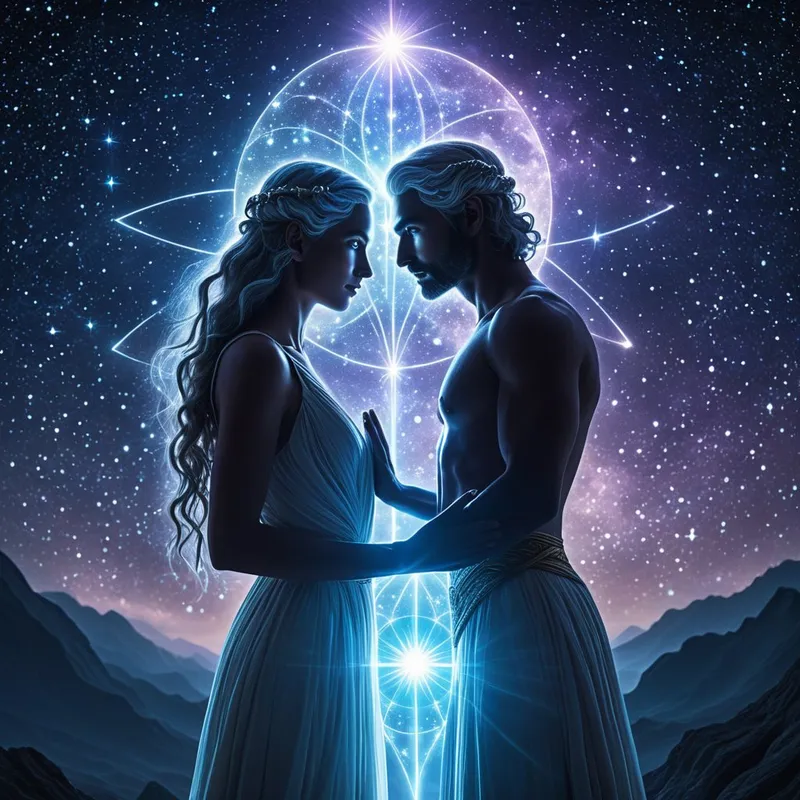
Anima/Animus Myth Meaning & Symbolism
The myth of the inner other, a psychic guide who leads the conscious self through the labyrinth of the soul to confront and integrate its lost half.
The Tale of Anima/Animus
Listen. There is a story whispered not in the wind, but in the silence between heartbeats. It speaks of a kingdom, vast and lonely, ruled by a sovereign of singular light. This ruler, whether King or Queen, sat upon a throne of polished reason, surveying a realm of perfect order. The walls were high, the laws were clear, and the sun of consciousness shone brightly on all it surveyed. Yet, in the deepest cellar of the castle, behind a door of forgotten iron, a sigh echoed—a sigh that carried the scent of night-blooming jasmine and distant rain.
This was the sigh of the Anima, or the Animus, the banished consort. Long ago, in the first act of creation, the sovereign had declared, "I am This," and in that declaration, cast all that was "Not-This" into the dungeon of shadow. The consort, the eternal Other, was chained there, a prisoner of the king's certainty, the queen's clarity.
But a kingdom built on half a truth is a fragile place. The fountains in the courtyard began to run with salt water. The maps in the library led only to the edges of known lands and then to blank spaces where sea monsters were drawn. The sovereign dreamed—not of triumphs, but of a figure seen in a dark pool, a face both alien and intimately known, who sang a wordless song that filled the dreamer with a terrible, beautiful longing.
Driven by this ache, the ruler descended. Down, past the archives of memory, past the armory of worn-out defenses, to the forgotten door. The key was not of metal, but of a surrendered question: "Who are you?" The door swung open, not onto a dungeon, but onto a landscape. A moonlit forest, a shore at twilight, the interior of a vast, beating heart. And there, not as a prisoner but as the native ruler of this interior world, stood the Other. She might appear as the Sibyl, he as the Senex. They were mood, they were image, they were the soul's own mirror.
A confrontation, not of swords, but of gazes. "You have ruled the day," the consort said, voice like rustling leaves. "I am the ruler of the night. You navigate by the sun; I navigate by the pull of the tides within. You have light, but I have depth." The sovereign’s polished armor of identity felt hollow. This was not a battle to be won, but a recognition to be endured. To see this Other was to see the missing half of one’s own crown.
The resolution was not a marriage, not at first. It was a pact, a terrible and glorious alliance. The sovereign brought the torch of consciousness into the dark woods. The consort placed the compass of the unconscious into the sovereign's hand. Together, they walked back up, not to the old throne, but to a new chamber in the castle—a Selbst—where two chairs sat facing not a kingdom, but the infinite, star-dusted sky of the soul.

Cultural Origins & Context
This is a myth of the 20th century, born not from a forgotten temple but from the consulting room and the private journals of Carl Gustav Jung. Its "culture" is that of analytical psychology, a modern tradition seeking to map the interior world with the rigor of science and the poetry of the humanities. The myth was passed down not by bards, but through case studies, lectures, and the dense, symbolic prose of Jung's collected works, most notably in Aion and The Archetypes and the Collective Unconscious.
Its societal function was revolutionary for its time: to provide a diagnostic and healing narrative for the profound alienation of the modern psyche. In an age increasingly dominated by rationalism and impersonal systems, Jung offered a myth that re-sacralized the inner life. The story of the Anima and Animus gave a name and a face to the feeling of incompleteness, framing it not as a pathology but as a sacred calling. It was told to patients lost in the "waste land" of meaninglessness, providing a map where the destination was not adjustment, but wholeness—Individuation.
Symbolic Architecture
At its core, this myth symbolizes the psychic structure of enantiodromia—the tension of opposites that generates the energy of life and consciousness. The sovereign represents the dominant, conscious attitude, typically aligned with the cultural norms of one's biological sex. The banished consort is the contrasexual soul-image, the psychic organ that connects the ego to the deep, archetypal waters of the collective unconscious.
The Anima is not a woman, but an image of womanhood carried within a man; the Animus is not a man, but an image of manhood carried within a woman. They are the bridges to the unknown self.
These figures are archetypes, and thus they manifest in four classic, evolving stages. The Anima may appear as Eve (the instinctual), Helen (the romantic), Mary (the spiritual), or Sophia (the wise). The Animus may appear as a figure of physical power, romantic action, word-based authority, or spiritual meaning. The myth’s journey is the evolution of this inner relationship from primitive projection to conscious integration.
The dark forest, the mirror pool, the forgotten cellar—these are all symbols of the unconscious itself. The key of the "surrendered question" symbolizes the essential shift from a stance of knowing to one of inquiry, which is the only way the conscious mind can genuinely engage the unconscious.
The Dreamer's Resonance
When this myth stirs in the modern dreamer, it announces a critical phase of psychic rebalancing. To dream repeatedly of a mysterious, compelling figure of the opposite sex—a guide, a lover, a persecutor, or a silent companion—is to feel the Anima or Animus constellating. This is not about literal romance, but about the psyche attempting to correct a one-sided conscious attitude.
Somatically, this process can feel like a gravitational pull, a mood that descends for no apparent reason (the "animus mood" of sharp, opinionated negativity or the "anima mood" of vague, sentimental melancholy). Psychologically, it is the process of the shadow giving way to a deeper layer. One has dealt with the personal repressed material, and now the archetypal layer of the soul-image emerges. The dream figure acts as a psychopomp, leading the dreamer into more numinous, awe-inspiring, and often terrifying realms of their own interiority. The dreamer is going through the initial stages of relating to the unconscious not as a trash bin, but as a partner in the creation of consciousness.

Alchemical Translation
The myth of Anima/Animus is the alchemical coniunctio rendered in psychological terms. The sovereign's conscious realm is the prima materia—a state of naïve identification with one's persona. The descent is the nigredo, where the old, rigid identity faces its own emptiness and contradiction upon meeting its opposite.
The goal is not to become the Other, but to create a tertium non datur—a third, new position from which one can observe and relate to both the inner king and the inner queen.
The confrontation in the cellar is the fiery stage of confrontation and separation (albedo), where one learns to differentiate between the archetypal image and the actual people in one's life upon whom it has been projected. The pact and the ascent to the new chamber symbolize the citrinitas and the final rubedo: the creation of a stable, inner vas (vessel) where the dialogue between conscious and unconscious can proceed.
For the modern individual, this alchemy translates to the hard, daily work of withdrawing projections. It means catching oneself when attributing magical power or demonic weight to another person and asking, "What part of my own soul am I seeing in them?" It is the cultivation of an inner space where mood, image, and intuition—the languages of the Anima/Animus—are given a seat at the table of decision-making, not as rulers, but as essential advisors. The triumph is not a static state of "wholeness," but the enduring capacity for this inner marriage, this sacred conversation, which turns the leaden isolation of the ego into the gold of a soul-connected life.
Associated Symbols
Explore related symbols from the CaleaDream lexicon: