Ammonites Myth Meaning & Symbolism
The myth of the horned god Ammon, his hidden oasis sanctuary, and the sacred ram that embodies divine power and the soul's hidden resilience.
The Tale of Ammonites
Listen, and let the wind carry you to a time before maps, to the edge of the known world. Here lies the Libyan Desert, a kingdom of thirst and blinding light, where the sun is a tyrant and the horizon a shimmering illusion. Men whispered of a power that ruled this barren expanse, a god who was the desert itself: Ammon. He was not a god of marble temples upon a hill, but of secrets. His sanctuary was the Oasis of Siwa, a jewel of palm and spring water cradled in the desert's stony palm, so remote it was more rumor than place.
The tale finds its heat in the footsteps of a hero, Perseus. He was not walking toward glory, but fleeing from it, carrying the dreadful, petrifying head of the Gorgon Medusa. The weight was not just in his sack, but in his soul. The desert welcomed him with a furnace breath, scouring his bronze and his resolve. Sand filled his sandals, the sun hammered his helm, and the whispers of mirages taunted him. He was a man adrift in a golden sea, his divine lineage a cold comfort against the consuming dryness.
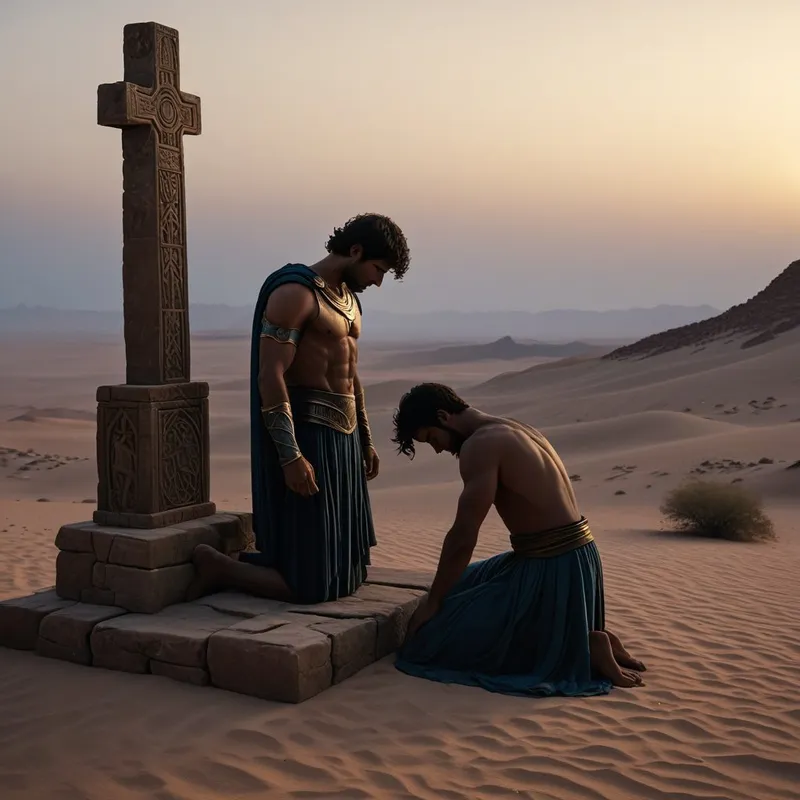
As his water-skin grew light and his vision began to dance with false pools, a desperation, colder than any night, took root. This was not a monster to be slain, but an emptiness to be endured. In his extremity, he did not call upon his father, Zeus, of the high, clear sky. He called upon the god of this place, the hidden sovereign of the deep earth. He poured the last of his water onto the burning sand as a libation, a sacrifice of his final hope to the dust.
And the desert answered.
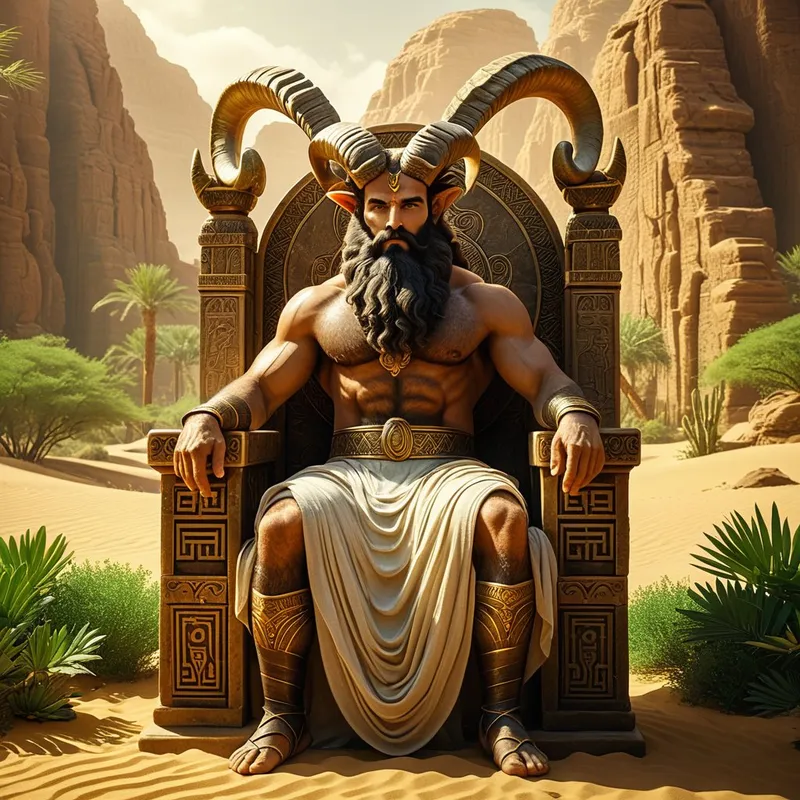
Not with a roar, but with a presence. The air grew still, heavy with a scent not of dust, but of damp earth and green things. Before him, the form of the god manifested. Ammon was a figure of terrible majesty, a fusion of human sovereignty and primal force. A powerful, bearded visage held the ancient calm of the bedrock, and from his temples grew the great, curling horns of a wild ram—not as ornament, but as crown and weapon, symbols of relentless strength and spiraling vitality. He spoke not with a human voice, but with the sound of a wind through canyon walls. He acknowledged Perseus, son of Zeus, and saw the Gorgon's burden he carried.
In that sacred space, at the world's forgotten hearth, a transaction of profound power occurred. Perseus, the wandering son of the sky god, entrusted the head of Medusa to the earth god. He asked that Ammon sanctify and receive this terrible trophy. And the god consented. But the gift flowed both ways. From the hidden springs of his oasis, Ammon provided the hero with sustenance, with guidance, and with a divine favor that would see him home. More than that, in a gesture of paternal blessing that echoed through the ages, Ammon declared that from this day, Perseus would also be called his son. The hero who entered the desert as a parched wanderer left it as a twice-blessed scion, bearing the favor of both Olympus and the deep, hidden earth. And in the heart of the oasis, the head of Medusa was kept, its power now guarded and integrated into the god's own formidable dominion.
Cultural Origins & Context
The myth of Ammonites is a story of cultural encounter and theological syncretism. The figure of Ammon is not originally Greek, but Egyptian: Amun, the "Hidden One," king of the gods at Thebes. As Greek traders,mercenaries, and colonists interacted with the Egyptian world, particularly from the 7th century BCE onward, they encountered this powerful deity. They equated him with their own king of gods, Zeus, creating the composite Zeus-Ammon.
The primary vector for this myth was the famed Oracle of Ammon at the Siwa Oasis, a site so remote its very existence felt mythical. Its reputation for uncanny accuracy drew pilgrims from across the Mediterranean, including the legendary visit of Alexander the Great, who was declared the son of Zeus-Ammon by the oracle, mirroring the mythic blessing of Perseus. The story functioned as a etiological myth for this cultural and religious fusion, explaining how a Greek hero came to be received and blessed by a foreign, desert god. It served to legitimize and naturalize the worship of Zeus-Ammon within the Greek imagination, transforming a "barbarian" god into an ancient, venerable aspect of their own pantheon. The tale was passed down not just by poets, but by historians and geographers like Herodotus, for whom the oasis and its god were wonders at the edge of the known world.
Symbolic Architecture
At its core, the myth of Ammonites is a profound narrative of finding resources in the barren places, both without and within. Ammon represents the Hidden Wisdom of the unconscious, the oasis of the soul that exists beneath the arid surface of conscious struggle and egoic pursuit.
The god who dwells in the desert is the Self that waits in the psyche's most arid, neglected quarters.
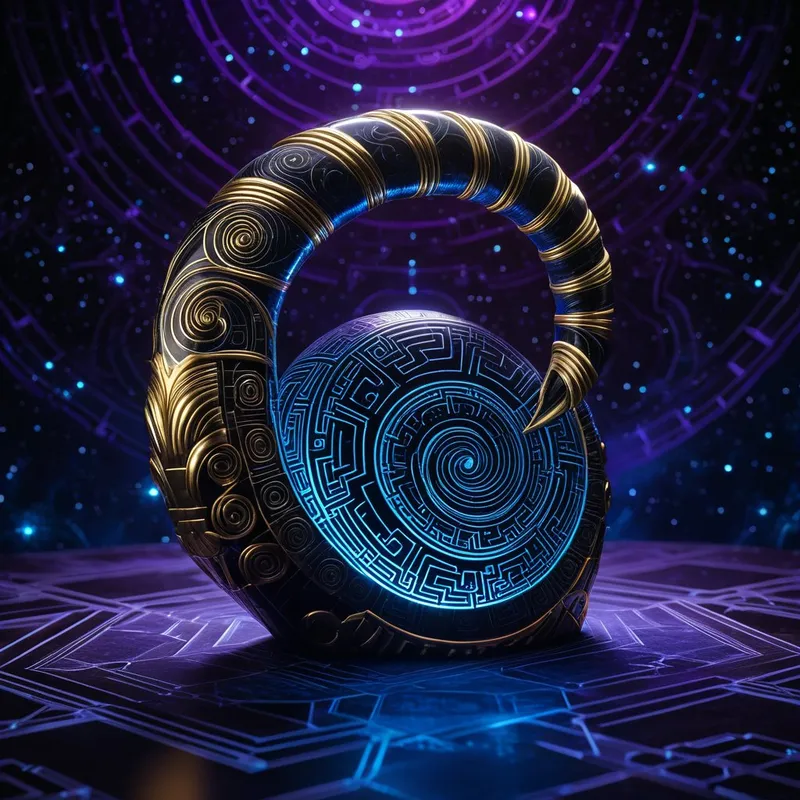
The desert is the landscape of crisis, depression, or spiritual drought—where the familiar supports of the ego (Perseus's heroic identity) fail. The ram is a potent symbol of vital, unstoppable life force, of headstrong determination and generative power. Its horns, spiraling like a labyrinth or a galaxy, speak of natural, cyclical growth and formidable defense. Perseus's journey is not one of conquest, but of surrender. He must exhaust his own resources and humbly petition the hidden power of the place. His offering of his last water is the ultimate act of faith, sacrificing his final conscious control to the unconscious. The resulting blessing—being called "son"—signifies a profound integration. The ego (Perseus) is not destroyed by the Self (Ammon), but is recognized, nourished, and legitimized by it, gaining a new, deeper source of authority.
The Dreamer's Resonance
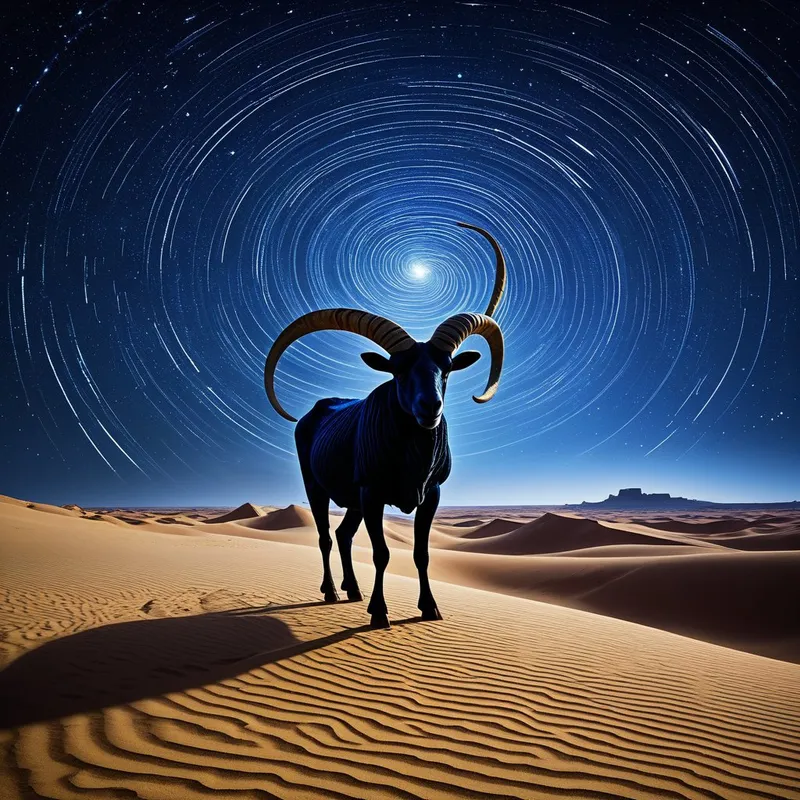
When the pattern of the Ammonites myth stirs in modern dreams, it often signals a "desert period" in the dreamer's life. One may dream of being lost in vast, beautiful but empty landscapes; of finding a hidden, lush garden in a place of urban decay; or of encountering a powerful, silent animal—a ram, bull, or stag—that emanates calm authority.
Somatically, this can correlate with feelings of exhaustion, dehydration, or a craving for something essential and nourishing that cannot be named. Psychologically, the process is one of ego-depletion leading to unconscious replenishment. The dreamer is being guided to stop striving on the surface level and to turn inward. The appearance of the ram or the oasis is the psyche's assurance that resources exist, but they are not found in the direction of conscious effort. They are found in descent, in rest, in the humble acknowledgment of one's own barren state. This dream motif invites a ritual of surrender: to stop seeking the water, and instead to honor the thirst itself as a prayer to the hidden god within.
Alchemical Translation
The alchemical journey mirrored in this myth is the nigredo, the blackening, the descent into the massa confusa of the desert. Perseus, with his monstrous trophy, is the conscious mind burdened by its own conquests and traumas, now facing dissolution.
The alchemy begins not with fire, but with thirst. The dissolution of the old form is a drought commanded by the soul.
The encounter with Ammon is the stage of albedo. The hidden Self (the oasis) washes over the parched ego, not to drown it, but to cleanse and recognize it. The libation of the last water is the crucial sacrifice—the conscious will giving up its final claim to control, allowing the unconscious to flow in. The ram's horns symbolize the circumambulatio around the Self, the winding path of individuation that one must travel.
The final blessing—"you shall also be called my son"—is the rubedo. It represents the creation of the filial bond between ego and Self. The hero is no longer just a wandering son of a distant sky-father (Zeus as abstract principle), but an acknowledged heir of the immanent, earthy, nurturing Self (Ammon). The monstrous head of Medusa, the petrifying trauma, is not discarded but integrated into the sanctuary of the psyche, its power guarded and contained by the greater wholeness. For the modern individual, this translates to the hard-earned wisdom that our deepest resilience and renewal are not forged in the sunlight of continual success, but in the humble, thirsty pilgrimage to our own hidden, inner oasis.
Associated Symbols
Explore related symbols from the CaleaDream lexicon: