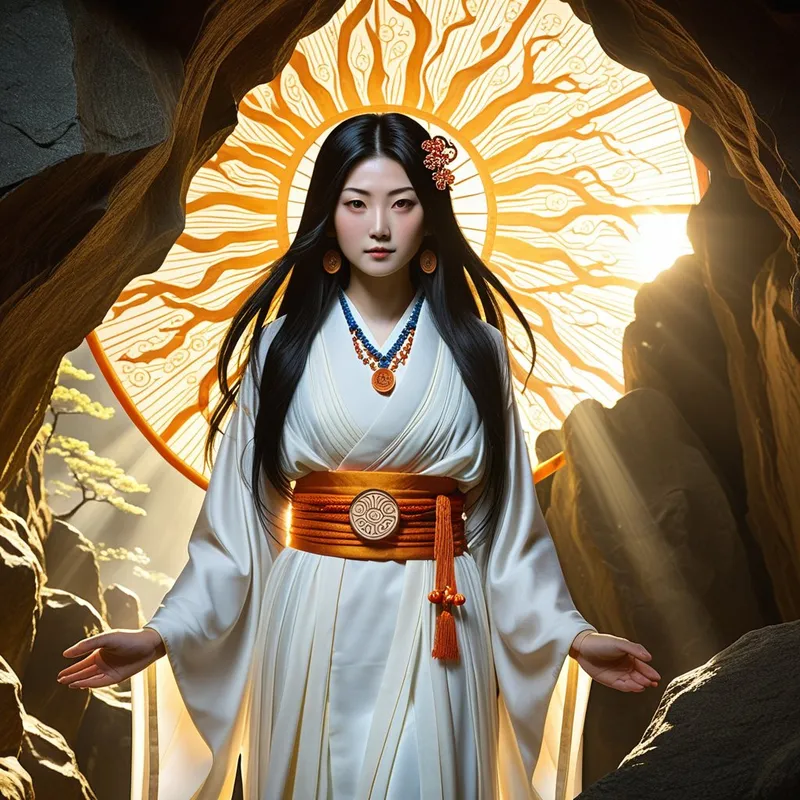
Amaterasu Myth Meaning & Symbolism
The sun goddess Amaterasu retreats into a cave, plunging the world into darkness, until a divine performance of laughter and light coaxes her forth.
The Tale of Amaterasu
Listen, and hear the story of the time the world went dark, not from the setting of the sun, but from its retreat.
In the High Plain of Heaven, the sun herself walked among the kami. She was Amaterasu Ōmikami, whose radiance nurtured the rice, warmed the soil, and defined the rhythm of life. Her light was order, clarity, and benevolent rule. Yet, she had a brother, Susanoo-no-Mikoto, a force of wild winds and torrential rains. His nature was chaos, raw and untamed.
Driven by a turbulent heart, Susanoo ascended to the heavens. To prove his intentions, he and Amaterasu undertook a ritual of creation. From her jeweled necklace, Amaterasu birthed three graceful goddesses. From Susanoo’s sword, five rugged gods sprang forth. He declared his victory and his purity, and in his triumph, chaos erupted. He broke the sacred rice paddies, defiled the hall of the first fruits, and in a final, unforgivable act, flung a heavenly piebald horse—flayed backward—through the roof of Amaterasu’s sacred weaving hall. One of her weaving maidens, startled, struck herself with her shuttle and died.
A profound silence fell, colder than any winter. Amaterasu did not rage. She turned away. The light in her eyes dimmed. In a gesture of ultimate withdrawal, she retreated to the Ama-no-Iwato and sealed the entrance with a mighty stone. The world was plunged into an abyssal, unending night. Without her light, chaos reigned supreme; spirits of pestilence and misfortune danced in the shadows. The voices of the eight million kami wailed in a chorus of despair.
The assembled deities gathered by the Ama-no-Yasukawa. Desperation hung thick in the eternal dark. Then, the kami of wisdom, Omoikane, conceived a plan. They collected a sakaki tree and adorned its branches with glittering magatama, shimmering mirrors, and fine cloth. They set it before the cave’s sealed mouth. Then, Ame-no-Uzume stepped forward. She placed a sounding-board before the cave, and with a ferocious, life-affirming energy, began to dance. She stamped her feet, whirled, and with shameless abandon, let her robes fall loose. The rhythm was primal, the spectacle absurd and glorious.
The other kami roared with laughter. The very rocks of the plain shook with their mirth. Inside her stony womb, Amaterasu heard the commotion. Curiosity, a faint spark, stirred within the darkness. What could possibly cause such jubilation in this eternal night? Peering through a crack in the stone, she saw her own dazzling reflection in the mirror hung upon the sakaki tree—a brilliance she had forgotten. “What is this radiant kami outside who shines as I do?” she murmured, edging forward.
At that moment, the kami of strength, Ame-no-Tajikarao, seized the rock door and flung it aside. Another deity stretched a sacred shimenawa behind her, barring retreat. Light flooded the world once more. Amaterasu had been lured out not by force, but by her own captured radiance and the irresistible, healing sound of collective joy. The sun had returned.
Cultural Origins & Context
This foundational myth is recorded in Japan’s oldest chronicles, the Kojiki (712 CE) and the Nihon Shoki (720 CE). These texts were not mere storybooks but political and cosmological documents, crafted to legitimize the ruling Yamato line by tracing its divine ancestry directly to Amaterasu. The myth served as the sacred precedent for the emperor’s role as her earthly descendant, the mediator between the heavenly realm (Takamagahara) and the land of the reed plains (Ashihara no Nakatsukuni).
The telling and re-telling of this myth was a sacred act, central to Shinto ritual. It was performed not just to explain celestial phenomena, but to enact a cosmic principle of renewal. The myth provided a template for understanding crisis: darkness (social strife, natural disaster, spiritual pollution) was not a permanent end, but a phase requiring ritual purification, collective action, and the invocation of joy to restore cosmic and social order. The Ise Jingu, where Amaterasu is enshrined, becomes the physical locus of this eternal cycle, its architecture and regular rebuildings mirroring the myth’s theme of periodic renewal.
Symbolic Architecture
At its core, the myth of Amaterasu is a profound allegory of the psyche’s relationship with its own light and the necessary, terrifying encounter with the shadow.
Amaterasu represents the conscious ego, the ruling principle of order, clarity, and life-giving energy. Her light is our identity, our productivity, our visible self. Susanoo’s violent chaos is not merely an external antagonist, but the eruption of the repressed shadow—the unruly, emotional, destructive, and creative forces that the orderly ego cannot accommodate. The flayed horse is a brutal image of nature inverted, a trauma so visceral it shatters the ego’s capacity to function.
The greatest light casts the deepest shadow. To hide one’s light is not its extinction, but its concentration in the womb of the unconscious.
The cave, the Ama-no-Iwato, is the unconscious itself. Retreat is not defeat, but a necessary descent. It is a psychic hibernation where the brilliant but wounded ego withdraws to a state of potential, awaiting a new form of integration. The assembled kami represent the totality of the psyche, which must work in concert to effect a cure. The mirror (Yata no Kagami) is the pivotal symbol of self-reflection. We cannot see our own radiance directly; we need an object, an art, a relationship, or a reflection to reveal our essence to ourselves.
Finally, Ame-no-Uzume’s dance is the catalytic function of the life force—eros, humor, embodied expression, and ecstatic absurdity. It is the irrational, somatic key that unlocks the rational, wounded mind. Laughter here is not trivial; it is the shock that breaks a depressive loop, the spontaneous joy that reconnects us to the instinctual world.
The Dreamer’s Resonance
When this myth patterns a modern dream, the dreamer is likely in a state of profound introversion or depression—a “hiding in the cave.” The dream landscape may feel perpetually dark, stagnant, or cold. One might dream of a room with no windows, a sealed door, or being trapped in a basement. The feeling is of self-imposed exile, where the dreamer’s own vitality feels inaccessible.
Somatically, this can manifest as chronic fatigue, a sense of heaviness, or a loss of appetite for life—a literal “dark night of the soul.” Psychologically, it often follows a “Susanoo event”: a betrayal, a shocking loss, a burst of rage (one’s own or another’s) that feels so violating it causes the conscious self to retreat. The dreamer isn’t battling an external monster, but is immobilized, listening to the muffled sounds of a world from which they feel utterly disconnected. The dream task is not to fight the darkness, but to attend to what tiny spark of curiosity might remain—the faint crack of light under the door, the distant sound of music or laughter.
Alchemical Translation
The myth models the complete cycle of psychic transmutation, or individuation. It begins with the nigredo, the blackening: the ego’s inflation (Amaterasu’s perfect rule) is punctured by the shadow (Susanoo), leading to a collapse into the darkness of the unconscious (the cave).
The collective efforts by the river represent the albedo, the whitening: the gathering and sorting of psychic contents. The crafting of the sakaki tree with its regalia is the careful reconstruction of a new symbolic center—a “temenos” or sacred space—where the fragmented self can be re-membered.
The self is not found by chasing the light, but by constructing a mirror in the darkness capable of catching its reflection.
Uzume’s dance is the citrinitas, the yellowing: the infusion of the transformative fire of life and libido, not as brute force, but as playful, embodied eros. It is the moment where analysis gives way to expression, where thinking is bypassed by feeling and movement.
The final emergence is the rubedo, the reddening: the birth of a new, more integrated consciousness. Amaterasu does not return as the same goddess. She has encountered her shadow brother and survived. She has seen her own essence reflected back. The light that returns is wiser, having integrated the knowledge of the cave. For the modern individual, this alchemy translates to the process where a breakdown—a retreat from life, a depression—becomes the necessary precondition for a breakthrough. We are coaxed back into the world not by sheer willpower, but by rediscovering what makes us curious, what makes us laugh, and by finally recognizing our own value reflected in the creations, relationships, and mirrors we place before ourselves. The sacred shimenawa left behind signifies that the cave remains; the unconscious is always present, but now we have a conscious relationship with its threshold.
Associated Symbols
Explore related symbols from the CaleaDream lexicon: