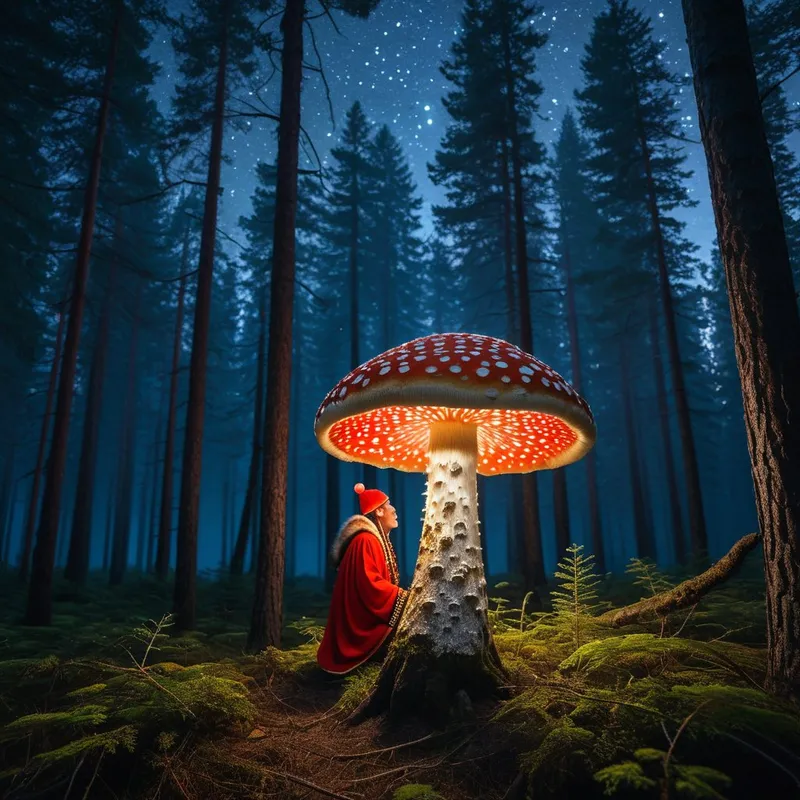
Amanita muscaria / Fly Agaric Myth Meaning & Symbolism
A myth of divine sacrifice where a celestial being descends, its flesh becoming the red-and-white mushroom that grants shamans passage to the spirit world.
The Tale of Amanita muscaria / Fly Agaric
Listen. In the time before time, when the world was young and the sky-tent was stitched close to the earth, the people knew only the waking world. The great Upper World was a distant rumor, a place of ancestors and animal masters, sealed away by a veil of ordinary sight. The people suffered, for they could not speak to the spirits of the hunt, could not heal the sicknesses sent by jealous shades, could not find their way when the path was swallowed by blizzards born of anger.
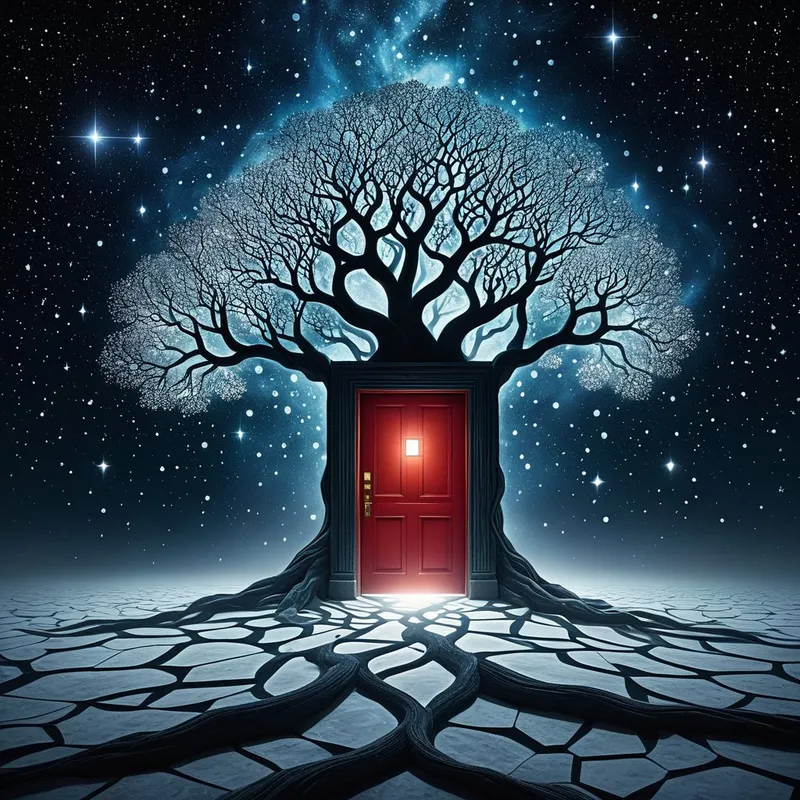
In their longing, their prayers rose like smoke from the hearth-fire, weaving through the branches of the great World Tree—a pine so vast its roots drank from the underworld rivers and its crown brushed the belly of the sky. The prayers gathered there, in the high green darkness, a knot of human yearning.
And the sky heard.
From the highest branch, a being descended. It was not a god of thunder, but a quiet deity of the in-between. Some say its skin was the white of birch bark, its hair the red of the last autumn berry. Others say it was a spirit of the stars, clothed in light. It was the Sky-Traveler. It saw the people’s plight, their blindness to the web of life. A great compassion, colder and clearer than mountain ice, filled its heart.
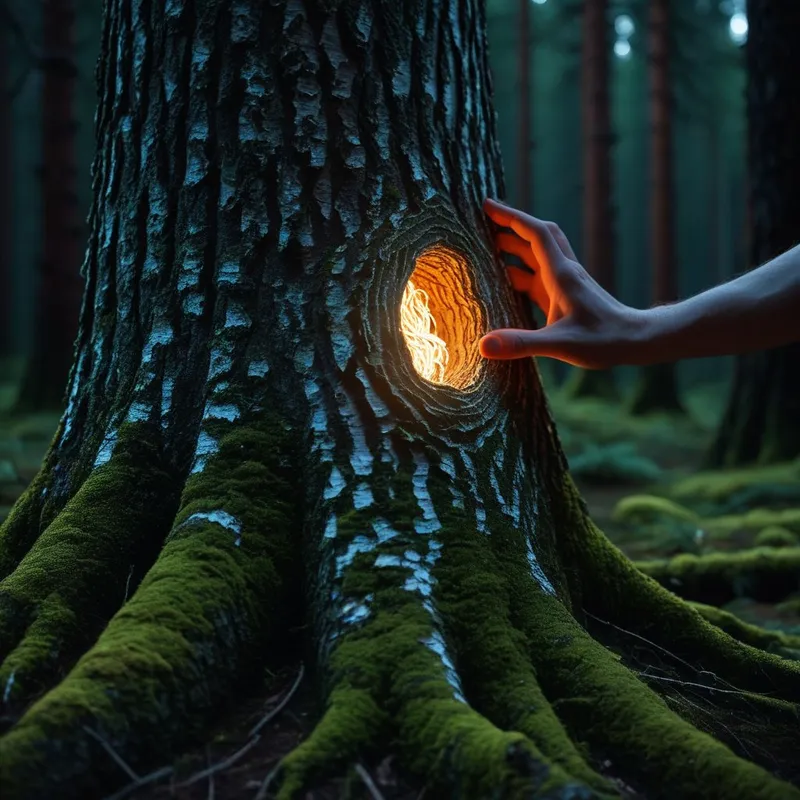
The Sky-Traveler did not speak with a voice of wind. Instead, it walked to the base of the World Tree, where the roots knuckled into the dark soil. There, in a circle of silence broken only by the drip of sap, it performed the unthinkable act. It took of its own flesh. Not in violence, but in a deliberate, sacred offering. Piece by luminous piece, it laid its substance upon the moss and the needle-carpet, beneath the sighing boughs.
Where each piece touched the earth, the ground shuddered. A soft, red light pulsed from the soil, swelling upward. From the offered flesh, forms pushed through the humus: sturdy stems crowned with caps of brilliant, blood-red skin, dotted with flecks of the being’s own white essence. They were firm, they were potent, they smelled of rain and life and something older. The Fly Agaric had been born from a divine sacrifice.
The Sky-Traveler, diminished but not gone, whispered a final secret into the wind that stirred the mushroom caps. Then it faded, its essence returning to the high branches, leaving behind its physical gift. The first shaman, a man or woman with ears tuned to the whisper, found the glowing red caps. Guided by dream or desperate instinct, they consumed the sacred flesh.
And the veil tore.
The shaman’s soul was loosened from its bone-house. They saw the Spirit-Double of the reindeer, glowing in the forest. They climbed the roots of the World Tree into the star-lit lands of the ancestors. They wrestled with sickness-spirits in the lower world and returned, sweating and singing, with the cure. The mushroom was the key, the flesh of a god that became a door. It was not a mere plant; it was the solidified compassion of the sky, the bridge between worlds, born from a celestial body broken so that human spirit might fly.
Cultural Origins & Context
This myth, in its many variations, forms the sacred etiology for the use of Amanita muscaria across Siberia, from the Evenki and Koryak to the Chukchi. It was not a story for children, but a core narrative of the shamanic vocation, transmitted orally during initiations and elaborate rituals. The teller was always the shaman or an elder, often in the context of preparing for or returning from a spirit journey. Its function was multifaceted: it sanctified the otherwise dangerous and taboo act of consuming a toxic mushroom, embedding it in a framework of sacred sacrifice rather than reckless foraging. It explained the shaman’s unique role as the community’s psychopomp and healer—their power was not their own, but a borrowed gift from a self-dividing deity. Furthermore, it reinforced the symbiotic relationship with the environment, particularly the pine and birch trees under which the mushroom commonly grows, linking the entire ecosystem into a single, sacred narrative of communion.
Symbolic Architecture
At its heart, this is a myth of mediated revelation. The divine does not appear in full glory to overwhelm humanity; it translates itself into a form the earthly body can ingest and translate into vision.
The ultimate secret is not spoken; it is metabolized. The god becomes food, and knowledge becomes a bodily process.
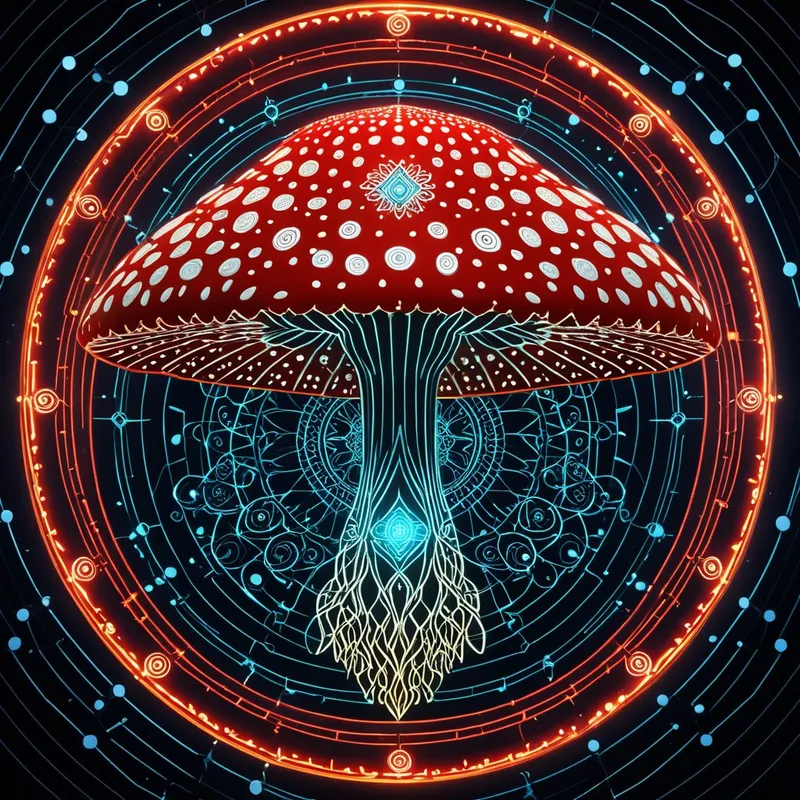
The Fly Agaric symbolizes the transubstantiated bridge. Its iconic red-and-white coloration is a map: red for the blood, flesh, and vitality of the earthly realm; white for the spirit, ancestors, and the celestial realm. The spots are often seen as traces of the original stellar nature of the Sky-Traveler. The mushroom’s growth pattern—often in a circle or “fairy ring”—mirrors the cyclical journey of the shaman: descent, communion, and return.
The Sky-Traveler embodies the archetype of the wounded benefactor, a being who must undergo a form of dismemberment (a common shamanic initiation trope) to bestow its gift. This reflects a profound spiritual law: true connection often requires a breaking of previous wholeness. The gift of expanded consciousness comes at the cost of the giver’s integrity, modeling the sacrifices required for healing and knowledge.
The Dreamer's Resonance
When this myth pattern stirs in the modern dreamer, it often signals a profound somatic and psychological crossroads. To dream of finding or consuming a glowing, oversized Amanita mushroom suggests the unconscious is offering a key—a potent but potentially destabilizing piece of insight that the psyche is now strong enough to “metabolize.” It is an invitation to undertake an inner journey for which the dreamer feels both drawn and unprepared.
The somatic experience might parallel the myth: a feeling of being “taken apart” or dismantled (relationship endings, career shifts, illness) that, in the dream logic, is revealed as a necessary sacrifice for a new kind of vision. The dreamer may feel the call of the World Tree—a longing for vertical connection, to understand their roots (personal history, trauma) and their crown (potential, spirit). Resistance to the call can manifest as dreams of poisonous food or being lost in a familiar forest. The myth activates in dreams when the conscious mind’s maps are insufficient, and the soul demands navigation by older, more visceral stars.
Alchemical Translation
For the modern individual, the Amanita myth is a precise map of psychic transmutation, or Individuation. The process begins with the Sacrifice of the Known Self (the Sky-Traveler’s act). This is the voluntary or involuntary dissolution of a dominant identity, a cherished belief, or an old coping mechanism. It feels like a loss, a dismemberment.
The alchemical fire is lit not by will, but by surrender. The old form must be broken for the new medicine to precipitate.
Next is the Ingestion and Transformation (consuming the mushroom). This is the courageous, often frightening, act of integrating the rejected parts of the self—the shadow, the unrealized potential, the ancestral pain. This is the “journey,” the liminal state of nausea, vision, and chaos where the ego is not in control. One “sees the spirits”—the autonomous complexes of the personal and collective unconscious in their raw, personified forms.
Finally, there is the Return with the Boon (the shaman’s healing). The integrated self returns to ordinary reality, but it is no longer ordinary. The individual gains the “shaman’s eye”—the ability to see the hidden patterns in their own life and in the world, to diagnose psychic illness, and to mediate between their own inner realms (the conscious, the personal unconscious, the collective unconscious). The gift of the myth is that it frames this terrifying, transformative process not as a pathology, but as a sacred, inherited journey. The bridge between worlds is built from the very substance of our own, willingly offered, limitations.
Associated Symbols
Explore related symbols from the CaleaDream lexicon: