Amanita Muscaria Myth Meaning & Symbolism
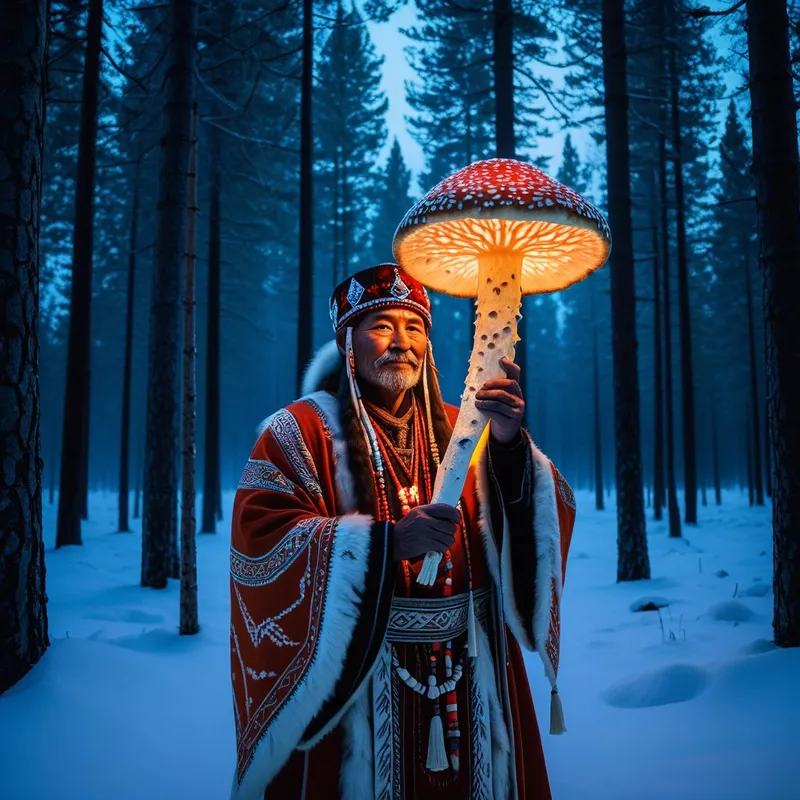
A myth of sacred exchange where the shaman drinks the reindeer's urine to commune with the spirit of the red-and-white mushroom, traversing worlds.
The Tale of Amanita Muscaria
Listen, and hear the whisper in the snow-laden boughs of the taiga. In the time when the world was raw and spirits walked as plainly as reindeer, there was a great hunger in the people. Not for meat or fat, but for vision. They lived in the world of bark and breath, but the world of dreams and healing lay just beyond the veil, a shimmering lake they could not drink from.
The shaman, his bones aching with the weight of his people's silence, climbed the World Tree until his hands bled sap and his breath came in clouds that froze to his beard. He sought an audience with the Great Spirit, his drum a frantic heartbeat against the vast silence of the sky. "How can I bridge the worlds?" his soul cried out. "How can I bring back the medicine of the unseen?"
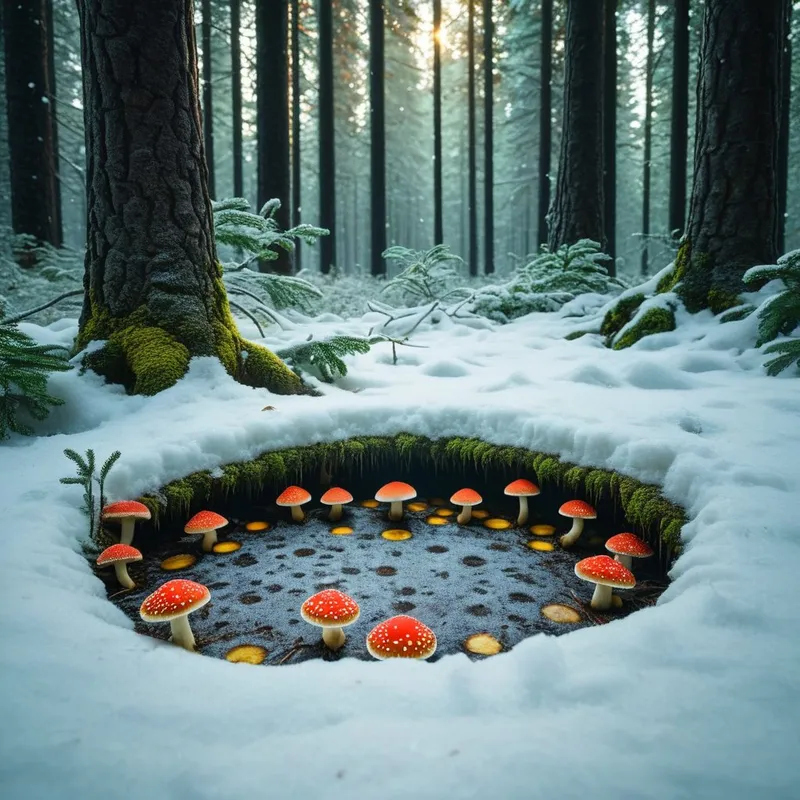
From the upper world, no voice answered. But from the roots of the Tree, in the dark, fertile underworld of decay and potential, a different spirit stirred. It was not a god of thunder, but a spirit of the earth itself—a quiet, potent intelligence that thrived in the secret marriage between tree root and forest floor. This spirit manifested as a being of startling beauty: a cap as red as the lifeblood of the sun, dotted with flecks of pure white like the first snows of winter. It was the Wapaq.
The Wapaq did not speak in words, but in a profound, somatic knowing that flooded the shaman's senses. It offered a pact, a sacred circuit. "My essence is too strong for your human body to hold," the spirit communicated through a vision. "It would shatter your mind like thin ice. You must find a vessel, a filter of pure life."
As the vision faded, the shaman descended, his mind alight with cryptic understanding. In the clearing below, a great reindeer stag stood, its breath steaming in the cold air. The reindeer, that noble wanderer who eats the lichen from the high rocks and the moss from the dark earth, looked at the shaman with ancient, knowing eyes. The shaman, following the silent instruction, gathered the radiant red-and-white mushrooms and laid them as an offering before the stag.
The reindeer, drawn by a deep, ancestral memory, consumed the Wapaq. For a moment, it stood still, then its eyes glazed with a vision of other forests, other skies. It began to prance and leap, its movements erratic yet purposeful, as if dancing to a music only it could hear. Then, it urinated onto the snow.
Where the golden stream met the white frost, a transformation occurred. The snow melted, and the shaman, with a reverence that shook his core, understood. This was the alchemy. The reindeer's body, its own sacred vessel, had filtered the raw power of the earth spirit. What remained in the urine was the essence, distilled—the vision without the poison, the message without the madness.
With a prayer to both the spirit of the Wapaq and the spirit of the reindeer, the shaman cupped his hands and drank. The world did not shatter; it unfolded. The pine needles sang in harmonies of green. The stars descended to whisper secrets in his ears. He saw the illness in his people as dark shapes clinging to their bones, and he learned the songs to scrape them clean. He traversed the roots of the World Tree to the underworld to retrieve lost souls, and climbed its branches to the upper world to bargain with weather spirits. He had become the bridge. The circuit was complete: Earth Spirit, to Animal Filter, to Human Interpreter. And the knowledge flowed back along the same path, a gift returned for a gift given.
Cultural Origins & Context
This is not a myth of a single hero, but a foundational ethnomycological narrative embedded in the practical spirituality of several Indigenous peoples across the Siberian Arctic, including the Evenki, Koryak, and Yukaghir. It was not merely a story told for entertainment, but a living, operative map of reality. Passed down through shamanic lineages, it explained the why and how of a profound ritual technology.
The myth served multiple societal functions. Primarily, it was a sacred justification and instruction manual for the use of Amanita muscaria as an entheogen. It provided a safe, culturally sanctioned protocol—the reindeer's biological filtration system—which was observed empirically. Shamans would follow reindeer herds, knowing the animals sought out the mushrooms, and would then collect the psychoactive urine. This practice was mirrored in human ritual, where a shaman might consume the mushrooms, and others would drink his urine to experience a milder, often more visionary effect, creating a chain of sacrament.
Furthermore, the myth cemented a holistic, non-hierarchical worldview. It portrayed a universe of constant exchange and interdependence, not of domination. The human shaman was not the powerful protagonist who conquers the spirit; he is the humble middle-man in a tripartite relationship between the plant kingdom (the mushroom spirit), the animal kingdom (the reindeer), and the human community. The myth taught respect for all beings as potential teachers and partners in the maintenance of cosmic and communal balance.
Symbolic Architecture
At its core, the myth is a masterful depiction of mediated transformation and the necessity of an intermediary in processing raw, unconscious content.
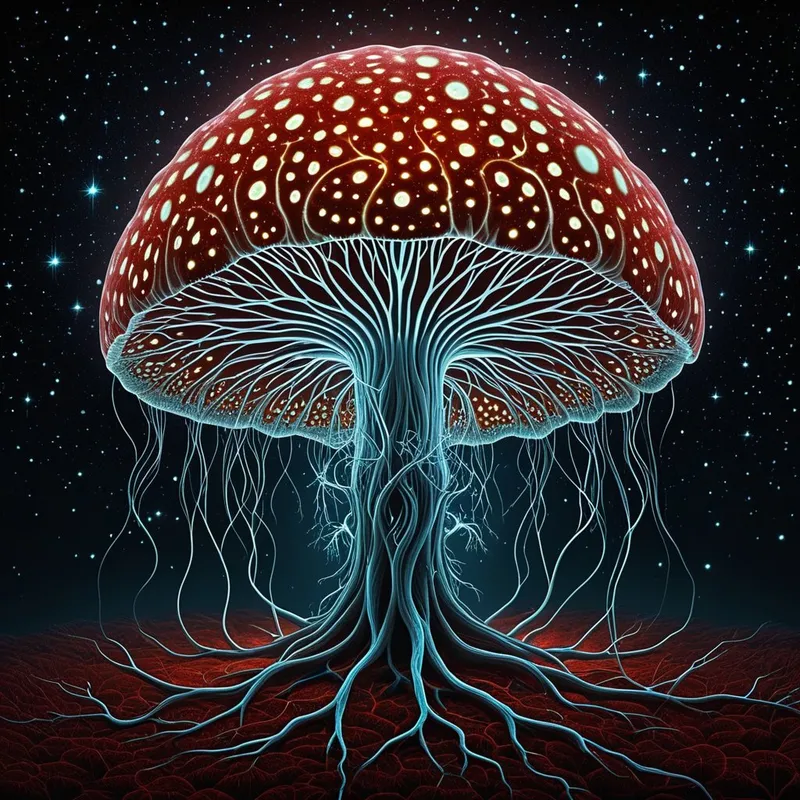
The Wapaq symbolizes the raw, undifferentiated power of the unconscious—the prima materia of the psyche. It is potent, brilliant, and dangerous in its pure form. Its red-and-white coloration is itself a profound symbol: red for the blood of instinct, passion, and the earthly body; white for spirit, illumination, and transcendence. It is the union of opposites, the coniunctio, growing at the threshold of worlds.
The raw truth of the Self is often too potent to confront directly; it requires a vessel to translate its language of chaos into a grammar of meaning.
The reindeer is the crucial psychopomp, the mediating function. In psychological terms, it represents the instinctual, somatic body, or the animal soul (anima). It is that part of our nature that can instinctively engage with primal, archetypal energies (consuming the mushroom) and, through its own natural processes, begin to metabolize them. The urine is the distilled product of this somatic processing—the unconscious content made more accessible, filtered through the body's wisdom.
The act of drinking represents the conscious ego's deliberate engagement with this now-mediated content. The shaman’s journey through the worlds is the psyche navigating its own depths (underworld), its everyday reality (middle world), and its highest ideals or spiritual yearnings (upper world). The myth models that true psychic wholeness is not achieved by the ego alone, but through a respectful collaboration between consciousness, the body, and the deep unconscious.
The Dreamer's Resonance
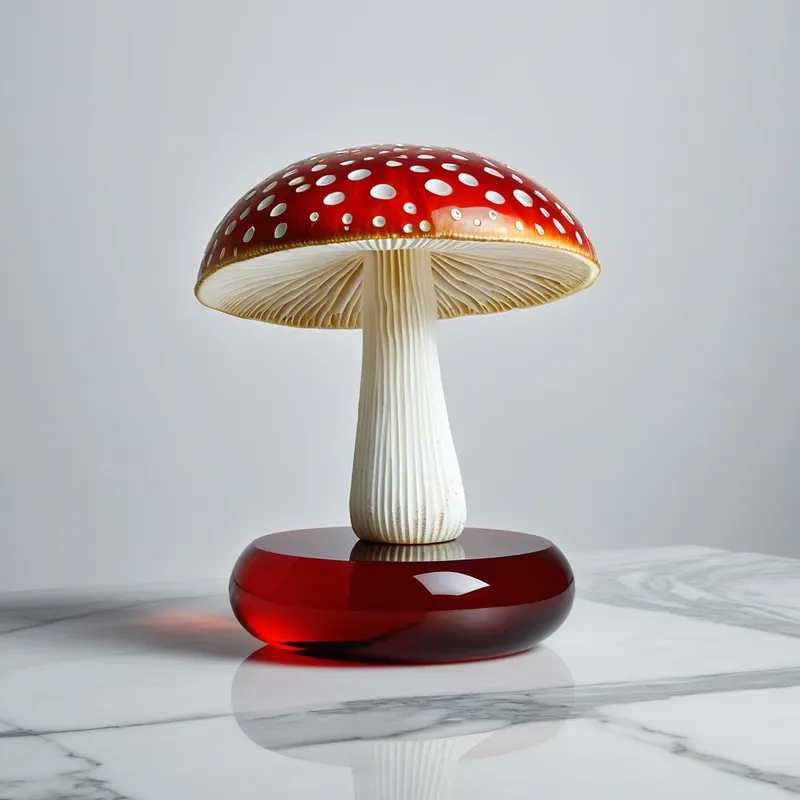
When this mythic pattern stirs in the modern dreamer, it often signals a profound somatic and psychological process of integration. To dream of a glowing red-and-white mushroom may not be about the literal fungus, but about an encounter with a potent, perhaps overwhelming, new insight, emotion, or creative impulse rising from the depths.
Dreams of drinking from an unusual or taboo source—a stream, a cup offered by an animal—can mirror the shaman's crucial act. This suggests the dreamer's psyche is ready to consciously receive and integrate something that has already been "pre-digested" by their unconscious processes. There is a sense of receiving sacred knowledge, but through a circuitous, mediated path.
Conversely, dreams where one is the reindeer, consuming something strange and feeling altered, point to the somatic phase. The dreamer may be undergoing a period where their body or instincts are processing a deep change—an illness, a trauma, a new love—that the conscious mind cannot yet fully comprehend. The psyche is assuring the dreamer that this animal-level processing is a necessary and sacred part of the journey toward wholeness. The feeling is often one of being an agent in a larger, intelligent system of exchange.
Alchemical Translation
For the individual on the path of individuation, the Amanita myth provides a powerful model for psychic transmutation. Our modern temptation is to seek enlightenment or healing directly and forcefully—to "eat the mushroom" of a quick fix, a profound theory, or a peak experience. The myth warns that this can lead to intoxication, disorientation, and psychic fracture.
The alchemical operation here is circumambulation—the indirect approach. The first step is to acknowledge the raw, potent material (the symptom, the complex, the creative block) and "offer it to the reindeer." This means engaging with it not just intellectually, but somatically and instinctively. It could involve physical practice, art, time in nature, or simply allowing the body to feel the emotion without immediate analysis. This is the filtration process.
Individuation is not a conquest of the unconscious, but a sacred negotiation with it, mediated by the humble wisdom of the living body.
The "urine," the distilled product, is the insight that emerges from this embodied process. It is the dream image after a period of emotional turmoil, the sudden clarity after a long walk, the intuitive solution that arises not from thinking, but from being. The conscious mind must then have the courage to "drink"—to accept and act upon this mediated wisdom.
Finally, the myth emphasizes that the goal is not personal enlightenment hoarded, but knowledge made communal. The shaman returns to heal his people. The completed individual, having integrated this mediated power, naturally becomes a bridge—translating the wisdom of the deep Self into forms that can nourish their relationships, work, and community. The circuit closes, and the psyche moves from a state of hungry seeking to one of sacred, reciprocal flow.
Associated Symbols
Explore related symbols from the CaleaDream lexicon: