Altan Khan's Dream Myth Meaning & Symbolism
A 16th-century Mongol ruler's prophetic dream of a celestial monk, which catalyzed the meeting that would transform Tibetan Buddhism and shape an empire's soul.
The Tale of Altan Khan's Dream
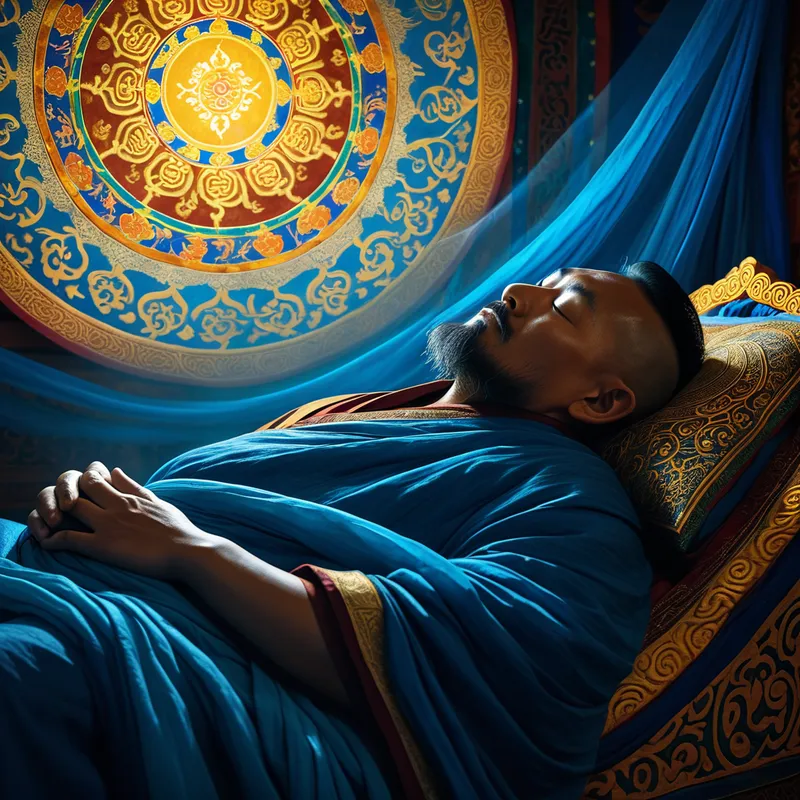
Listen, and let the wind carry you back across the centuries, to a time when the steppe whispered secrets to those who dared to dream. The air was cold and clear, scented with smoke from dung fires and the endless, sighing grass. In his great ger, pitched where the earth meets the infinite sky, slept Altan Khan, the Tiger of the Mongols, the ruler whose power stretched from the Wall of China to the edges of Siberia. His sleep was not the sleep of common men. It was the sleep of kings, heavy with the weight of conquest and the silent question of legacy.
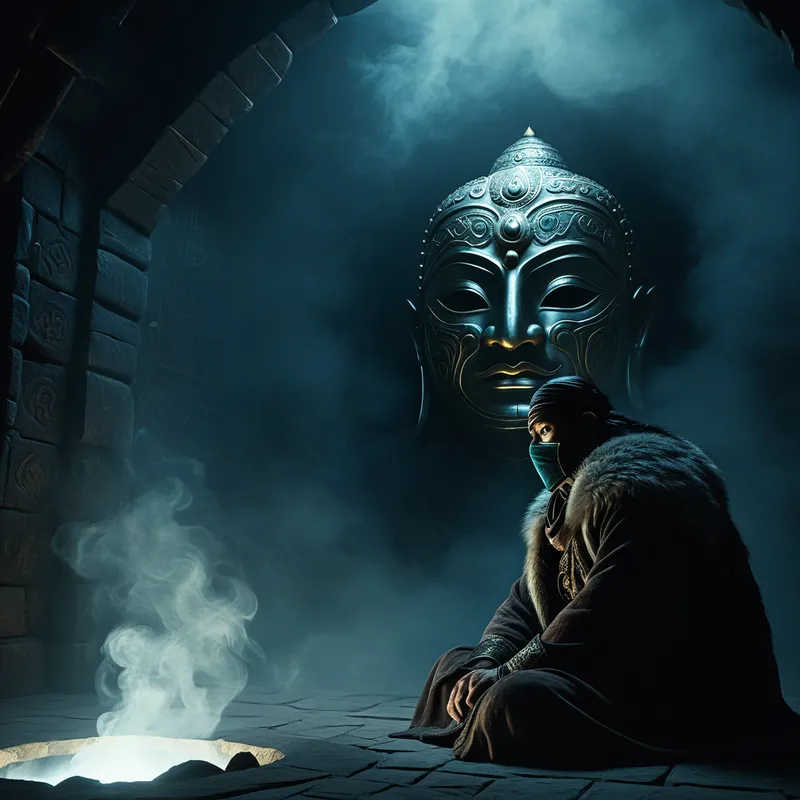
That night, the fabric of the world grew thin. The Khan’s spirit slipped from his body, not into darkness, but into a luminous realm beneath the Tengri. He stood upon a plain of shimmering silver light. Before him, a figure approached, walking not upon the ground, but upon the air itself. It was a monk, yet unlike any he had seen. His robes were the color of a sunset sky, a profound, impossible saffron, and they flowed around him like liquid light. His face was serene, ancient, and infinitely kind, radiating a wisdom that felt both foreign and intimately familiar. In his hands, he held not a sword or a scepter, but a simple begging bowl and a text wrapped in silk that glowed with a soft, golden pulse.
The monk spoke without moving his lips, his voice the sound of a distant bell carried on the wind. “Great Khan,” the voice resonated in the dreamer’s soul, “you have conquered the earth. Now, seek the conquest that has no end. Seek the jewel that outshines all crowns. I am coming to you from the Land of Snows. In me, you will find the mirror of your true sovereignty.”
As the words faded, the monk raised his hand. From his palm, light erupted—not the harsh light of the sun, but the cool, clarifying light of the full moon. It washed over Altan Khan, and in that illumination, he did not see his armies or his wealth. He saw the interconnected web of all life, the suffering and the joy, the endless cycle of cause and effect that his own mighty actions had set in motion. He saw that his power was immense, but also a kind of profound responsibility he had only dimly understood. The vision was terrifying and beautiful, and it filled him with a yearning so sharp it was a physical ache.
He awoke with a start, the predawn grey seeping into his ger. The scent of the dream—incense and ozone—still clung to the air. His heart hammered against his ribs, not with fear, but with a certainty that shook him to his core. He had been visited. He had been shown a path. The celestial monk was no phantom; he was a promise, a destiny walking towards him from across the mountains. Altan Khan rose, called for his scribes and advisors, and with the authority of one who has conversed with the numinous, declared: “Prepare. A master is coming. We will meet him, and the world will change.”
Cultural Origins & Context
This is not a myth of antiquity, but a recorded historical event from the 16th century, one that swiftly ascended into the realm of foundational legend. Altan Khan (1507–1582) was a formidable leader of the Tümed Mongols, a grandson of the great Dayan Khan, who sought to reunify the Mongol tribes and reassert their prestige. His realm was a crossroads of spiritual influences: the ancestral Tengrism, with its veneration of the Eternal Blue Sky and the spirits of nature, coexisted with lingering traces of Nestorian Christianity and, increasingly, the sophisticated Buddhist traditions filtering north from Tibet.
The dream was a pivotal moment in this cultural alchemy. It was passed down not by wandering bards alone, but by learned lamas and court historians, integrated into the official chronicles of the meeting it foretold. In 1578, Altan Khan indeed met the Tibetan lama Sonam Gyatso at a grand ceremony by the beautiful Koko Nor (Qinghai Lake). Recognizing him as the incarnation of the celestial monk from his dream, Altan Khan bestowed upon Sonam Gyatso the title “Dalai Lama” (“Ocean of Wisdom”), a title that would define the lineage of Tibetan Buddhism’s spiritual leadership to this day. In return, the lama recognized Altan Khan as a reincarnation of the great Buddhist emperor Khubilai Khan, weaving the Mongol ruler’s authority into a sacred, timeless lineage.
The myth’s function was multifaceted: it legitimized the Khan’s conversion to Buddhism not as a political convenience, but as a divine mandate; it sacralized the political alliance between the Mongol nobility and the Tibetan Buddhist hierarchy; and it provided a powerful narrative of spiritual destiny that could unite the diverse Mongol tribes under a new, shared cosmic order.
Symbolic Architecture
At its heart, Altan Khan’s Dream is a myth about the awakening of the Ruler to a higher order of authority. The Khan, the ultimate symbol of temporal, worldly power (Earth), is visited by an emissary of spiritual, transcendent power (Sky). The dream itself is the Bridge between these two realms.
The true ruler is not the one who commands armies, but the one who first submits to a law greater than himself.
The celestial monk represents the Sage or the Self archetype. He is the integrated, wise figure who emerges from the depths of the unconscious to correct and guide the conscious ego, represented by the Khan. The monk’s begging bowl and text symbolize that the wisdom he offers is not taken by force, but received through humility (Cup) and study. The luminous text is the Map of Dreams itself.
The Khan’s vision of the interconnected web of life is the core revelation. It shatters the simplistic ego-identity of “conqueror” and replaces it with the profound psychological burden of seeing one’s actions in a vast, causal network. This is the moment the Shadow of his power—the unintended suffering, the karmic debt—is brought to light, not to condemn, but to initiate.
The Dreamer's Resonance
When this mythic pattern stirs in a modern dream, it signals a profound shift in the dreamer’s relationship to personal authority and destiny. One may dream of meeting a serene, authoritative guide in a place of personal power (an office that becomes a Temple, a family home). This guide often presents a simple, potent object or speaks a phrase that feels divinely ordained.
Somatically, the dream may be preceded by feelings of restless dissatisfaction with worldly achievements—a sense that one’s “kingdom,” however large or small, feels hollow. The dream itself can bring a physical sensation of expansion or a chilling awe, a somatic registration of the numinous. Upon waking, there is often not clarity, but a powerful, disorienting yearning—the same ache Altan Khan felt. This is the psyche’s signal that the ego’s current structure of power and identity is being called to account by the deeper Self. The conflict is between the pride of what one has built (Tower) and the humbling call to serve a purpose that transcends it.
Alchemical Translation
The process modeled here is the alchemical transmutation of leaden, ego-centric power into golden, responsible sovereignty. The “lead” is the Khan’s identity as a conqueror, driven by Pride and the need for external validation. The dream is the nigredo, the blackening—the shocking confrontation with the limitations and shadows of that identity.
Individuation for the ruler archetype begins when the crown feels heavy, and the only way to lighten it is to place it at the feet of one’s own soul.
The meeting with the monk is the albedo, the whitening—the purification and illumination. The ego (Khan) does not destroy the Self (monk), nor does the Self obliterate the ego. Instead, they enter into a sacred relationship of mutual recognition. The Khan bestows a worldly title (Dalai Lama), grounding the spiritual in the historical. The lama bestows a spiritual lineage, elevating the historical into the timeless. This is the sacred marriage (coniunctio) of inner opposites: power and wisdom, action and reflection, the temporal and the eternal.
The resulting “gold” is the individuated Ruler: a person whose authority flows not from the need to dominate, but from a conscious alignment with a transpersonal, ethical order. Their decisions are informed by the wisdom of the inner Sage. Their power becomes a form of stewardship, a Sacrifice of petty control for the sake of a greater harmony. The myth tells us that our highest destiny (Destiny) is not something we invent, but something that dreams us, and awaits our courageous, waking recognition.
Associated Symbols
Explore related symbols from the CaleaDream lexicon:
- Dream — The primary vessel of divine communication and the liminal space where temporal power is reconfigured by spiritual vision, serving as the Bridge between worlds.
- Sky — Represents Tengri, the transcendent realm, spiritual authority, and the infinite potential from which the guiding vision descends.
- Earth — Symbolizes Altan Khan's domain, his temporal power, conquests, and the grounded reality that must be spiritually transformed.
- Bridge — The dream state itself, which connects the conscious reality of the Khan with the unconscious, archetypal realm of the Sage.
- Cup — The begging bowl of the celestial monk, representing the vessel that must be emptied of ego to receive the elixir of transcendent wisdom.
- Map of Dreams — The luminous text held by the monk, symbolizing the karmic web, the soul's destiny, and the guiding doctrine that reorients a life.
- Temple — The Khan's ger transformed by the dream into a sacred space of revelation, and later, the historical meeting that institutionalized the spiritual alliance.
- Destiny — The foreordained meeting between Khan and Lama, representing the unfolding of the Self's plan for the individual's life and legacy.
- Ruler — The core archetype embodied by Altan Khan, undergoing the crisis and transformation of power from domination to enlightened stewardship.
- Sage — The archetype embodied by the celestial monk/Sonam Gyatso, representing the inner wisdom that guides the ego toward wholeness.
- Tower — The Khan's constructed identity and worldly achievements, which must be seen from the higher, critical perspective of the dream.
- Sacrifice — The Khan's offering of his former, purely secular identity to embrace a role defined by spiritual responsibility and a higher law.