
Albedo Myth Meaning & Symbolism
The mythic stage of Albedo represents the soul's purification, a luminous dawn of clarity and truth after the dissolution of the Black Sun.
The Tale of Albedo
In the silent, perpetual midnight of the Nigredo, the world was a sealed flask of despair. The Philosopher labored in a darkness so complete it was a substance, a thick, suffocating ink that stained the soul. All forms had melted into a single, groaning mass of confusion—a Massa Confusa where memory, identity, and hope fermented into a bitter poison. The Athanor's fire was banked, emitting not light, but a heat that promised only dissolution.
Then, in the deepest hour, when the weight of the blackness threatened to crush the vessel entirely, a sigh passed through the laboratory. It was not a wind, but a release of pressure, the first exhalation of a world holding its breath. The Ablutio began not with a roar, but with a whisper—a single, silvery tear falling from an unseen eye onto the calcined remains within the crucible.
Where it fell, the absolute black did not lighten to grey, but transmuted. A spot of pure, shocking white appeared, like the first star piercing a storm-wracked sky. This was not the white of snow, which covers, but the white of bone, which is revealed. It was the white of the moon, a cold, truthful light that shows things as they are, without the sun’s comforting warmth. The White Queen was awakening from her tomb of shadow.
She did not rise with fanfare. She emerged, as dawn seeps across the horizon. The inky chaos began to recede, not vanishing, but washing away in great, gentle tides. A luminous milkiness flowed through the Pelican, circulating not blood, but clarity. The once-formless mass began to show contours—not the familiar shapes of the old world, but the clean, severe lines of its essential truth. The Spiritus, once trapped in the black earth, now ascended as a shimmering, white vapor, condensing on the cool glass like a blessing of dew.
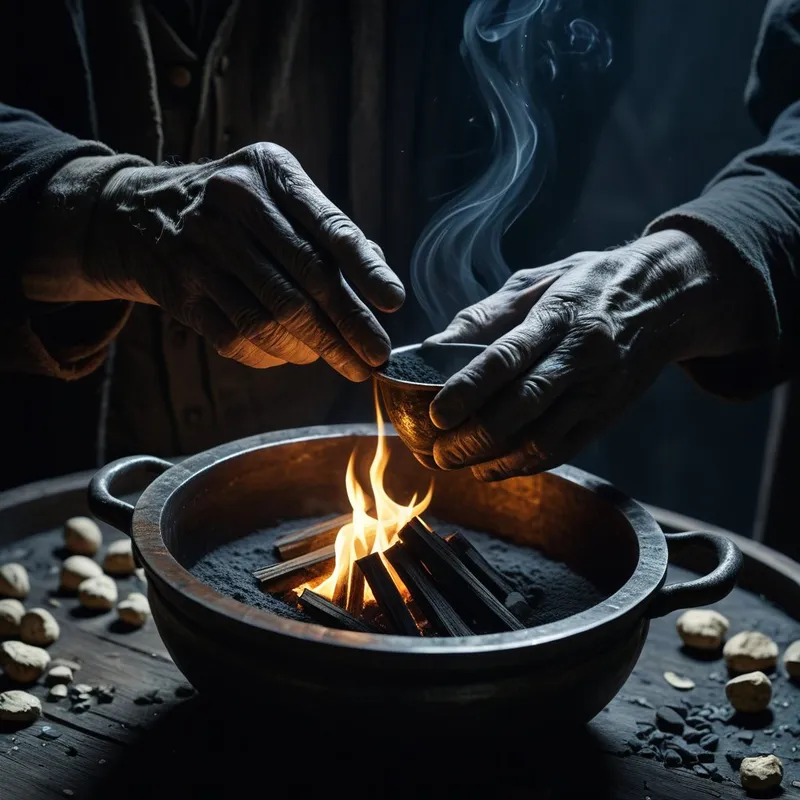
The laboratory, once a dungeon, became a chapel of ice and pearl. Every surface gleamed with this hard-won whiteness. The fire in the Athanor now burned with a clear, blue flame, its heat no longer for breaking down, but for illuminating. In this radiant, silent dawn, the Philosopher beheld the White Stone. It held no color, and in its absence, it held all potential. The long night of the soul was over. The Albedo had come, not as a victory, but as a breathtaking, fragile peace.
Cultural Origins & Context
The mythos of Albedo is not a folktale with a singular author, but a core operational metaphor from the esoteric tradition of Western alchemy, flourishing between the 12th and 17th centuries. It was passed down through encoded manuscripts, such as the Rosarium Philosophorum, and through the personal, often secretive, notebooks of practitioners. Its tellers were not bards for the public, but philosophers, monks, and proto-scientists like Paracelsus, writing for a discerning few.
Its societal function was dual. Exoterically, it described a literal laboratory process—the washing and whitening of a substance after its initial blackening (Nigredo). Esoterically, and more profoundly, it served as a spiritual roadmap. In an age where orthodox religion dictated the path to salvation, alchemical symbolism provided a parallel, deeply personal narrative of inner transformation. The Albedo myth offered a model for achieving illuminatio—a divine illumination reached not through doctrine alone, but through the fiery and watery ordeals of one's own psyche. It was a myth for the individuating soul, charting the passage from the chaos of sin or ignorance to the clarity of wisdom and conscience.
Symbolic Architecture
Albedo represents the psyche's emergence from the swamp of the unconscious into the clear, cold light of conscious realization. It is the stage of discernment following the dissolution of Nigredo. Symbolically, it is a baptism not by water, but by meaning.
The white stage is not an answer, but the first correct formulation of the question. It is the soul learning to see in the dark.
The White Queen symbolizes the redeemed anima or the purified spirit (Spiritus). She is consciousness itself, washed clean of personal complexes and projections. Her whiteness signifies candor—both in the sense of shining brightness and of brutal honesty. The White Stone is the nascent, authentic self beginning to coalesce, no longer identified with the persona or the shadow, but existing in a state of potential purity. The dominant elements are Water (for purification, emotion, the unconscious) and Air (for intellect, clarity, and spirit), working in concert after the reign of Earth and Fire in the Nigredo.

The Dreamer's Resonance
When the Albedo pattern stirs in the modern dreamer, it signals a profound psychological cleansing is underway. This is not the dramatic death-and-rebirth of the Nigredo, but its essential aftermath.
Dreams may feature: Washing or Flooding with Clear/White Liquid (bathing in milk, a room filling with luminous water); The Emergence of White Animals (a white stag, dove, or swan appearing as a guide); Sterile or Sanctified Spaces (empty white rooms, pristine hospitals, silent libraries); The Revelation of a Skeleton or Bone Structure (seeing the "bare bones" of a situation or relationship). Somatically, the dreamer may awaken feeling peculiarly calm, hollowed out, or "washed clean," even if slightly melancholic. There is a sense of weight lifted, but also of exposure. The comforting clutter of old narratives has been scoured away, leaving a stark but truthful landscape. This is the psyche integrating shadow material and achieving a new, more objective perspective—a "morning after" clarity following an emotional storm.

Alchemical Translation
For the modern individual, the Albedo models the critical phase of psychic integration where insight becomes stabilized. After the painful deconstruction of the Nigredo—where one confronts depression, failure, or the breakdown of a life structure—the Albedo is the dawn where one can finally see what is.
Individuation requires not only the courage to descend into the mud, but the patience to wait for the water to clear.
This is the stage of therapy where chaotic emotions begin to crystallize into understandable patterns. It is the moment after a great loss when grief gives way to a clear, if sad, memory of what was. It is the creative process where a jumble of ideas suddenly arranges itself into a coherent outline. The "whitening" is the act of making conscious: translating the raw, often dark data from the unconscious into a form the conscious mind can observe, analyze, and accept without being overwhelmed.
The triumph of Albedo is not joy, but lucidity. It is the development of an inner witness, the White Queen, who can observe the self and the world without immediate judgment or inflation. This lucidity is the essential prerequisite for the next stage, the Citrinitas, where the warmth of meaning and purpose can return without burning up the newly gained clarity. One must become empty and white, like a blank page, before the golden text of one's authentic life can be written.
Associated Symbols
Explore related symbols from the CaleaDream lexicon: