Al-Mi'raj Myth Meaning & Symbolism
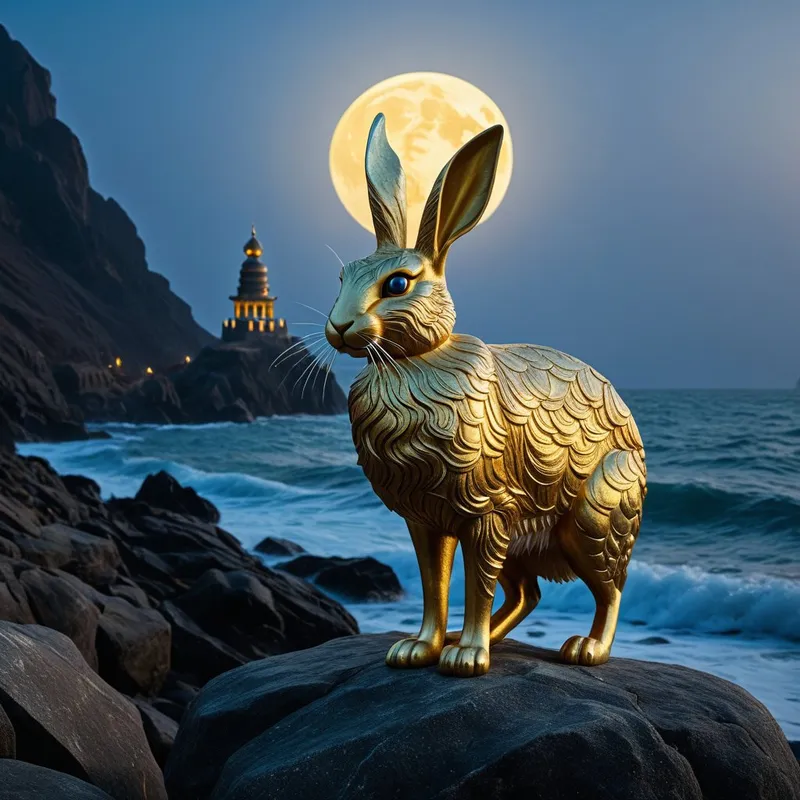
A mythic horned rabbit, Al-Mi'raj, embodies the impossible journey, guarding the boundary between the known world and the island of ultimate mystery.
The Tale of Al-Mi'raj
Listen, and let the salt air fill your lungs. Let your mind sail beyond the last known port, past the charts drawn by trembling hands, to where the sea whispers of secrets older than memory. Here, in the vast, untamed ocean, lies an island that is not an island—a place spoken of in hushed tones by those who have seen too much and those who dream of seeing more. It is a land of wonders, a place where the laws of earth and sky unravel, and where the very animals defy creation’s common tongue.
To reach this shore is a trial of fate. The currents conspire against you; the winds sing siren songs to lead you astray. But for the one whose heart is a compass pointing only to the veiled truth, the way may—or may not—be revealed. And at the threshold, where the known world dissolves into legend, you will find the guardian.
It is not a dragon of scale and flame, nor a giant of stone and wrath. It is a creature of profound paradox, a quiet truth that upends reality. Upon the black rocks of the last cape, where the spray hangs like a perpetual veil, it waits. Smaller than a hound, with the soft, familiar form of a rabbit, yet crowned with a single, glorious horn that spirals towards heaven like a petrified prayer. This is the Al-Mi'raj.
Its eyes are not the eyes of a simple beast. They hold the deep, still knowledge of the abyss and the sharp, glittering awareness of the stars. It does not roar; its power is in its impossible presence. To see it is to have every certainty questioned. The sailor, parched and desperate for the island’s fabled springs, must confront this living riddle. The creature is both barrier and key. It does not attack, but its very existence poses the ultimate question: Can you accept a world where a rabbit bears a unicorn’s crown? Can your soul stretch wide enough to contain this contradiction?
The myth does not speak of battles won by sword or strength. The triumph is one of perception. The seeker must behold the Al-Mi'raj not as a monster to be slain, nor a mere curiosity, but as the rightful sovereign of this liminal space. In that moment of awe-filled recognition—a surrender of the mind’s rigid categories—the path forward shimmers into being. The mists part, not for a hero, but for a witness. The guardian, its purpose fulfilled, may simply turn and vanish into the crags, leaving the seeker to step onto the shores of the unimaginable, forever changed by the gaze of the impossible made flesh.

Cultural Origins & Context
The tale of the Al-Mi'raj finds its home not in the central religious texts of Islam, but in its rich and expansive imaginative landscape—the world of the <abbr title="Stories, sayings, and deeds of the Prophet Muhammad and his companions">Hadith</abbr>, <abbr title="Islamic literature exploring the lives of prophets and other figures, often with moral and miraculous tales">Qisas al-Anbiya</abbr>, and most vividly, within the genre of <abbr title="Wonders, marvels; a literary genre describing strange and miraculous creatures and places">‘Aja’ib</abbr> literature. These "Books of Wonders" served as medieval encyclopedias of the marvelous, blending travelogue, cosmology, theology, and folklore.
Scholars and storytellers like Al-Qazwini compiled accounts of bizarre creatures from the edges of the known world, which, in the medieval Islamic geographical imagination, was a place of constant divine creativity. The Al-Mi'raj was one such marvel, often located near the mysterious island of <abbr title="Often identified as the legendary eternal island or city at the edge of the world">Jazira al-Waqwaq</abbr>. Its function was multifaceted: it testified to the boundless creativity of Allah, it marked the literal and metaphorical boundaries of human knowledge, and it served as a narrative device to underscore that true discovery requires a transformation of the seeker. It was a tale told to inspire awe, to cultivate intellectual humility, and to remind listeners that the universe is far stranger and more wonderful than our daily perceptions allow.
Symbolic Architecture
Psychologically, the Al-Mi'raj is a supreme symbol of the coincidentia oppositorum—the coincidence of opposites. It is a living paradox, a fusion of the mundane (the rabbit, a creature of the earth, timidity, and fertility) with the celestial (the horn, a symbol of spiritual ascent, purity, and piercing insight). It does not belong to the ordinary animal kingdom; it is a denizen of the psychic borderlands.
The guardian of the threshold is never what you expect it to be. It is the embodied question your soul must answer before it can proceed.
The island it guards represents the <abbr title="The self, the totality of the conscious and unconscious psyche in Jungian psychology">Self</abbr>—the ultimate, integrated center of the psyche that is both a destination and a source of unimaginable riches and terrors. The Al-Mi'raj itself is the guardian of this threshold. Its challenge is not physical but cognitive and emotional: Can you tolerate profound contradiction? Can you hold two seemingly incompatible truths in your mind at once? To "defeat" it is to integrate it—to acknowledge that within your own nature, timidity and transcendent courage, earthly instinct and spiritual longing, coexist.
The Dreamer's Resonance
When the image of the horned rabbit emerges in modern dreams, it signals a psyche at a critical juncture. The dreamer is likely approaching a deep inner frontier—a core belief, a long-held self-image, or a buried potential that feels as alien and miraculous as a mythical island. The Al-Mi'raj appears not as a threat, but as a paradoxical truth the ego must face.
Somatically, this might manifest as a feeling of cognitive dissonance, a "mental itch" or a sense of awe mixed with anxiety. The dreamer may feel both drawn to and repelled by a new idea or path in waking life, one that seems to contradict their established identity (the "rabbit" part of them) yet promises a higher integration (the "horn"). The dream is an invitation to pause at this inner shoreline, to study the impossible guardian, and to realize that the key to passage is not force, but a radical expansion of acceptance. The conflict is between the psyche's conservative, familiar order and its drive toward wholeness, which always includes elements that initially seem nonsensical or impossible.

Alchemical Translation
The journey to the island guarded by the Al-Mi'raj is a perfect allegory for the Jungian process of individuation. The voyage across the unknown sea is the descent into the unconscious. The island is the nascent, undiscovered Self. And the Al-Mi'raj is the personification of a crucial complex or archetypal image that blocks the way precisely because it is not understood.
The alchemical work is not to slay the dragon, but to decipher its language; not to capture the unicorn, but to earn its silent consent.
The modern individual's "alchemical translation" of this myth involves recognizing their own inner "impossible creatures." These are the parts of ourselves we have split off and deemed contradictory: the artist who is also a pragmatist, the leader who is also vulnerable, the spiritual seeker with robust earthly desires. We try to navigate around them, deny them, or fight them, seeing them as obstacles to our goals. The myth instructs us otherwise. The transmutation occurs in the moment of sacred observation. When we can behold these inner contradictions with awe instead of judgment, with curiosity instead of fear, they cease to be blockers and transform into gatekeepers. Their very paradox becomes the key. Integrating the Al-Mi'raj means accepting that we are walking paradoxes, and that our wholeness—our personal "island of wonders"—is accessible only when we stop trying to resolve our nature into simple categories and instead learn to dwell, creatively and consciously, within its beautiful, impossible tension.
Associated Symbols
Explore related symbols from the CaleaDream lexicon: