
Al-Khidr and the Mystic Path
A mysterious immortal guide in Sufi tradition who teaches through paradoxical actions, revealing hidden spiritual truths beyond conventional understanding.
The Tale of Al-Khidr and the Mystic Path
The story unfolds not in a palace or a city, but on the open road, where the seeker meets the unknowable. It is a journey shared between the prophet Moses, a man of divine law and luminous certainty, and a mysterious stranger he is commanded to find: a servant of God possessing a special, direct knowledge. This is Al-Khidr, whose name whispers of verdant life, “the Green One.” He is an eternal wanderer, his form shifting like a mirage, his wisdom buried in actions that defy all surface logic.
Moses, earnest and devoted, asks to follow him, to learn this unmediated knowledge. Al-Khidr consents but issues a stern condition: “You will not question me about anything until I myself mention it to you.” Thus begins a pilgrimage into paradox.
Their first encounter is with a fishing village. After receiving hospitality, Al-Khidr proceeds to scuttle a small, seemingly sound boat belonging to poor fishermen. Moses, the champion of justice, is aghast. “Have you scuttled it to drown its passengers?” he cries, breaking his vow. With patience that feels like a deeper kind of fire, Al-Khidr reminds him of the condition and reveals the hidden reality: a tyrannical king was seizing every sound boat by force; the act of sabotage was, in truth, an act of preservation for the destitute owners.
They journey on. Next, they meet a young boy. Without warning, Al-Khidr kills him. Horror-stricken, Moses condemns the act as a monstrous, unjust murder. Again, he is chastised for his haste. Al-Khidr then unveils the boy’s destiny: he would have grown to cause his faithful parents unbearable grief and disbelief; his death, a mercy, clears the way for them to receive a purer, more righteous child.
The final test comes at a town that refuses them the most basic courtesy of food. There, Al-Khidr finds a crumbling wall on the verge of collapse and, instead of leaving it to ruin, he sets it upright and repairs it. Now Moses, confused by this charity toward the inhospitable, can bear it no longer. “If you had wished, you could have taken payment for it!” Al-Khidr, knowing their companionship has reached its end, finally explains. Beneath the wall lay a treasure belonging to two orphaned boys. Their righteous father had hidden it for them. To leave the wall collapsed would have exposed the treasure before the boys came of age. The act of rebuilding was not for the town, but a silent guardianship of a future promise.
With these revelations, Al-Khidr vanishes as mysteriously as he appeared, leaving Moses—and every seeker who hears the tale—standing at the shore of a vast, unsettling ocean of understanding. The lesson is not in the actions, but in the vision that perceives a tapestry where individual threads of “good” and “evil” are woven into a pattern only comprehensible from a divine vantage point, the al-ghayb.
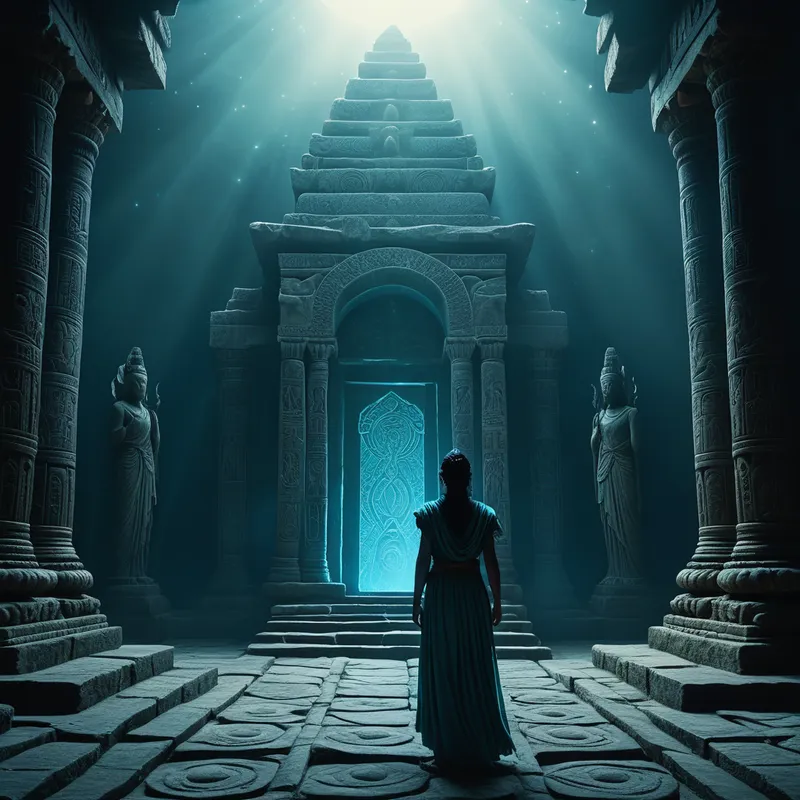
Cultural Origins & Context
Al-Khidr’s roots are deep and syncretic, flowing through the spiritual aquifers of the Near East. While his most canonical narrative is enshrined in the Qur’an (Surah Al-Kahf, 18:60-82), his identity is a palimpsest written over by time and tradition. He is often equated with the unnamed “servant of God” who guides Moses in the Qur’anic account, a figure of direct, experiential knowledge (‘ilm ladunni) granted by God’s presence, contrasting with Moses’s prophetic, legislative knowledge.
In Sufi Islam, Al-Khidr transcends a mere historical or scriptural figure to become the archetypal eternal guide. He is the patron of wanderers, the master of the invisible, and the living embodiment of the Sufi path itself—a path that operates beyond the binary mind. He is said to drink from the Fountain of Life, granting him immortality, a symbol of the timeless, ever-renewing nature of divine wisdom. He appears not in mosques but at crossroads, in deserts, and in moments of profound spiritual crisis, offering guidance that is often recognized only in hindsight. His “greenness” connects him to perpetual vitality, to the hidden sap of life that flows beneath the apparent decay of the world, and to the direct knowledge of the heart, which is ever-living.
Symbolic Architecture
The myth of Al-Khidr is not a moral fable but a symbolic map of the mystical consciousness. Each episode dismantles a pillar of conventional understanding.
The journey with Moses represents the necessary, agonizing dialogue between the rational, law-bound ego (the nafs al-lawwama, the blaming soul) and the transcendent, intuitive Self. Moses stands for the earnest seeker who has mastered the outer forms but has yet to penetrate the inner meanings. Al-Khidr is the function of the deeper psyche—or the spiritual guide—that operates from a unified field of vision where cause and effect, justice and mercy, destruction and preservation are not opposites but complementary movements in a single divine intention.
The boat is scuttled to save it. The child is killed to grant life. The wall is rebuilt for those who showed malice. Here, the mystic path reveals itself as a path of inversion, where every cherished assumption must be broken upon the rock of a higher reality.
Al-Khidr’s actions are initiatory ruptures. They force a crisis in Moses’s—and by extension, the disciple’s—cognitive framework. The pain of witnessing apparent injustice is the fire that burns away the ego’s certainty, making space for a terrifying, liberating trust in a wisdom that encompasses all timelines, all outcomes. The condition of silence imposed on Moses is the condition of the heart in deep meditation: to suspend judgment, to hold the tension of the paradox, and to wait for understanding to be given, not grasped.

The Dreamer's Resonance
To encounter Al-Khidr in dream or meditation is to confront the limits of one’s own understanding. Psychologically, he represents the autonomous, guiding center of the psyche—what Carl Jung might term the Self. He appears when the conscious mind, with its rigid plans and moral codes, has reached an impasse. His guidance is never comfortable; it often feels like a betrayal of one’s own values, a dismantling of a carefully constructed identity.
The dreamer who meets Al-Khidr may experience dreams where a trusted figure acts inexplicably, where a cherished possession is destroyed, or where a seeming disaster leads to an unexpected liberation. The emotional tone is one of profound disorientation followed, potentially, by a slow-dawning awe. This mirrors the Sufi concept of hayra, a state of bewildered wonder, which is considered a necessary precursor to true gnosis. Al-Khidr guides the soul into this sacred confusion, where the old maps are useless and one must learn to navigate by the stars of a different sky.

Alchemical Translation
The alchemical process mirrored in this myth is the solve et coagula—dissolve and coagulate. Al-Khidr is the alchemical agent, the aqua permanens or eternal water, that dissolves the fixed, leaden perceptions of Moses (the prima materia) so that a new, golden consciousness can be formed.
The scuttled boat is the dissolution of personal security. The slain child is the death of a potential future born of egoic inheritance. The rebuilt wall is the coagulation of a hidden treasure—the integrated Self—protected until the psyche is mature enough to claim it.
Each paradoxical act is a stage in this spiritual alchemy. The ego’s structures must be broken (the boat) to save the essence from a greater tyranny (attachment, identification). The latent, destructive complexes within the psyche (the boy) must be consciously sacrificed to allow for the birth of a new, more authentic potential. Finally, the act of repairing what seems undeserving (the wall) signifies the integration of shadow and the protection of one’s deepest, often orphaned, spiritual essence until it can fully emerge. The journey with Al-Khidr is the transformation of the soul from a state of knowing about God to a state of being known by God.
Associated Symbols
Explore related symbols from the CaleaDream lexicon:
- Water — The primordial element of life and hidden knowledge; Al-Khidr is associated with the Fountain of Life and the fluid, adaptable wisdom that defies rigid structures.
- Path — The very essence of the journey; an unpredictable route of spiritual development where the guide’s actions redefine the meaning of the way itself.
- Door — A threshold between conventional and mystical understanding; each of Al-Khidr’s actions opens a door to a reality Moses had not perceived.
- Key — The paradoxical wisdom Al-Khidr embodies, which unlocks meanings hidden beneath the surface of events, inaccessible to literal interpretation.
- Shadow — The unrecognized, often frightening aspect of the divine will or the psyche’s own depth; Al-Khidr’s actions force a confrontation with this shadow to integrate it.
- Mystical Portal — Al-Khidr himself functions as a living portal, his presence transporting the seeker from the realm of law to the realm of direct gnosis.
- Fish — Often linked to Al-Khidr’s discovery of the Fountain of Life; a symbol of the soul and of wisdom found in the deep, unseen currents of existence.
- Journey — Not a linear pilgrimage but a transformative ordeal of perception, where the destination is a state of seeing, not a physical place.
- Veiled Enlightenment — The core teaching; truth is not unveiled through explanation but through experience that initially appears as its opposite.
- Paradoxical Path — The path Al-Khidr walks and teaches; a way where destruction is preservation, loss is gain, and mercy wears the mask of cruelty.
- Winding Pathway — Reflects the non-linear, confusing, and iterative nature of mystical insight, where progress is measured in shattered certainties, not miles traversed.
- Dream — The state of consciousness required to comprehend Al-Khidr’s lessons; a receptivity to meanings that logic cannot parse, where the soul’s language is understood.