Aine Myth Meaning & Symbolism
Aine, the radiant sun goddess of sovereignty, is assaulted by a mortal king, reclaiming her power through a transformative act of vengeance and renewal.
The Tale of Aine
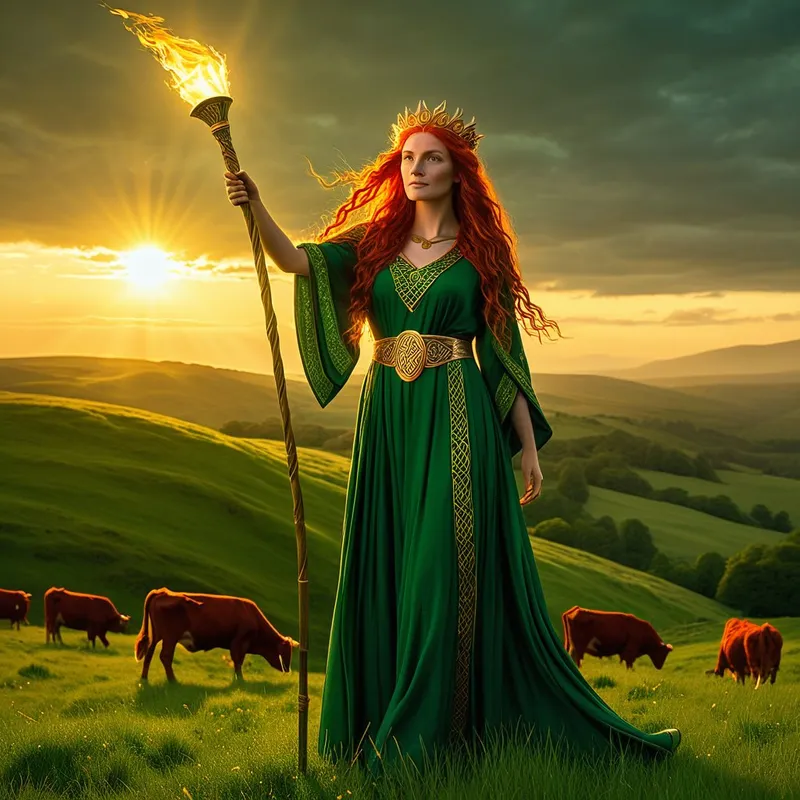
Listen, and let the firelight carry you to Munster, to the sacred hill of Knockainy. Here, in the long, golden twilight of Midsummer, the land itself holds its breath. The air is thick with the scent of blooming meadowsweet and the low hum of life. This is the domain of Aine, she who is the sun’s gentle warmth on your face, the ripe swell of the grain, the sovereign right of the land to choose its king. Her laughter is the ripple in the stream, her anger the sudden summer storm.
She walks the slopes of her hill, a being of pure, untamed radiance. Her hair is the color of the dying sun, her eyes hold the deep green of the oak wood. The red cattle, sacred to her, graze peacefully, their coats gleaming like polished copper in the slanting light. She is the land, and the land is her.
But a shadow falls across the hill. It is the shadow of Ailill Aulom, the King of Munster. He sees not a goddess, but a prize. He sees not sovereignty, but possession. Drunk on his own power and the mead of arrogance, he ascends the sacred mound. He finds Aine bathing in a pool, her light reflected and multiplied in the water. He does not kneel. He does not offer tribute. With a heart of stone and a hand of iron, he seizes her. The peaceful hum of the hill shatters. The cattle low in alarm. He forces himself upon her, a violent theft of light, an attempt to bury the sun in the cold earth of his ambition.
In that moment of profound violation, the world cracks. Aine does not weep; she gathers. She gathers the fury of every scorched field, the vengeance of every wronged queen, the raw, untamed power of a goddess defiled. As Ailill pulls away, triumphant in his brutality, she turns. Her hand, which moments before had cupped water, now flashes. Her teeth, which had smiled upon the land, now bite. With a scream that is both agony and power, she tears the ear from the king’s head.
The wound is not merely physical. It is a curse, a mark of geis broken, of sovereignty denied. The king stumbles down the hill, clutching his head, his royal authority bleeding into the soil. Aine stands on the summit, holding the torn ear. She does not cast it away. She transforms it. She plants it in the earth of Knockainy, and from that seed of violence grows a new understanding. Her light is not diminished; it is changed. It is fiercer, wiser. She becomes the protector of the wronged, the avenger of the violated, the sovereign who reclaims her throne not through gentle blessing alone, but through the necessary, terrible fire of retribution. The hill remains hers. The sun rises again. But it rises over a land that knows the cost of its light.

Cultural Origins & Context
The figure of Aine emerges from the rich, fragmented tapestry of Irish myth, primarily preserved in later medieval manuscripts like the Lebor Gabála Érenn and various Dindshenchas. She is intrinsically tied to specific topography—the hill of Knockainy (Cnoc Áine) in County Limerick. This localization is key; she is not an abstract Olympian but a genius loci, a spirit of the place. Her worship was likely central to the Érainn people, and her rites persisted for centuries.
Her stories were told not in grand epic cycles of Ulster, but in the lore of the land itself, passed down by local bards and filí (poet-seers). Her primary societal function was twofold. First, she was a goddess of sovereignty; the legitimate king of Munster would need to ritually marry or be approved by her to ensure the fertility and prosperity of the land. Second, she was a seasonal goddess of summer and the sun, with festivals on Midsummer Eve where communities would carry torches around her hill and through their fields, blessing the crops with her embodied light. The myth of her assault served as a potent etiological narrative, explaining both the sacredness of the site and the dire consequences of failing to honor the sacred contract between ruler and land-spirit.
Symbolic Architecture
At its core, the myth of Aine is a profound drama of sovereignty violated and reclaimed through transformative action. Aine represents the innate, luminous power of the Self—the vital, creative, and life-giving principle of the psyche and the world. She is the sun, not as a distant star, but as the immanent warmth that animates growth, joy, and rightful order.
The violation of sovereignty is not the loss of power, but the forced eclipse of the light by which power is rightly seen and wielded.
Ailill Aulom symbolizes the tyrannical aspect of the ego—the part of the psyche that seeks to possess, control, and dominate the deeper sources of life (the unconscious, the instinctual, the numinous) for its own aggrandizement. His assault is the archetypal pattern of trauma: an invasive, disempowering act that seeks to turn a subject into an object. The biting off of the ear is the crucial, symbolic pivot. The ear is the organ of listening, of heeding. In maiming the king’s ability to hear—to listen to the land, to the goddess, to his own deeper conscience—Aine permanently marks the failure of his kingship. She turns the instrument of his violation (his body) into the proof of his incapacity.
The planting of the ear is the alchemical key. The trauma is not repressed or forgotten; it is consciously integrated into the sacred ground of being. From this buried fragment of violence, a new form of sovereignty grows—one that encompasses protection, justice, and a fierce, unassailable autonomy. Aine becomes the Hag as well as the Maiden, the avenger as well as the blesser.
The Dreamer's Resonance
When this myth stirs in the modern dreamer, it often signals a profound process of reclaiming personal sovereignty after a experience of violation or profound disempowerment. This may not mirror Aine’s trauma literally, but symbolically: a betrayal of trust, a crushing of creative spirit, an invasion of boundaries, or a systemic undermining of one’s authority.
The dream imagery may be atmospheric: a radiant, beautiful place (a hill, a garden, a room) that suddenly turns oppressive and dark. There may be a figure of imposing, shadowy authority. The dreamer may feel paralyzed, their voice or light stolen. The somatic resonance is often a feeling of cold weight on the chest, a constriction in the throat, or a literal numbness.
The turning point in the dream—the “biting off of the ear”—might manifest as a sudden, shocking act of defiance by the dream-ego: shouting a forbidden word, breaking a symbolic object, or a surge of transformative anger that feels both terrifying and empowering. This is the psyche initiating its own justice, marking the aggressor (whether an internal complex or a memory of an external force) and beginning the reclamation of its own territory. The dreamer often awakens with a mix of adrenaline and a deep, solemn sense of a boundary having been irrevocably drawn.
Alchemical Translation
The alchemical journey modeled by Aine’s myth is the transmutation of violated innocence into unassailable authority. It maps the individuation process where the ego, having encountered and been wounded by the shadow, must not retreat into victimhood but engage in a conscious, transformative act of self-reclamation.
The initial state is sol, the golden, innocent consciousness of the sun-goddess, blissfully identified with her domain. The assault is the nigredo, the blackening, the descent into the utter darkness of trauma, where the light seems extinguished. Ailill is the corrupting agent, the prima materia of shadow forced upon the light.
The alchemical fire is not lit to destroy the base metal, but to reveal the gold that has always been there, now tempered by the heat of experience.
Aine’s retaliation is the critical operation of separatio and calcinatio—the separating of the corrupt element (the ear/ the false authority) and the burning of it in the fire of righteous fury. This is not mere revenge; it is a sacred, surgical act of differentiation. “This is you. This is not me. I remove your mark from my being.”
Finally, the planting is the coagulatio and the return as sol invictus—the unconquered sun. The digested experience is returned to the psychic soil. From it, a new consciousness grows: a sovereignty that knows its own strength because it has defended its borders, a compassion that is wise because it has known violation, a light that shines not with naive brightness, but with the enduring, tempered glow of hard-won self-possession. The modern individual undergoing this process moves from a state of being acted upon to a state of authoring their own life, their boundaries firm, their light their own.
Associated Symbols
Explore related symbols from the CaleaDream lexicon: