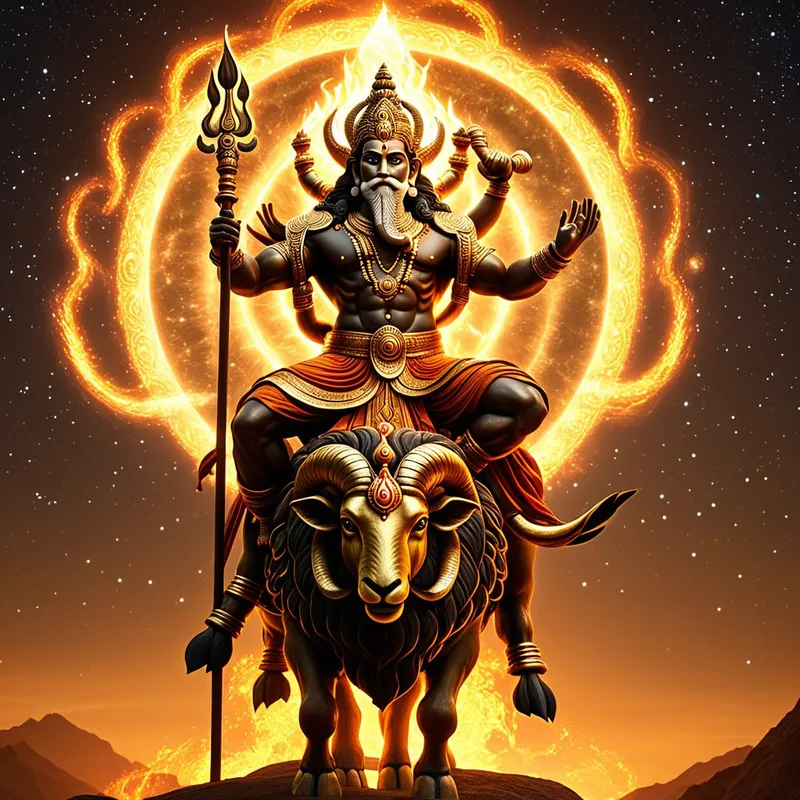
Agnideva Myth Meaning & Symbolism
The story of Agni, the divine fire, born of cosmic waters, who becomes the mouth of the gods and the bridge between heaven and earth.
The Tale of Agnideva
In the beginning, before the worlds were named, there was only the great, dark, and boundless ocean. From its unfathomable depths, a hunger arose—not a hunger of flesh, but a hunger of spirit. The Devas and the Asuras, locked in their eternal churn, yearned for a voice, a means to speak their desires into being. They needed a mouth.
And so they churned the ocean of possibility. With the great serpent Vasuki as their rope and the mountain Mandara as their staff, they pulled. The waters frothed and boiled, giving forth wonders and terrors. But the one thing they sought most ardently did not appear.
Then, from the very heart of the turbulence, he was born. Not with a cry, but with a crackle. He was Agni. He emerged as a flickering, restless infant of light, born of the watery abyss itself—a paradox made manifest. He was tender, this child of flame, vulnerable to the very element that bore him. A great wind arose, threatening to extinguish him. The Devas saw his peril and knew this fragile fire was the key to all things. They sheltered him, they fed him with whispers of intention and drops of clarity.
Agni grew, but he was restless. He hid himself, becoming elusive. He fled into the waters, becoming the latent heat in the deep. He vanished into the trees, becoming the potential for warmth locked within wood. The gods were dismayed. Without their fiery mouth, their prayers were silent, their sacrifices meaningless. They sent Vayu, the wind, to seek him. Vayu scoured the worlds and found Agni concealed within a Samudra tree. "Come back," Vayu implored. "The worlds are cold without you."
And Agni, feeling the pull of his destiny, agreed—but on a condition. He would be the messenger, but he would not belong to any one realm. He would be the consumer, but also the purifier. He would take the offerings of the earth and carry their essence to the heavens. He would dwell in the friction of two sticks, in the heart of the sun, in the belly of every living being as the fire of digestion and life. The gods consented. They gave him the ram as his vehicle, for the ram butts its way forward, unyielding. They gave him seven tongues to taste every offering: Kali, Karali, and others, each for a different flavor of sacrifice.
Thus, Agni took his place at the center of all things. He became the crackle in the altar, the heat in the hearth, the lightning in the storm. He was the divine witness, present at every birth, every marriage, every death. He was the first to taste the ghee and the last to witness the ashes. He was the great connector, the luminous bridge between the human and the divine, the tangible and the ineffable, forever transforming matter into spirit.

Cultural Origins & Context
The myth of Agnideva is not a single story but a foundational presence woven into the earliest strands of Hindu thought: the Vedas. He is one of the most invoked deities in the Rigveda. This was not merely mythology for entertainment; it was a living, breathing cosmology for the Vedic people, whose society was organized around the sacred fire altar (Agni itself).
The myth was passed down through an unbroken oral tradition of rishis and priests. Its primary function was liturgical. Every ritual, from the grand yajna to the simple domestic rite, required the invocation of Agni. The story of his birth from the waters and his hiding explained his ubiquitous yet elusive nature—why fire exists everywhere in potential, and why it must be "called forth" with skill and reverence. It established the protocol of the universe: communication with the divine is only possible through the medium of transformative fire. The myth served as the theological backbone for a culture that saw the cosmos as a continuous cycle of offering and transformation, with Agni as its indispensable priest.
Symbolic Architecture
At its core, Agni is the archetype of the mediating principle. He is not the creator, nor the destroyer in the ultimate sense, but the essential process that makes creation and destruction meaningful.
He is the spark of consciousness that emerges from the unconscious waters, the moment an idea ignites in the mind's dark ocean.
His flight and hiding symbolize the elusive nature of psychic energy—our libido, our passion, our creative drive. It cannot be owned or commanded directly; it must be courted, provided for, and given a proper channel (the sacrificial altar). His seven tongues represent the multifaceted nature of desire and consumption; we "ingest" the world in many ways, and all must be offered up and transformed.
His position as the "mouth of the gods" is profoundly psychological. He represents the function that translates raw, instinctual impulse (the offering) into something with spiritual value (the prayer that reaches the heavens). He is the metabolism of the soul, burning away the dross of mere materiality to extract the subtle essence. He is the pain of truth-telling and the warmth of genuine connection—the fire that both tests and tempers.
The Dreamer's Resonance
When the pattern of Agnideva stirs in the modern dreamer, it speaks to a crisis or opportunity of transmission. One may dream of a vital but fragile light that needs protection, of trying to start a fire in the rain, or of a sacred hearth that has grown cold. Somaticl1y, this can feel like a gathering of heat in the chest or gut—a pressure of unexpressed energy, a "fire in the belly" with no outlet.
Psychologically, this is the process of seeking one's authentic voice. The dreamer is the churning ocean, full of potential, and the nascent Agni is their nascent truth or creative power, threatened by the "winds" of external opinion or internal doubt. The dream asks: Where have you hidden your fire? What old, damp logs of resentment or fear are smothering your spark? The search for Agni in the dream is the search for the inner priest who can perform the sacrifice—the willingness to offer up one's current state to be transformed by the flames of conscious attention.

Alchemical Translation
The individuation journey modeled by Agnideva is the alchemy of the self through the sacred fire of awareness. We begin in the materia prima, the chaotic, watery unconscious. Our first task is not to create the fire, but to discover it already latent within us—the innate spark of consciousness, the Atman.
The sacred work is to build the altar of the psyche—a disciplined, respectful container—and to learn the art of offering.
This is the process of abhyasa. We offer our thoughts (the ghee of attention), our emotions (the wood of experience), and our actions (the grains of effort) into the fire of witness consciousness. Agni, as the inner magician, transmutes them. Greed becomes discernment, anger becomes righteous force, attachment becomes loving connection. The gross is made subtle.
His role as mediator is crucial. We are perpetually churning the ocean, caught between opposites: ego and shadow, persona and true self, humanity and divinity. Agni is the function that holds the tension of these opposites and allows for an exchange. He does not take sides; he facilitates a sacred transaction. To integrate the myth is to become a living altar, where the fires of experience are not avoided or feared, but tended with reverence, becoming the very light by which we see our way and offer our transformed being back to the mystery from which we came. The ultimate sacrifice is the ego itself, and the final flame is the luminous, indivisible awareness that remains.
Associated Symbols
Explore related symbols from the CaleaDream lexicon: