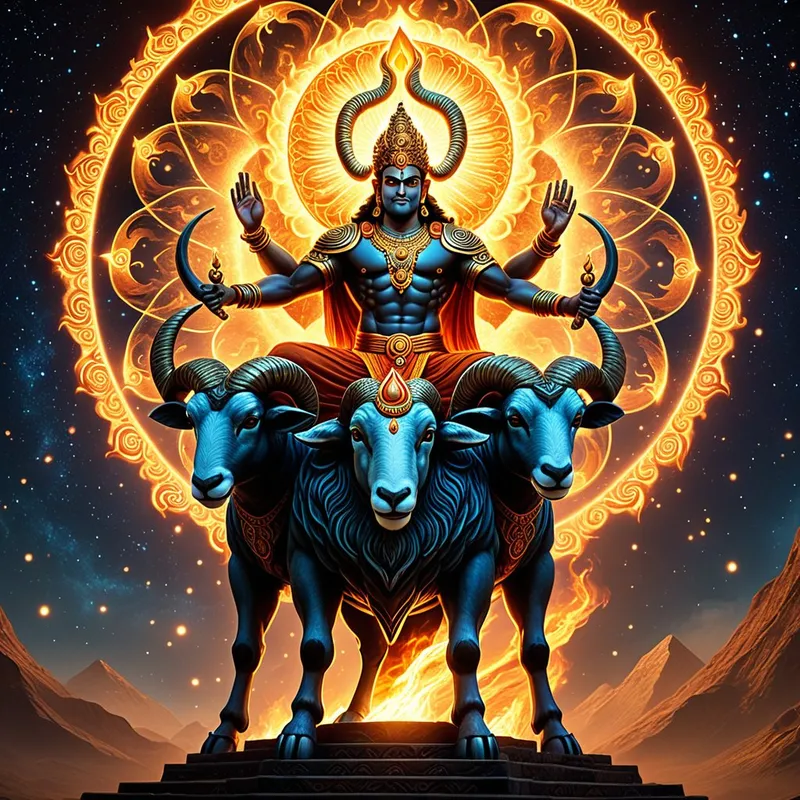
Agni Myth Meaning & Symbolism
The story of Agni, the divine fire, born of cosmic waters and celestial friction, who becomes the mouth of the gods and the bridge between worlds.
The Tale of Agni
Listen, and feel the heat of the first story.
In the beginning, before time was counted, there was only the dark, boundless, and silent Apas. Within that watery womb, a longing stirred. It was a longing for light, for warmth, for a voice to break the silence. The gods themselves slept within those depths, formless and mute. Then, from the friction of the sleeping worlds, from the desperate yearning of the unmanifest for form, a spark was struck.
It was not a loud birth, but a profound one. A single, golden point of light kindled in the heart of the deep. It was Agni. He was born hungry, this infant fire, consuming the very darkness that birthed him. He licked at the waters, and they hissed and steamed, giving him his first taste of substance. He was hidden, for he was precious and vulnerable, a secret held by the waves.
But a fire cannot be hidden forever. The great Angirasas, the seer-priests, heard his crackling whisper in the wind. They sought him in every log, in every stone. They chanted, they drilled, they sacrificed their comfort, and with a great cry of "Svaha!" they drew him forth from the Arani wood. They saw him then—not just a spark, but a being: radiant, seven-tongued, riding a ram, his chariot pulled by red horses, his hair streaming like flames against the sky.
Yet, Agni was burdened. To be the fire is to consume. The gods demanded he carry their offerings to the heavens. Mortals begged him to bear their prayers, their ghee, their hopes. He became the mouth of the Devas, the messenger, the transporter. He grew weary, for to carry the desires of all worlds is a heavy task. The sacred offerings blackened his luminous form; he felt himself becoming nothing but soot and duty.
So, Agni fled. He hid himself in the most secret places: in the waters, where he became the Vadava; in the trees, as latent life; in the belly of every living thing, as the digestive heat. The worlds grew cold. Prayers fell unheard to the earth. The gods were silenced, starving for the sustenance only he could bring.
A great despair fell upon creation. The gods searched, and the Bhrigu finally found him, concealed within a Sami branch. They implored him. They did not command, but offered a new covenant. They granted him the first share of every offering, the title of Hotr. They showed him that his consumption was not an end, but a transformation—a sacred alchemy that turned the material into the spiritual, the earthly into the divine.
Agni, understood. He returned, not as a servant, but as the essential pillar of the cosmos. He stood at the center of every hearth, every altar, every sunrise. He became the visible sign of the invisible order, the flame that connects the mud of the earth to the stars of heaven. And in his crackling, we still hear the echo of that first spark, and the resolution of his sacred, eternal task.

Cultural Origins & Context
The myth of Agni is not a single story but a constellation of hymns, rituals, and philosophical speculations woven into the earliest layers of Hindu thought: the Vedas, particularly the Rigveda. He is one of the most invoked deities in these texts. This was not a myth told for mere entertainment; it was a living, functional reality for the Vedic people. The priests, the Brahmins, were not just reciting stories—they were performing the myth itself every time they kindled the sacrificial fire.
The societal function was profound. Agni’s myth provided the cosmological justification for the central act of Vedic life: the Yajna. He was the technology of the sacred. Through him, the community maintained its covenant with the divine order (Rta), ensured prosperity, and structured time itself around the three sacred fires of the ritual arena. The myth explained why fire had to be tended, why offerings were made, and how the human realm participated in a cosmic cycle of exchange. It was passed down through an unbroken oral tradition of immense precision, where the very sound of the hymns was considered as potent as their meaning, a verbal spark to ignite the divine flame.
Symbolic Architecture
Agni is the archetype of the mediating principle. He is the ultimate symbol of transformative energy that stands at the threshold between states of being.
Fire does not create or destroy; it transmutes. It is the visible process of one thing becoming another, the alchemist of the material world.
Psychologically, Agni represents the ego-consciousness in its essential function. Just as Agni is the "mouth" of the gods, our conscious awareness is the mouth of the unconscious—the faculty that gives voice, form, and expression to the raw, archetypal energies within us. His seven tongues symbolize the multiplicity of this expression: speech, digestion, perception, passion, intellect, will, and spirit.
His flight and hiding represent the ego's burden and its periodic dissolution. To carry the projections of the gods (the inner archetypal demands) and the prayers of men (the demands of the outer world) is exhausting. The psyche often retreats, hiding its fiery vitality in the "waters" of the unconscious (depression, lethargy, confusion) or in latent potentials ("the trees"). The finding of Agni by Bhrigu is the act of deep self-reflection, where the conscious mind, through effort (Tapas, which also means "heat"), rediscovers its central, mediating role—not as a tyrannical ruler, but as a willing priest of the inner totality.
The Dreamer's Resonance
When the archetype of Agni stirs in the modern dreamer, it often manifests as dreams of fire in its myriad forms. A small, persistent flame in a dark place indicates the first kindling of a new consciousness or passion that feels fragile yet vital. A raging, uncontrolled wildfire may speak to a psychic energy that has been ignored and is now consuming the dreamer's old structures in a painful, necessary purge.
Somatically, this process can feel like a rising internal heat—anxiety, creative fervor, inflammatory illness, or a sudden rush of metabolic energy. Psychologically, it is the process of digestion. Just as Agni is the Jatharagni, the dreamer is being asked to metabolize an experience, an emotion, or a truth. The conflict is between the desire to let this transformative fire work and the fear of being consumed by it. The dream may present images of altars, forges, or crucibles, signaling that the psyche is in a ritual space of sacrifice, where something must be offered up (an old identity, a grievance) to be transformed.

Alchemical Translation
The myth of Agni is a master blueprint for the alchemical process of individuation—the forging of the integrated Self. The initial spark in the waters is the first glimpse of individual consciousness emerging from the undifferentiated unconscious. This is the nigredo, the dark beginning.
The sacred fire is not lit to burn the world, but to illuminate the path between what we are and what we might become.
The seers drawing Agni forth with friction (Aranis) represent the necessary effort of consciousness-building: meditation, therapy, artistic discipline, or any sustained practice that generates the "heat" of awareness. Agni's flight is the inevitable crisis of consciousness, the dark night of the soul, where the ego, overwhelmed by its role, collapses back toward the unconscious.
The resolution is the alchemical rubedo, the reddening. Agni's return under a new covenant symbolizes the birth of the conscious ego in service to the Self. The individual no longer identifies as the fire (a dangerous inflation), but becomes its skilled tender, its priest. The "offerings" are our daily experiences, emotions, and thoughts. Our conscious awareness (Agni) now willingly receives them and, through the sacred heat of reflection, transmutes their base lead into spiritual gold—insight, meaning, and connection to the transpersonal. We become the living altar where heaven and earth, spirit and matter, eternally meet in a transformative flame.
Associated Symbols
Explore related symbols from the CaleaDream lexicon:
- Heat
- Motor
- Match
- Grill
- Incense Holder
- Handling Fire
- Boundless Energy
- Heatwave
- Explosive Rocket
- Fiery Orange
- Solar Flare
- Spessartine Garnet
- Spinel Stone
- Carnelian Flame
- Potassium Burst
- Fluorescent Neon
- Astilbe Glow
- Celosia Fire
- Herbal Incense
- Cooking Spices
- Bellows
- LED Light Bulb
- Incense Smoke
- Stone Griddle
- Plantains on Fire
- Fire Drill
- Fire Starter Kit
- Tinder Bundle
- Ritual Firepit
- Flame-Kissed Arrow
- Fires of Creation
- Wildfire Whisper
- Inferno Spirits
- Kindled Dreams
- Cleansing Flames
- Fiery Aura
- Ritual Fire Pit
- Ember from Fire
- Ceremonial Fire
- Ritualistic Offerings
- Incense Burner
- Fire Ceremony
- Incense
- Spicy Aroma
- Primal Fire
- Thermal Radiation
- Digestion
- Generator
- Piston
- Spark
- Chromosphere
- Molten
- Spicy
- Zesty
- Fiery
- Ginger
- Curry
- Gunpowder
- Blaze