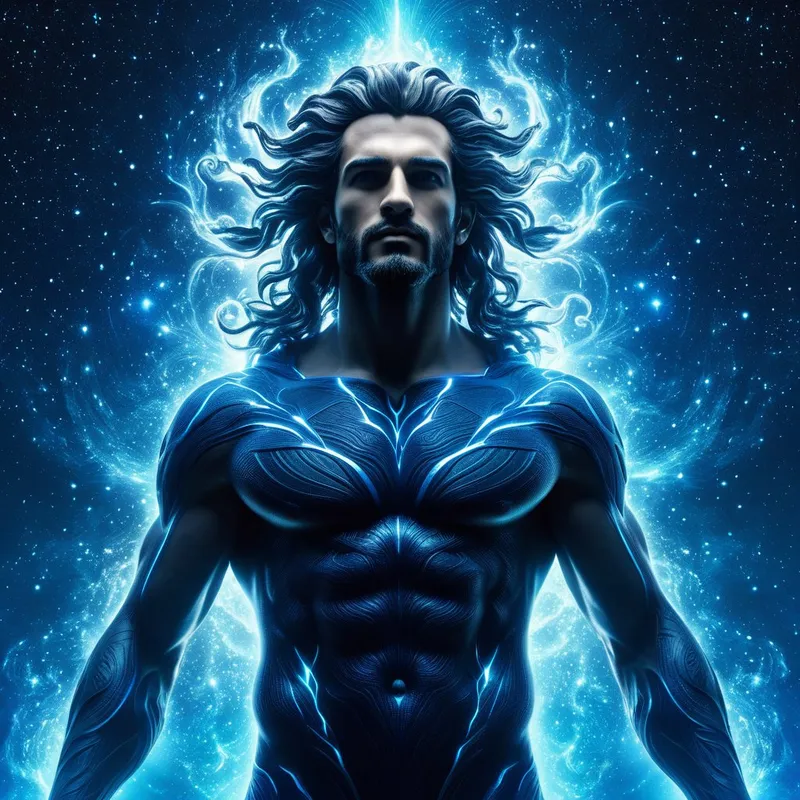
Aether Myth Meaning & Symbolism
The story of Aether, the first-born god of the shining upper sky, who embodies the pure, conscious space from which all life emerges.
The Tale of Aether
In the beginning, there was no beginning. There was only Chaos—a yawning, silent, formless chasm. Not darkness, for darkness is a thing, but the utter absence of thingness. A breath held for eternity.
And from that breathless void, the first stirrings came. Not as a bang, but as a sigh. A differentiation. The first to emerge was Gaia, the broad-breasted Earth, solid and sure. Then came Eros, the force of drawing-together, the longing that makes one out of two. And from the womb of Chaos also came Nyx, Night, a cloak of profound shadow, and her brother Erebus, the very mists of the deep underworld.
These first beings mingled in the formless deep. Nyx and Erebus embraced, and from their union, a miracle was born—not of flesh, but of essence. Two children, twins of a sort, yet opposites. The first was Hemera, Day. She was bright, but hers was the bright of the earthly sun upon soil, the light that reveals form and detail.
But the second… the second was different. He did not illuminate; he was illumination. He was not a light within space; he was the space that allowed light. His name was Aether. As Hemera spread her clear light over Gaia, Aether unfolded above her. He was the boundless, shining blue, the pure, crisp air of the highest heavens where the gods themselves would one day dwell. He was not the sky you see—that was his father, Erebus, the lower air of gloom. Aether was the sky beyond the sky, the radiant firmament, the very breath of the cosmos made visible.
Each dusk, their mother Nyx would draw her veil across the lower world, and Erebus would rise with his mists. Hemera would recede, her work done. But Aether remained, constant and serene above the turmoil. He was the canvas upon which the first stars were pinned, the silent witness to the birth of Uranus from Gaia, and the violent dramas of the Titans that would follow. While wars raged below, Aether held the high, silent watch. He was the first space, the first clarity, the original expanse from which all possibility gazed down upon the struggling world of form.

Cultural Origins & Context
The myth of Aether comes to us from the earliest layers of Greek cosmogony, most notably from Hesiod’s Theogony (8th-7th century BCE). Here, he is not a god with a cult, temples, or a rich narrative of adventures. He is a primordial deity, a personified natural force essential to the ancient Greek understanding of the universe's structure.
This was a culture attempting to map the cosmos through story. They perceived a layered reality: the murky darkness of the underworld (Hades), the tangible earth (Gaia), the hazy, changeable air of mortals, and finally, the sublime, unchanging, and luminous region above the moon. This highest region was Aether. His myth served a philosophical and cosmological function, providing an answer to the question: "What is above the weather, above the clouds, where things are eternal and perfect?" He was the answer—the personification of that perfect, divine medium.
Passed down by poets like Hesiod, the tale was part of a foundational "family tree" of the gods, establishing a divine genealogy that explained the origin of everything from love to strife to the very air we breathe. Aether represented the pinnacle of that cosmic order, the pure, rational space that contrasted with the chaotic, emotional, and tumultuous world below.
Symbolic Architecture
Aether is perhaps the most profound symbol of consciousness itself in the Greek pantheon. He is not content (thoughts, feelings, images) but the container for content. He is not the light of awareness focused on an object (that is Hemera, or later, Apollo), but the vast, open, and luminous field in which awareness arises.
Aether is the psychic space that must be cleared before creation can begin. He is the silent witness prior to the witnessed.
He symbolizes differentiation—the first critical act of consciousness is to separate from the undifferentiated murk of the unconscious (Chaos, Erebus). He is the "upper air" of the mind, the realm of clarity, perspective, and transcendent insight, forever distinct from the "lower air" of personal moods, passions, and psychological complexes. His constancy above the cyclical drama of Day and Night represents the part of the Self that remains undisturbed by the alternating cycles of our inner light and darkness, our joy and despair.
Psychologically, Aether maps to what we might call the observing ego or the transcendent function—the capacity to hold opposing forces (light/dark, chaos/order) in a wider, reconciling field of awareness. He is the archetype of pure potential, the clear sky that allows the bird of thought to fly.
The Dreamer's Resonance
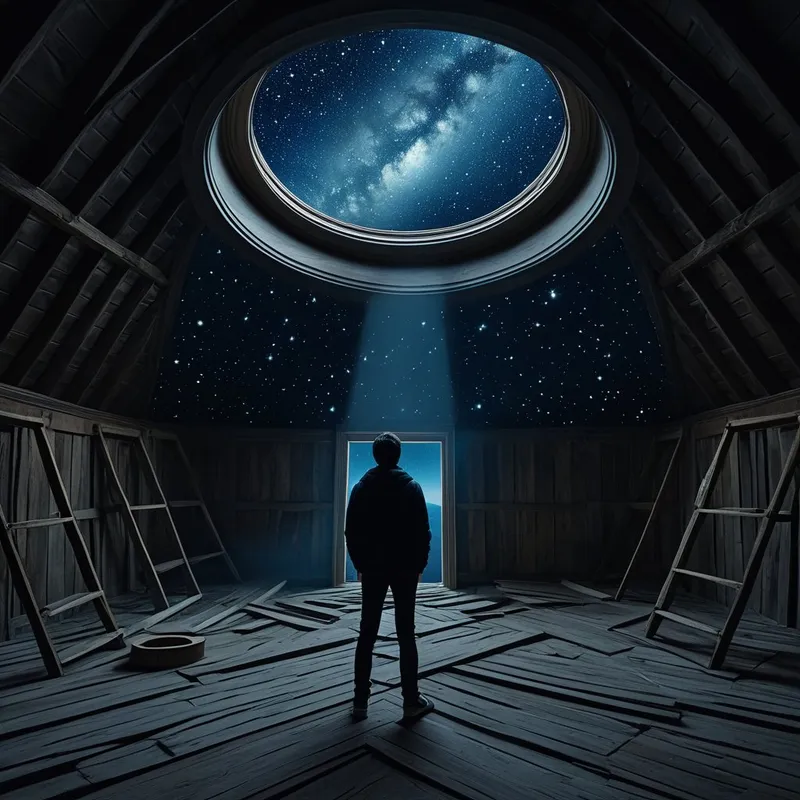
When the archetype of Aether stirs in the modern psyche, it often manifests in dreams of vast, open spaces. One might dream of finally reaching a high mountain peak and gazing over an endless, serene, blue horizon. Or of being in a cramped, cluttered room (representing a cluttered mind or life situation) and discovering a previously hidden door that opens onto a breathtaking, empty balcony under a star-filled sky.
Somatically, this can feel like a sudden, deep breath after being submerged—a literal and psychological expansion. The process at work is one of psychic differentiation. The dreamer is moving from a state of identification with their thoughts, emotions, or problems (stuck in the "lower air" of Erebus) toward a state of witnessing them. The dream is an experience of gaining perspective, of finding the "space" between stimulus and reaction. It signals a readiness to dis-identify from inner chaos and access a calmer, more objective vantage point. This is not an escape, but an ascension to a wider viewpoint.
Alchemical Translation
The individuation process, the alchemical work of becoming whole, requires precisely the creation of an inner Aether. Our psychological journey often begins in Chaos—a confused, suffering, or conflicted state. The first great work is not to change the content, but to create a container.
This is the alchemical solve et coagula: first, one must create a space (solve—to dissolve into openness) before a new synthesis can occur (coagula—to coagulate into new form). We must cultivate our own upper sky.
The modern alchemist does not seek to fill the void, but to become the vessel that can honorably hold it. To transmute leaden confusion into golden clarity, one must first become the crucible of Aether.
Practically, this translates to practices that build conscious space: mindfulness, meditation, reflective journaling, or any discipline that allows us to pause and observe the swirling "weather" of our inner lives without being swept away by it. It is the work of distinguishing the Self from the persona, the complexes, and the impulses. We are not erasing the darkness of Nyx or the mists of Erebus; we are learning that we exist in a relationship to them, from the vantage point of Aether.
The triumph of the Aether myth is not a battle won, but a perspective gained. It models the ultimate psychic transmutation: from being the drama to being the stage upon which the drama unfolds, and in that spacious awareness, finding a profound and unshakeable freedom. We become, like Aether, the silent, shining space that makes all sight—and insight—possible.
Associated Symbols
Explore related symbols from the CaleaDream lexicon: