Adam Myth Meaning & Symbolism
The first human, formed from earth and divine breath, awakens in paradise, gains knowledge, and is exiled, embodying the universal journey into consciousness.
The Tale of Adam
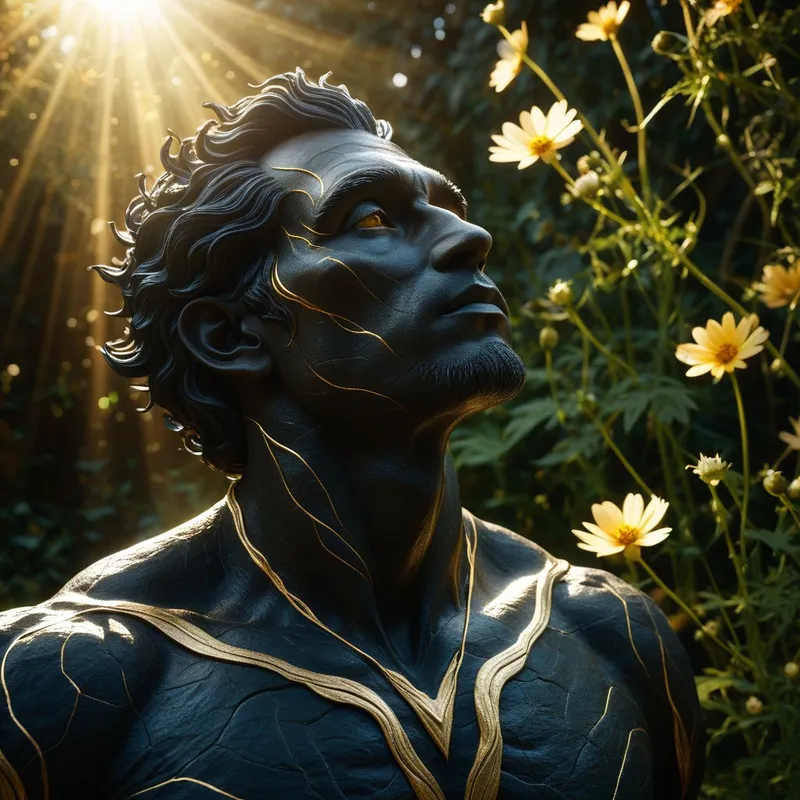
In the beginning, before memory, there was a silence so deep it was a kind of sound. From the formless void and the watery dark, a Voice spoke—not with words, but with intention. And there was light. And there was land. And from that land, the Yahweh shaped a form. Not with the command that spun stars, but with His own hands, as a potter works clay. From the red earth, the adamah, He sculpted the first man, Adam—a being whose name meant “of the earth.”
Into the nostrils of this earthen statue, Yahweh breathed. It was not wind, but the very essence of life—nephesh—the spark of the divine. The clay chest rose. Eyes, formed of mud and mystery, opened upon a world fresh from the loom of creation. Adam found himself in Eden, a garden of impossible harmony. Rivers of honey-light watered trees heavy with fruit that shimmered with inner fire. Beasts of the field and birds of the air came to him, and he gave them names, his voice weaving their essence into language.
Yet, a profound loneliness echoed in the garden’s perfect stillness. “It is not good for the man to be alone,” spoke the Voice. And so, a deep sleep fell upon Adam, a sleep like the one before creation. From his side, Yahweh drew forth substance and shaped a companion. When Adam awoke and beheld her, bone of his bones and flesh of his flesh, he knew his solitude was broken. She was Isha, woman, and he called her Eve, for she was the mother of all living.
But in the midst of the garden stood two trees: the Tree of Life, and the Tree of the Knowledge of Good and Evil. Of the latter, Yahweh had given one command: “You shall not eat, for on the day you eat of it, you shall surely die.” The command hung in the air, the only note of limitation in the symphony of abundance.
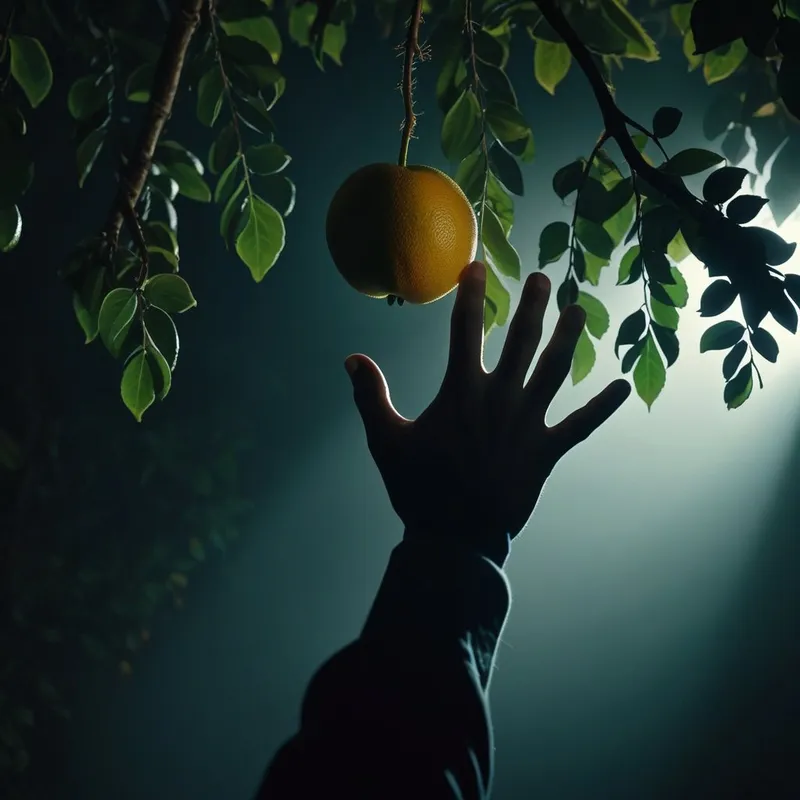
Then came the serpent, most subtle of creatures. It spoke to Eve, not of rebellion, but of potential. “You will not surely die. For God knows that when you eat of it, your eyes will be opened, and you will be like God, knowing good and evil.” The fruit glowed with a forbidden allure. She took. She ate. She gave to her husband, and he ate.
And in that moment, the world fractured. Their eyes were opened, but not to godhood—to nakedness, to vulnerability, to the terrifying chasm between “I” and “Thou.” They heard the sound of Yahweh walking in the garden in the cool of the day, and for the first time, they hid, sewing fig leaves into crude garments. The Voice called out, “Where are you?” It was not a question of location, but of state.
Confronted, the man pointed to the woman, the woman to the serpent. The harmony was shattered. And Yahweh spoke the consequences: pain in childbirth, toil against a resistant earth, and finally, a return to the dust from which he came. But before that return, exile. Cherubim with a flaming sword were placed at the east of the garden, turning eternally, guarding the way to the Tree of Life. Adam and Eve, clothed now in garments of skin made by Yahweh Himself, walked out into the world beyond the walls, into the sunrise of history, bearing the unbearable weight of their new knowledge.
Cultural Origins & Context
The myth of Adam is the foundational narrative of the Torah, opening the book of Genesis. Its origins are woven from the threads of ancient Near Eastern creation and flood myths, but it was radically re-spun by the priestly and Yahwist traditions of ancient Israel. It is not a scientific account but a theological and anthropological one, composed during the Babylonian exile and after, as a people sought to understand their unique covenant with Yahweh and their place in a chaotic world.
Passed down orally long before being codified, it was a story told around fires and recited in temples, answering profound communal questions: Why do we labor? Why do we suffer? Why are we separate from the divine? Why do we die? Its function was to establish the human condition as one of both supreme dignity—being formed by God’s hands and breath—and profound tragedy, defined by a primordial choice that introduced moral consciousness and its attendant sorrows. It set the stage for the entire salvation history that follows.
Symbolic Architecture
Adam is not merely a historical first man; he is the archetypal Human. His story is the symbolic blueprint for the birth of individual consciousness out of the unconscious unity of nature and divinity.
The Garden is the womb of the psyche, a state of unconscious participation mystique where the self is undifferentiated from its source and its environment.
The adamah, the red earth, symbolizes the physical, mortal body and the grounded reality of material existence. The divine breath is the spirit, the animating principle of consciousness itself. Adam is thus the eternal tension between dust and divinity, earth and spirit. The naming of the animals represents the human cognitive function imposing order and identity upon the chaotic flux of experience—the dawn of the logos.
The central, catastrophic symbol is the Fruit. It is not “sin” in a simplistic moral sense, but the acquisition of discriminative knowledge. It is the consciousness of duality: good/evil, self/other, naked/clothed, life/death. This is the “fall” upward into complexity, out of infantile bliss and into the burdensome freedom of moral choice.
Exile from Eden is not a punishment, but a necessity. One cannot remain in the garden of unconscious unity after eating the fruit of consciousness.
The flaming sword guarding Eden’s gate symbolizes the irreversible nature of psychological development. There is no return to innocence, only the forward path through the wilderness of experience.
The Dreamer's Resonance
When the Adamic myth stirs in modern dreams, it signals a critical threshold in the dreamer’s psychological life. Dreaming of a pristine, walled garden often reflects a longing for a pre-conscious state, perhaps during times of overwhelming complexity or moral fatigue. It can indicate a retreat into a persona of false innocence.
Dreaming of eating a forbidden, luminous fruit typically coincides with a life moment where one is on the verge of a painful but necessary insight—seeing a truth about one’s family, one’s shadow, or one’s own complicity in a situation. The somatic feeling is often one of simultaneous dread and exhilaration, a “guilty knowledge.”
Dreams of being naked in a public or sacred space directly mirror Adam and Eve’s realization of nakedness. This points to a feeling of being exposed, vulnerable, with one’s defenses (the fig leaves) stripped away, often before an internalized judgmental authority (the voice of Yahweh). Finally, dreams of walking away from a beautiful place into an unknown, harsh landscape embody the active, if sorrowful, process of leaving an old, constricting stage of life (a relationship, a job, an identity) to enter the necessary “wilderness” where genuine selfhood is forged.

Alchemical Translation
The alchemical journey of the individual soul—individuation—is precisely mapped onto the Adam myth. The process begins with the prima materia, the chaotic, unconscious state: the tohu wa-bohu (formless void). The forming of Adam from clay is the coagulatio stage—the condensation of a nascent ego out of the psychic mire.
The breath of life is the infusion of awareness, the animatio. The paradise state represents the initial, fragile inflation of the ego, believing itself to be the center of a world made for it. The serpent is the catalyst, the mercurius, the trickster spirit of the unconscious that disrupts stasis and forces development. It is the call of the Self beyond the ego’s garden walls.
Eating the fruit is the nigredo, the blackening. It is the painful, disillusioning encounter with the shadow, with duality, with one’s own capacity for “evil” and separation. It feels like a fall, a death of the old, innocent self.
The sewing of fig leaves and the garments of skin represent the construction of the persona—necessary armor for the journey ahead. The exile into the world, East of Eden, is the beginning of the true work: the albedo (whitening) and rubedo (reddening). It is the long, arduous process of integrating that knowledge, working the cursed ground of one’s own psyche, building a conscious relationship with the divine (now experienced as distant), and ultimately, through a lifetime of labor and love, transforming the base adamah of one’s nature into a vessel capable of bearing spirit. The goal is not to re-enter the lost garden, but to cultivate, with conscious toil, a sacred inner space in the wide world—to earn, through lived experience, a wisdom more profound than innocence.
Associated Symbols
Explore related symbols from the CaleaDream lexicon: