
Acetum Philosophorum Myth Meaning & Symbolism
The myth of a corrosive, purifying essence that dissolves all false forms, revealing the prima materia from which the true self is forged.
The Tale of Acetum Philosophorum
In the silent, star-haunted hours before dawn, when the boundary between the fixed and the volatile grows thin, the true work begins. It is not a work of building, but of unbuilding. Not of creation, but of reduction.
Listen, then, to the tale not of a hero, but of an essence. Of the Acetum Philosophorum.
In the heart of the mountain, where earth’s blood runs cold and slow, the Alchemist labored. His kingdom was not of crowns and courts, but of crucibles and condensation. He sought the One Thing, the Prima Materia, the hidden seed of all metals, all life, all spirit. But it was buried, locked within a thousand false forms—the dross of lead, the arrogance of iron, the deceptive glitter of fool’s gold.
For years, decades, he applied fire. He coaxed, he hammered, he distilled. He sought to elevate, to sublime. Yet the more he worked, the more solidified the illusion became. The metals resisted, their forms stubborn, their secrets held fast behind walls of apparent nature. Despair, a heavier metal than any in his furnace, began to settle in his bones.
Then came the whisper, not from a book, but from the substance itself in a dream of corroded glass. It spoke of a different path. Not the Royal Road of the Sun, but the hidden, descending path of the Saturnine. It spoke of the Vinegar that eats away the vessel to reveal the wine within.
Guided by this somber star, the Alchemist gathered his failures—the brittle slag, the misshapen ingots, the ashes of countless calcinations. Into a vessel of blackest glass, shaped like a weeping womb, he placed them all. Over this mound of ruin, he began a distillation not of spirit, but of spirit’s opposite. A slow, cold, downward drawing. A putrefaction.
For seven times seven nights, a bitter, acrid mist rose and fell within the vessel. It was the breath of dissolution. When the glass was cleared, there remained not ash, but a liquid. It was clear, yet held all colors faintly within it, like a memory of light. It was still, yet seemed to seethe with a silent, hungry potential. This was the Acetum Philosophorum.
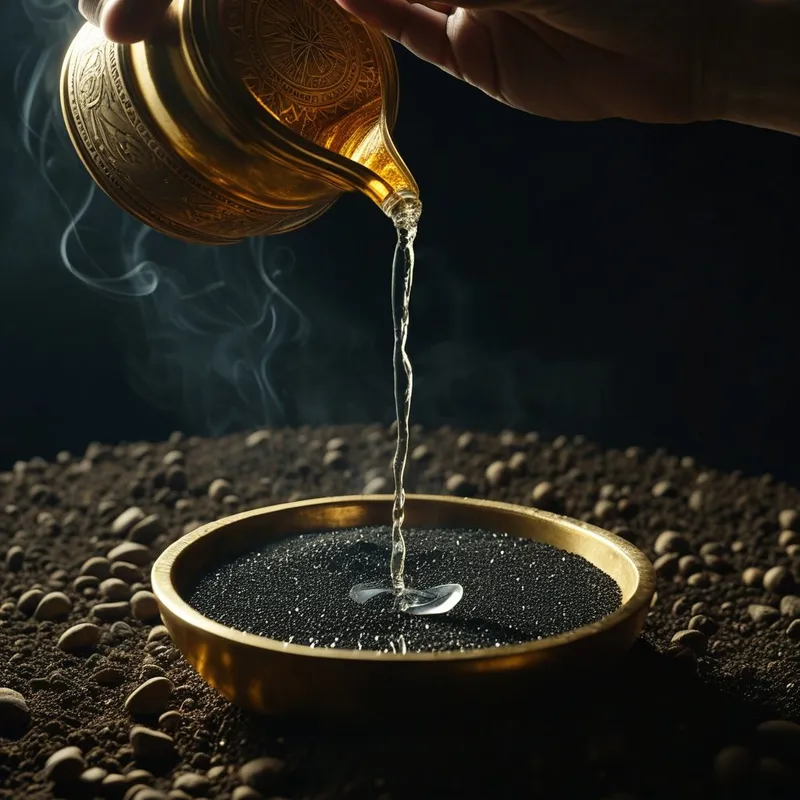
With a hand steadied by fatal resolve, he let a single drop fall upon a lump of common lead. There was no glorious explosion, only a terrible, patient hiss. The metal did not transform; it unbecame. Its solidity wept, its form flowed away like a lie exposed. The grey, dull crust dissolved into a smoking chaos, and from that chaos, bereft of all its familiar shape, there shone forth—not gold—but a moist, dark, radiant potential. The Prima Materia. The true beginning, revealed only after every false end had been eaten away.
Cultural Origins & Context
The mythos of the Acetum Philosophorum emerges from the core paradox of Western alchemical tradition, flourishing between the 12th and 17th centuries. It was not a tale told in public squares but a secret doctrine passed in coded manuscripts, whispered in locked laboratories, and encoded in emblematic drawings. Its tellers were not bards, but practitioners like Hermes Trismegistus (in attributed texts), or later adepts writing under the mantle of "Basil Valentine" or "Anonymous."
Its societal function was profoundly subversive. In a culture and a cosmology that valued spirit over matter, ascent over descent, and purity over corruption, the Acetum championed the necessary, sacred role of decay. It served as a corrective to the more popular narrative of glorious, solar transmutation. It taught that before the Magnum Opus could begin in earnest, the Opus Contra Naturam—the work against the apparent nature—must first be accomplished through radical deconstruction. It was the myth for the alchemist who had tried every fire and found only ash, guiding them to embrace the corrosive wisdom of surrender.
Symbolic Architecture
The Acetum Philosophorum is the archetypal symbol of the solvent of the soul. It represents not an agent of destruction, but of ruthless truth. Its action is the psychological process of disillusionment—the dissolution of the persona, the complex, the neurotic structure, and every "noble" identity we construct to avoid the raw, unformed truth of our being.
The Acetum does not create the gold; it destroys everything that is not the gold, revealing that the gold was always there, hidden beneath a lifetime of plating.
The Lead is the psychological burden, the base matter of the ego: our conditioned behaviors, our unresolved traumas, our prideful self-images. The Fire of conscious effort and willpower (the ego's preferred tool) often only hardens these structures. The Acetum is the corrosive power of conscious suffering, of shadow work, of humbling insight that allows these rigid forms to break down. The Prima Materia revealed is the psychic germ plasm, the unvarnished Self before culture, before trauma, before persona—the essential, fertile chaos from which authentic life can grow.

The Dreamer's Resonance
When this myth stirs in the modern psyche, it manifests in dreams of potent, unsettling dissolution. One does not dream of drinking the Vinegar, but of being exposed to it. Common motifs include: acid rain that melts away the façades of buildings (one's life-structures) to reveal crumbling, ancient foundations; a cherished heirloom or piece of jewelry (a valued identity) corroding in a drawer, leaving behind a strange, beautiful patina; or a mirror whose silvered backing is peeling away, showing not a reflection, but a dark, swirling void behind the glass.
Somatically, the dreamer may awaken with a sense of profound vulnerability, as if their psychological skin has been stripped away. This is not the anxiety of attack, but the raw exposure of truth. They are going through a process where long-held beliefs, self-concepts, or life narratives are losing their solidity. The ego feels it is dying, because it is. The dream is an assurance from the deeper Self: this corrosion is not an annihilation, but the prelude to a more authentic reconstitution. The pain is the feeling of the lie being separated from the truth.

Alchemical Translation
For the modern individual pursuing individuation, the myth of the Acetum models the essential, often bypassed, stage of mortificatio and solutio—death and dissolution. Our culture glorifies the "hero's journey" of acquisition and achievement (the making of the Gold). The Acetum presents the "sage's journey" of relinquishment and revelation.
The core struggle is the willingness to apply the solvent to oneself. This is the triumph of humility over pride. It means subjecting one's most cherished accomplishments, one's polished self-story, one's spiritual bypassing, to the corrosive question: "What remains when this is gone?" It is the practice of radical honesty, of shadow integration, of allowing grief and anger to dissolve the calcified residues of old wounds.
The psychic transmutation occurs in the liminal space created by the Acetum's work—in the formless, fertile chaos after the old identity has dissolved but before the new has coalesced. To endure this nigredo, this blackening, without rushing to rebuild, is the operation.
The ultimate alchemical translation is this: we do not become whole by adding more qualities, more light, more spiritual attainment. We become whole by subtracting everything we are not, until only the irreducible, authentic core stands revealed. The Acetum Philosophorum is the mythic embodiment of that holy, terrible, and necessary subtraction. It is the vinegar that cleanses the vessel, so that it may finally hold the wine.
Associated Symbols
Explore related symbols from the CaleaDream lexicon: