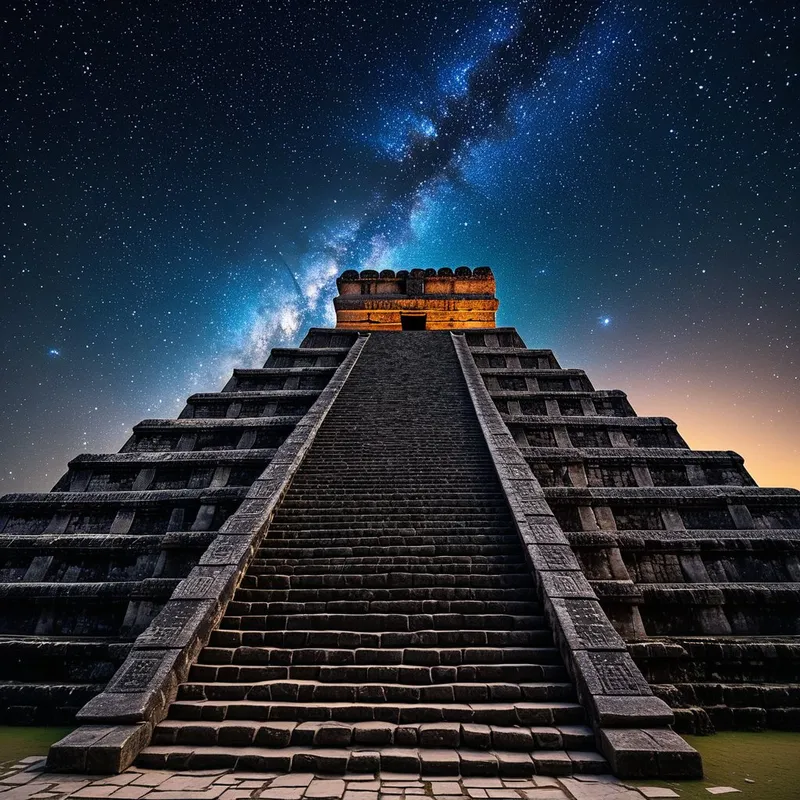
2012 Harmonic Convergence Myth Meaning & Symbolism
A myth of cosmic cycles ending and beginning, where humanity's consciousness aligns with the galactic heart, heralding a new age of awareness.
The Tale of 2012 Harmonic Convergence
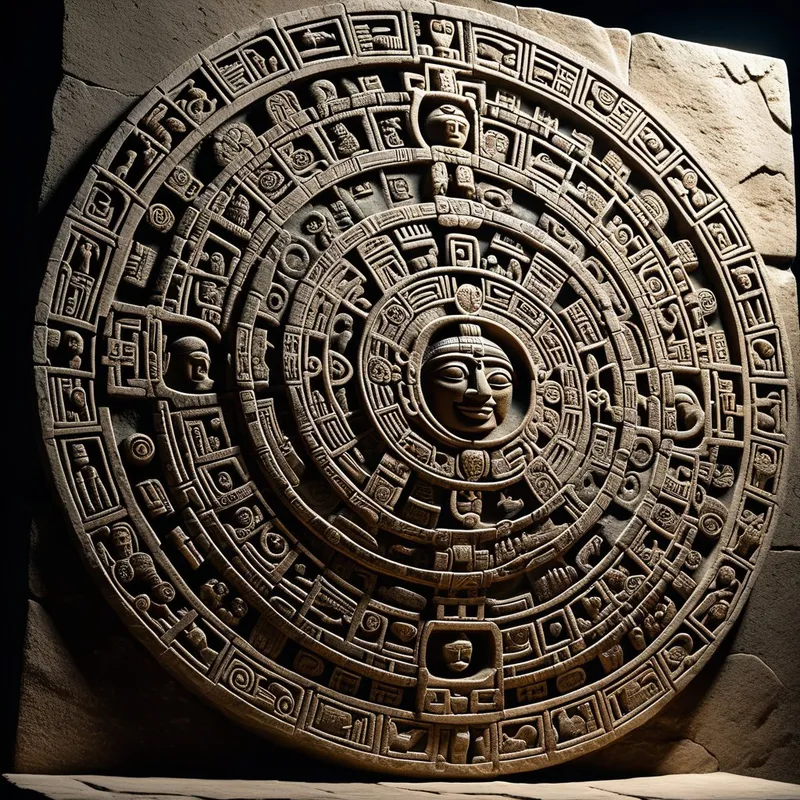
Listen. The great stone calendars, worn smooth by the breath of centuries, have nearly turned their final glyph. The world does not end. It holds its breath.
In the high temples, where the mist clings to the jungle canopy like a ghost, the Ah Kin keep their vigil. Their eyes, dark as the cenote’s depths, are fixed not on the earth, but on the river of stars that splits the night—the Xibalba Be, the Black Road. For thirteen baktuns, the Haab' has measured the sun’s journey. Now, on the eve of the fourteenth, the sun-king prepares to meet a different sovereign.
Deep in the cosmic black, where the stars gather in a great, swirling cloud, there is a rift. A dark place in the belly of the Cipactli. This is no void, but a womb. The Kukulkan, who once taught the people the count of days, now sleeps coiled within it, waiting. His scales are the nebulae, his breath the solar winds.
On the final day, a profound silence falls. The howler monkeys are still. The wind dies in the ceiba trees. As the sun dips below the western pyramids, it does not merely set. It descends into the underworld, a hero-king on his final journey. But this is no defeat. For at the precise moment of solar midnight, a miracle of alignment occurs. From the vantage of the sacred observatory, the dying sun is seen to kiss the very heart of the dark rift in the Milky Way.
It is a conjunction unseen for 26,000 years. The Wakah-Chan, the great tree that holds the cosmos, thrums from roots in Xibalba to its crown in the heavens. The itz that flows through all things—stone, water, blood, starlight—becomes a torrent. The boundary between the realms of the k'uh and the world of men grows thin as mist.
And in that moment, Kukulkan stirs. Not with a roar, but with a resonant hum—a frequency that is the sum of all orbits, the pulse of all hearts. This is the Harmonic Convergence. It is not an event one sees, but one one becomes. The collective soul of humanity, for a fleeting, eternal instant, is tuned to the galactic core. The old cycle, burdened by its own weight, exhales its last. The new cycle, pristine and full of potential, draws its first breath. Dawn breaks not on a destroyed world, but on a world remembered, realigned, awake.
Cultural Origins & Context
The narrative of 2012 is not a single, unified myth from the classical Mayan period, but a profound interpretation drawn from their sophisticated cosmology. The core is calendrical. The Mayans tracked multiple, interlocking cycles of time, the most famous being the Long Count, which measured vast epochs. The completion of its 13th Baktun (approximately 5,125 years) on December 21, 2012, was identified by modern scholars as a moment of profound cyclical reset.
This was not a prophecy of doom, but a marker of period-ending. In Mayan thought, time was not linear but cyclical, with each era possessing its own character and challenges. The completion of a grand cycle was a moment of cosmic renewal, a recalibration of the world's order. The "Harmonic Convergence" term itself was popularized by late 20th-century spiritual thinkers, who synthesized this Mayan calendrical milestone with concepts of planetary consciousness and astrological alignment, particularly the sun's conjunction with the galactic equator. While this specific phrasing is modern, it taps into the authentic Mayan understanding of the cosmos as a living, resonant system where astronomical events and human destiny were intimately woven together through sacred timekeeping.
Symbolic Architecture
At its heart, the 2012 mythos is a story about consciousness meeting its source. The galactic center—the dark rift—symbolizes the unconscious, the collective womb of all potential and the origin point of cosmic order. The sun’s journey to align with it represents the ego, the guiding light of individual awareness, undertaking a sacred journey to reunite with its transcendent source.
The end of a world is always, psychologically, the end of a way of seeing the world.
The Kukulkan embodies the unifying principle—the divine intelligence that bridges earth (serpent) and sky (feathers). Its awakening is the moment the psyche realizes its inherent connection to a vaster, intelligent cosmos. The "harmonic" aspect is critical: it suggests not a catastrophic collision, but a resonant attunement. The myth symbolizes the shift from a perception of separation—of humans from the cosmos, of spirit from matter—to a recognition of fundamental unity and synchronous flow.
The Dreamer's Resonance
When this myth pattern stirs in the modern dreamer, it often manifests as dreams of immense celestial events—planets aligning, stars falling into new patterns, or the sun and moon meeting in the sky. There may be dreams of ancient calendars, clocks striking thirteen, or the profound, vibrating silence just before a monumental change.
Somatically, this can correlate with a process of "core realignment." The dreamer may be experiencing a deep, often unsettling, sense that an old life structure—a relationship, career, or identity—has reached its natural, exhaustive conclusion. There is a feeling of being in a void, the "dark rift," between what was and what is not yet born. The psyche is processing the death of a long-standing personal cycle. The harmonic element appears as dreams of hearing a perfect chord, feeling a healing vibration, or experiencing a sudden, blissful moment of cosmic connection that dissolves anxiety. This is the unconscious signaling that the disintegration is not chaos, but a necessary recalibration toward a more authentic, soul-aligned state of being.
Alchemical Translation
For the individual, the 2012 narrative is a powerful map for the alchemical stage of solutio (dissolution) and coagulatio (renewal). The first step is the honest acknowledgment that a major cycle of one's life is complete. This is the "end of the baktun"—the job that no longer fits, the belief system that has grown hollow, the self-image that has cracked. One must consciously journey (like the sun) into the dark rift of the unknown, the unconscious, and surrender the old form.
Individuation is the personal Harmonic Convergence—the moment the story you tell yourself aligns with the truth of your soul.
The "waiting Kukulkan" represents the latent, higher pattern of the Self that has been developing all along beneath the surface of the old life. The convergence occurs in the act of deep introspection and acceptance, where the conscious mind (the sun) stops fighting the change and aligns with the deeper, soul-level purpose (the galactic center). The new "cycle" that dawns is not merely a new external circumstance, but a new mode of perception. One emerges with a felt sense of being part of a larger, intelligent order, where personal trials are seen as phases within a grand, meaningful rotation. The individual becomes, in a sense, their own temple astronomer—able to read their inner cycles, respect their completions, and await their alignments with a sage's patience and awe.
Associated Symbols
Explore related symbols from the CaleaDream lexicon: